





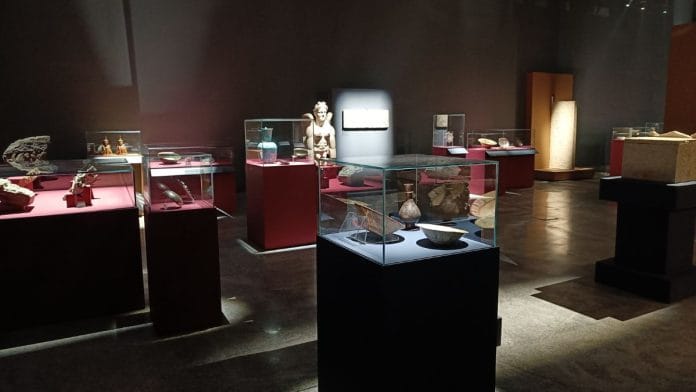



New Delhi: Showcasing more than a hundred artefacts spanning Iran, Afghanistan, India, China, and the Mediterranean, a new exhibition at Delhi’s Humayun’s Tomb Museum highlights how ancient civilisations were far more interconnected than assumed.
The exhibition, titled Shared Stories: An Art Journey Across Civilisations Beyond Boundaries, explores the complexity and depth of human and societal relations that shaped the ancient world. The artefacts, all from Rome’s Museo Delle Civilta, include ceramics, bronzes, stone sculptures and paintings spanning more than two millennia of artistic traditions.
“Amidst conflicts, alliances and political changes, precious objects were transferred across borders as gifts or spoils of war while artists and artisan workshop continued their activities under new patrons, transmitting techniques, knowledge and visual vocabularies,” reads the introductory description of the exhibition, inaugurated by Italy’s foreign minister, Antonio Tajani, on 10 December.
The rarely seen objects trace the long arc of cultural exchange—from Buddhist Afghanistan shaped by Greek, Kushana and Ghaznavid influences to Eurasian motifs that travelled across continents. At a time of global churn, the exhibition underscores how war, diplomacy, trade and artistic migrations once carried ideas, images and technologies across borders, creating shared visual languages that continue to echo in the present.
“It is an extraordinary example of how living in peace brings benefits all over the world. The exhibition sheds light on the past and connects it to the present,” said Tajani.
The exhibition, which will be on display till May next year, is curated by Laura Giuliano, archaeologist at the Roman museum.
The curator featured a selection of oeuvres from the Indian subcontinent, Central Asia, China, Iran and the Mediterranean area, which are part of the collections of Italian museums. The artefacts are dated from the period immediately before the Common Era to the 19th century, and they reveal the diffusion, sharing and adaptation of visual codes, the circulation of cultural motifs and the intertwining of the religious and intellectual dialogues.
“They aim to convey to the visitors the suggestion of an interconnected world. The exhibition topics are just a few examples of the figurative themes and cultural traditions shared by different civilisations,” reads the descriptive note.
Also read: Air India’s Maharaja among King’s Guard—how the airline advertised travel to London in 1976
Crossroads of civilisation
A focal point of the exhibition is Afghanistan—a historic crossroads whose cultural life was shaped by Greek foundations, Kushana cosmopolitanism, Shahi and Hindu-Shahi patronage and later the Ghaznavid court.
“The exhibitions invite us to reflect on the deep historical roots of cultural dialogues, and the ways in which this shared past continues to inform our present,” said Andrea Anastasio, director, Istituto Italiano di Cultura, New Delhi.
One of the sections is devoted to the objects found from the excavations at Ghazni and the reliefs of the Ghaznavid Palace. Between 1957 and 1968, the Italian Archaeological Mission in Afghanistan conducted numerous excavation campaigns in Ghazni, revealing an extraordinary continuity of settlement from the Buddhist period (2nd-9th centuries).
“These findings have played a key role in reconstructing Afghanistan’s cultural history, shedding light on how different traditions succeeded and intertwined over time and on how, owing to its strategic location, Ghazni has been a true crossroads of influences between Iran, India, and Central Asia,” reads the description note.
From the site of Ghazni, marble slabs and terracotta pieces that once formed part of the architectural decoration of a Ghaznavid palace dating back to the 11th and 12th centuries are on display.
“The presence in Ghazni of al-Baruni, the scholar who wrote Kitab al-Hind and translated Patanjali’s Yoga Sutras into Arabic, introducing a systematic exposition of yoga to the Islamic world for the first time, confirms the circulation of Indian ideas and concepts within the Ghaznavid environment,” reads one of the descriptions titled Pre-Islamic legacies in the Art of Ghazni.
The artefacts also show the traces of Buddhism and Hinduism in ancient Afghanistan, where some Hindu images were found within Buddhist contexts.
A striking example is the colossal Durga Mahishasuramardini discovered in the Buddhist sanctuary of Tepe Sardae by the Italian Archaeological Mission in Afghanistan.
One of the artefacts, from 10th-century Iran, is a bowl with a bird holding a string of pearls in its beak. Another was a hookah base, with the motif of a peacock holding a necklace in its beak, which was found in Northwestern India.
“Some of these themes have ancient origins. Often transmitted through textiles such as silk and cotton or through luxury objects. While some motifs derive from careful observation of nature, others are rooted in the mythological heritage of different cultures,” reads the description titled Motifs on the Move: Animal and Plant Imagery Across Eurasia.
(Edited by Theres Sudeep)