





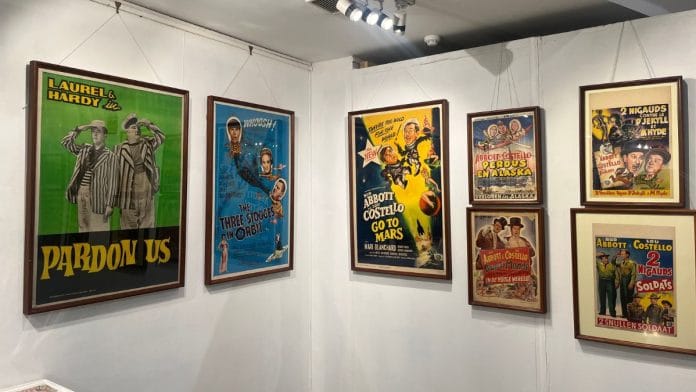



New Delhi: They say “a picture is worth a thousand words”—cliched but true. The exhibition “The Greatest Show on Earth: The Golden Age of Hollywood | 1914-1964”, curated by archivist Neville Tuli, features rare posters, photographs and memorabilia from the early Hollywood era.
The exhibition is on display till 3 March at the India International Centre in New Delhi and has been organised by the Tuli Research Centre. Tuli told ThePrint that several archives are on display for the first time in almost 40 years.
Divided into ten sections, it chronicles the journey of the dream factory. From studios, German expressionism to Clint Eastwood and animation and musicals, the exhibition is “part of a knowledge base more than an archive”.
Tuli said that the exhibition is a key research category in India’s history with the world. “How do you transform the nature of knowledge in our educational systems so that the visual is respected as a source of knowledge, not just the text?” he asked.
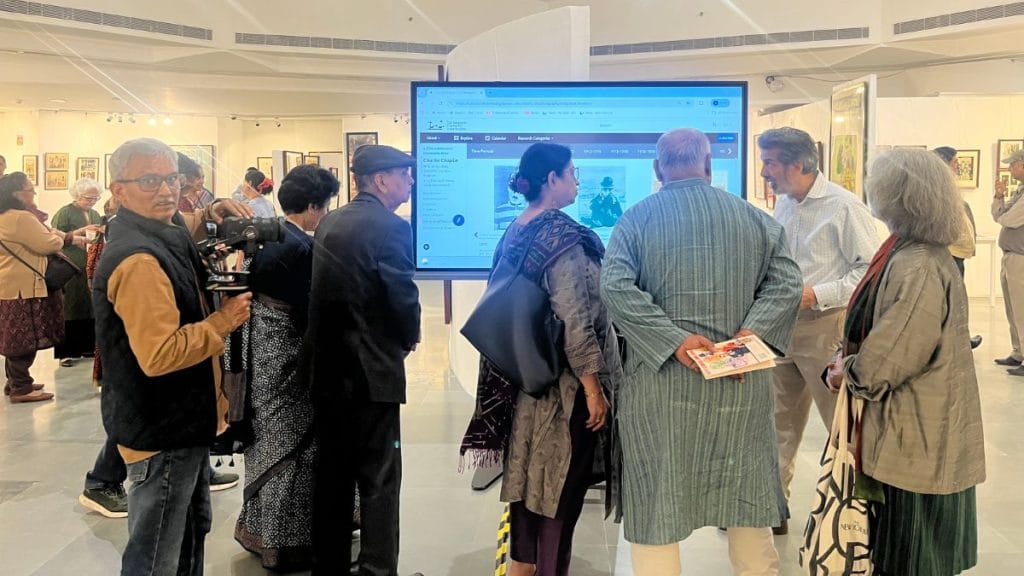
He added that visuals are not part of one’s knowledge base: “You’re not taught history by studying the visuals of cinema. You’re not taught anthropology, economics or political science by studying the visuals of cinema. But cinema has a voice which has tackled politics, economics, and every issue in the world. But unless you have the visuals available, how are you going to create that knowledge base?”
For him, arts, humanities and social sciences are about the visual and not the text. There is almost a sort of jugalbandi (tussle) between the two, Tuli explained.
Also read: How PM Modi’s ‘Revolutionary Raj’ transformed India
A mind-boggling exhibition
And it wasn’t just Tuli who felt this way. A professor of film studies from the Indian Institute of Management Kozhikode, who spoke to ThePrint on the condition of anonymity, described the exhibition as “mind-boggling”.
The professor visited the exhibition because he was a huge fan of cinema. He pointed to several pieces on display that were or would be “priceless”, including a large poster of Singing In The Rain (1952), a Japanese version of the 1941 hit Citizen Kane, and an oil painting of legendary American actor and filmmaker Orson Welles.
“If you know the history of cinema, it’s really quite interesting. But I am still very curious about it,” he said.
Among the many items on display are stills from the silent horror/fantasy film The Cabinet of Dr Caligari (1920). Directed by Robert Wiene, the film, which takes place entirely in a dream, is heavily influenced by the works of Austrian psychoanalyst Sigmund Freud and the desolation of the First World War.
Another German expressionist film poster and memorabilia on display is from the 1927 science fiction silent film Metropolis. The film is an interesting piece of history because, as the IIM professor pointed out, it shows the birth of Hollywood. Before the rise of Nazism in Germany, Berlin was the hub of world cinema, but as freedom of speech was questioned, several artists ran away to the New World, including future Hollywood A-lister Marlene Dietrich.
There is also a whole wall dedicated to Charlie Chaplin and his quiet genius. A large poster of James Bond hangs on one wall. While a display case in the centre hall shows the headshots of several beauties from the past, such as Katharine Hepburn, Ingrid Bergman, Lauren Bacall, and even an old print of the iconic American Civil War film Gone With The Wind (1939). It even has a Japanese print of The Seven Year Itch (1955) with Marilyn Monroe in her scandalous skirt -blowing-in-the-wind pose.
“Just putting it together, preserving, archiving, documenting, and getting it out there is maybe a lucky thing. So this is part of that ongoing journey for the last one and a half years, explicitly to the Tuli Research Centre and 36 years as part of my life,” Tuli said.
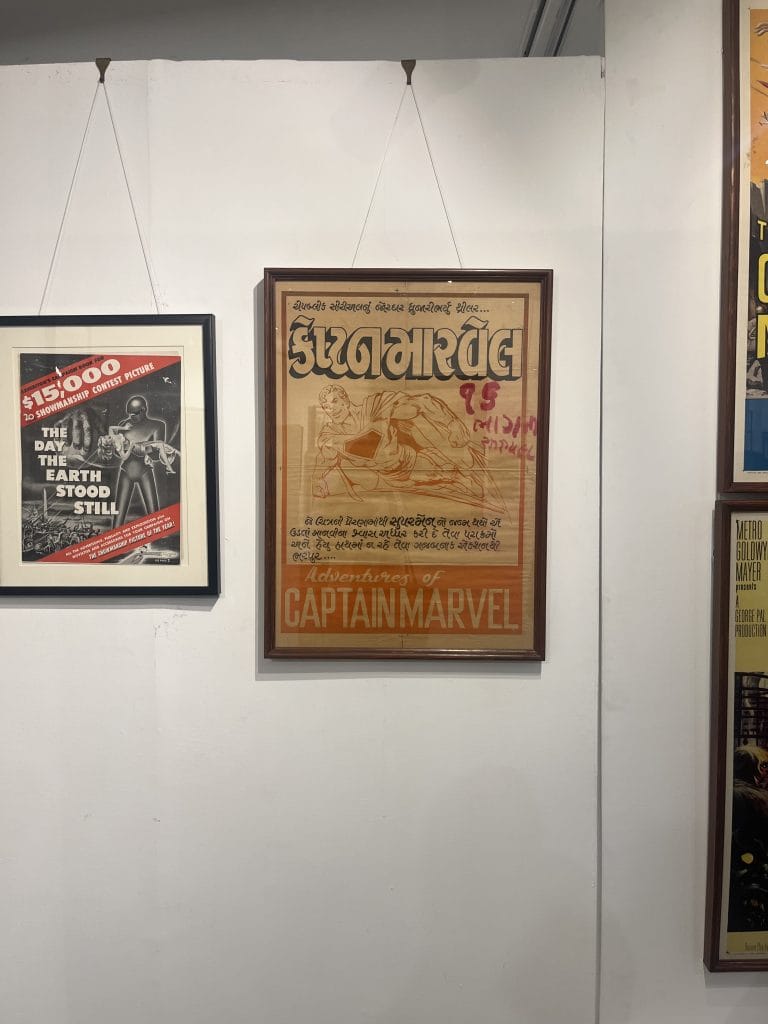
But perhaps, its hidden gem is a poster of Captain Marvel from the 1940s in Gujarati, which also happens to be Tuli’s favourite piece.
(Edited by Saptak Datta)