





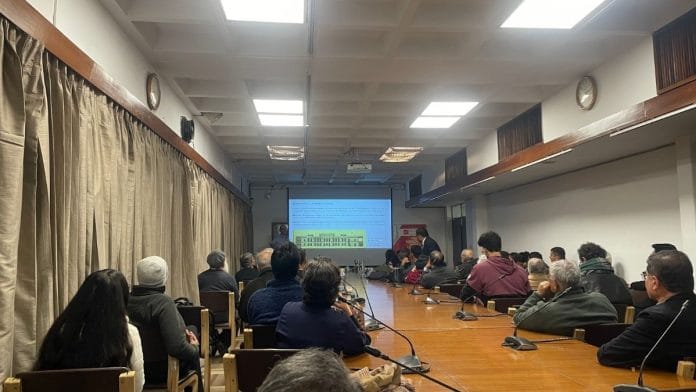



New Delhi: France was not merely a peaceful trading partner, but an active imperial and territorial force in India for 150 years. And this history has largely been understudied and forgotten, said historian Robert Ivermee to a cramped conference room at the India International Centre.
“The basis of that territorial expansion was France’s military force, for much of the 18th century, which was superior to the military power encountered from different Indian courts at the time,” said Ivermee, a professor at Sciences Po, France and author of the book, Glorious Failure: The Forgotten History of French Imperialism in India.
Ivermee was challenging older scholarship that portrayed France as a ‘good coloniser’, an empire that focused exclusively on trade and commerce. With the help of colonial-era maps, pictures, and quotes, he traced French colonial history in the Indian subcontinent to support his argument.
Ivermee’s talk—titled The Forgotten History of French Imperialism in India—drew a small but attentive audience of students, senior IIC members, and academics. It was moderated by Zohra Chatterji, a retired IAS officer and vice president of the Alliance Française de Delhi.
The hall listened attentively as Ivermee shifted the lens away from the British Raj, illuminating India’s lesser-known encounters with other European colonial powers.
“Inevitably, France’s attempts to establish a territorial empire in central and southern India in the 18th century brought it into conflict with other European powers. So, this [French colonial history] is very much also a history of conflict,” he said.
From 1664 to 1950
Ivermee started with a map of the Indian subcontinent in 1750, with areas in the centre and south shaded in grey. It showed the French empire at the height of its glory: controlling the Deccan, the Carnatic, and most of the eastern coast either directly or through a large degree of influence.
“By 1815, which is where my study comes to an end, France has lost control of its empire and been reduced to possession of five small colonies around the Indian coastline,” said Ivermee solemnly, adding that these five colonies remained French until the 1950s.
He pointed them out on the projected map: Chandannagar in West Bengal, Yanaon (Yanam) and Pondicherry in modern-day Puducherry, Karaikal in Tamil Nadu, and Mahe on the coast of Kerala.
The precursor to this empire was the establishment of the French East India Company (Compagnie française des Indes orientales) in 1664 under the reign of King Louis XIV, who was at the time ‘the most powerful and grandest’ of the European monarchs.
“From the beginning, the company is about more than commerce, setting it apart from its British and Dutch rivals,” said Ivermee, pointing to an image of the articles of the company. “One of its stated aims was to establish the glory and the power of France outside of Europe.”
The French arrived in India in 1667, looking for a place to establish trade. Mughal emperor Aurangzeb gave them permission to set up shop in Surat. According to Ivermee, however, the French were really after a ‘fortified trading base’ that could survive both war and changes in local politics.
After several failed attempts to set up a base of operations—including trying to seize control of a port in Sri Lanka—France was finally permitted to establish a post in a village that would become the city of Pondicherry.
“The main attraction of the area is the local textile trade, the presence of weavers,” said Ivermee, adding that the company began negotiating to secure contracts for the export of cloth from the Coromandel Coast back to Europe.
Also read: From Rashid un-Nisa to Anandibai Joshi, how women shaped India’s literary history
Two French India companies
The first French East India Company—with a 50-year monopoly on trade between France and India—was a commercial failure. It was only after the second company was launched in 1719 that the French saw signs of success and prosperity.
“The second French company is the creation of a Scottish economist. This is an interesting example of how France draws on expertise from other European nations to help kick-start its flagging trade with India,” said Ivermee.
Through maps, Ivermee showed how Pondicherry grew through the 1720s and 1730s, and how two more trading bases were established in Mahe and Yanaon. “There are a small number of slaves being exported from India, brought onto French ships and taken to Mauritius or the Reunion Islands,” said Ivermee.
In the 1740s, two major changes wreaked havoc on this period of commercial prosperity for the French. The War of the Austrian Succession caused the first conflict between the French and the British in India. “There may be an earlier commercial rivalry, but it’s only from 1744 that that commercial rivalry becomes an armed conflict,” he added.
The second change was the deterioration of the political situation in the Carnatic region, following the death of Nawab Saadatullah Khan in the late 1730s. This led to an internal power struggle, with the French lending their military in favour of one of the contenders.
“The French begin to realise from this point onward that lending their military to Indian powers can be as important, maybe an even more important, source of revenue than trade itself,” said Ivermee. “This is the period of the Europeans becoming military entrepreneurs.”
(Edited by Prasanna Bachchhav)