





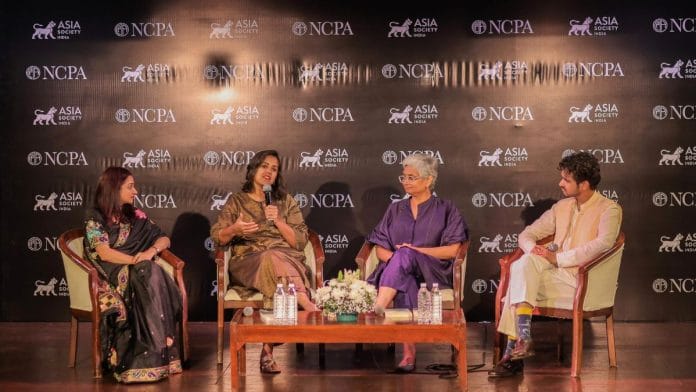



Mumbai: Behind many of India’s new mental health clinics, advocacy platforms, and alternative therapies lies a deeply personal story. At a discussion in Mumbai’s NCPA on Wednesday, mental health practitioners and entrepreneurs spoke about how encounters with illness within their own families pushed them to build institutions, develop new therapies, and advocate for systemic change.
The conversation, organised by Asia Society India Centre, titled “A State of Wellbeing: Assessing Mental Health and Society Over Time” coincided with the launch of the book Homecoming: Mental Health Journeys of Resilience, Healing, and Wholeness, co-edited by Neha Kirpal and Nandini Murali, which brings together first-person accounts of mental illnesses of eleven women from different fraternities, including educators, activists and professionals, who recount their journeys with recovery and healing.
The discussion featured Kirpal, co-founder of Amaha Health; child and adolescent psychiatrist Dr Kavita Arora, co-founder of Children First Mental Health Institute; and dance movement psychotherapist Devika Mehta Kadam, co-founder of Synchrony India.
Moderated by writer, politician and founder of Pink List India, Anish Gawande, the conversation focused on how lived experience is increasingly shaping India’s mental health ecosystem.
Kirpal spoke about growing up in a family dealing with severe mental illness, including her mother’s long struggle with schizophrenia and her brother’s suicide.
“Those experiences pushed me to move from the art world into the mental health sector and build Amaha Health, a network of mental health services that now operates across hundreds of cities and works with tens of thousands of clients,” Kirpal said.
She noted that personal narratives can help break isolation and encourage others to seek support.
“By placing lived experiences at the centre of the conversation, the book and the broader movement around it aim to create a culture where speaking about mental health becomes both normal and necessary,” she said.
Dr Arora described a similarly personal motivation behind her work with children and families. Reflecting on her own childhood, she said the lack of spaces where young people could openly talk about emotional struggles influenced her decision to co-found Children First Mental Health Institute.
“Through the book, I revisited those experiences and found the process of telling my story unexpectedly healing. Telling the story of that child and truly owning it has been immensely therapeutic,” she said.

Treatment gap & collaborative efforts
One of the central issues raised during the discussion was the scale of India’s mental health treatment gap. According to a 2022 report by the United Nations on mental health in India, nearly 20 per cent of Indian adults (around 150 million) require some form of mental health intervention, but less than 30 million are seeking care. It stated that, “the current high treatment gap could escalate.”
Additionally, it states that, “One in 20 persons in the country suffers from depression, out of which 39 per cent suffer from severe depression. Three out of four persons with severe mental disorders have disabilities affecting their work, family, education and other aspects of life.”
India has an acute shortage of trained professionals, with only about 0.75 psychiatrists and 0.07 psychologists per one lakh people.
The speakers noted that this mismatch between demand and supply leaves millions without access to formal care and places a significant burden on families and communities, who often become the primary caregivers.
Also read: Euthanasia decision opens the conversation about palliative care at Nainital Lit Fest
Dance therapy
A significant part of the discussion also focused on expanding the understanding of mental health care beyond traditional clinical treatment, with Devika Mehta Kadam highlighting the role of dance movement therapy as an alternative approach to healing. Kadam, co-founder of Synchrony India, described how movement and the arts can help individuals process emotions, trauma, and psychological distress in ways that conventional talk therapy may not always address.
She went on to explain that dance movement therapy is based on the idea that the body and mind are deeply interconnected.
“Emotional experiences are often stored in the body, and movement can provide a way for individuals to express feelings that may be difficult to articulate verbally. Through guided movement exercises, improvisation and reflection, one can explore emotions, release tension and develop greater awareness of one’s physical and psychological states,” she said.
For Kadam, the long-term goal is to build a collaborative mental health ecosystem in which psychiatrists, psychologists, therapists, and arts practitioners work together.
This brought the panel to the India Mental Health Alliance (IMHA), which aims to create a platform for organisations to share their experiences, resources, and solutions.
“The platform now includes hundreds of member organisations working across sectors such as education, livelihoods, women and child development, and community health,” said Dr Arora, founding member of the cohort at IMHA.
She noted that many psychiatrists and psychologists enter practice after completing formal degrees but often find themselves unprepared for the complex social realities their patients face.
“The Alliance aims to create spaces where professionals can discuss real-world dilemmas and learn from one another’s experiences,” she said.
(Edited by Ratan Priya)