








New Delhi: Former DGP of Uttarakhand Ashok Kumar was pursuing his master’s at IIT Delhi in the 1980s when he heard of three dowry deaths in the national capital that deeply shook him. That night, he couldn’t sleep and felt compelled to write about what might have led the three women to take their own lives.
But the times have changed, and now we have cases where men are struggling to get justice, the IPS officer went on to say.
“Back then, there were very few criminal laws. But now, we have laws. All these laws are important, but the question is about their transparency and the possibility of misuse,” said Kumar, who is also the president of the Doon Cultural and Literary Society.
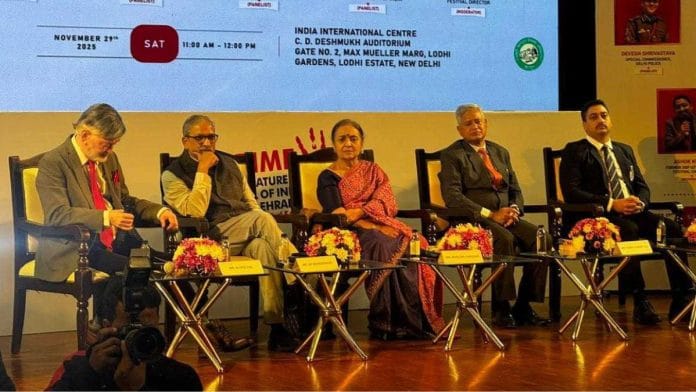
Kumar’s remarks became a prelude to the discussion on Equitable Justice – Are Men Being Left Behind? at Delhi’s India International Centre last week. The panellists included senior journalist Nidhi Kulpati, men’s rights activist Deepika Narayan Bhardwaj, Delhi Police Special Commissioner Devesh Chandra Srivastva, and Supreme Court advocate Juhi Arora.
The discussion was part of the third edition of the Crime Literature Festival (CLF) in India. The festival does not celebrate crime fiction with abstract characters but focuses on stories of real lives, straight from the hinterlands. Bringing these stories to the stage are men and women in uniform, activists, and those who document such narratives. The curtain raiser on 29 November will be followed by the three-day event from 12 December to 14 December in Dehradun.
“With rising crime rates in the country, such festivals are important to raise awareness and make citizens vigilant. The festival not only recognises officers who solve complex cases but also those who bring crime narratives to the masses,” said Kumar.
Lopsided laws
The discussion started with Deepika Bhardwaj introducing three families of men — Vikas Modi, whose brother Atul Subhash died by suicide, Captain Rakesh Walia, who had fake rape cases against him, and the family of a man who was murdered by his wife.
“And I am fighting along with them. I am standing with all of them. For women, protection and laws are very important. But in the name of genuine victims, those who have made our laws a business, I am against it,” said Bhardwaj.
And then the discussion revolved around how men are struggling for justice and the way laws are biased in favour of women.
“In today’s time, many such cases come to us. And when these men go to the police, they are being told that we don’t have any laws to take your complaint,” Bhardwaj said, as the audience nodded their heads in agreement.
“If a man gets gangraped today, he doesn’t have any provision in the Indian justice system to file a complaint.”
Also read: The Sri Lanka story in 100 fridge magnets
‘Hunterwali’
From discussions on dowry and equitable justice to the challenges faced by men, the event set the stage for the Crime Literature Festival. Yet, one story stood out: that of Bihar’s first woman IPS officer, Manjari Jaruhar. Her book, Madam Sir: The Story of Bihar’s First Lady IPS Officer, released in 2022, became the focus of the discussion.
IPS Jaruhar recalled that she was the only woman in uniform at a time when it was highly uncommon. She was even nicknamed “Hunterwali” for her conviction and handling of cases fairly. “When people first saw me in uniform, there were stares and surprise. But over time, that perception changed into respect,” she said.
As the discussion progressed, AP Maheshwari, former DG of the CRPF, made a statement that drew cheers from the audience. He said that male superiority in terms of physical strength is no longer relevant.
“Today, technology has become a great equaliser. The whole war is now based on technology. It is our dexterity and behavior that determine success in the field”.
(Edited by Aamaan Alam Khan)