





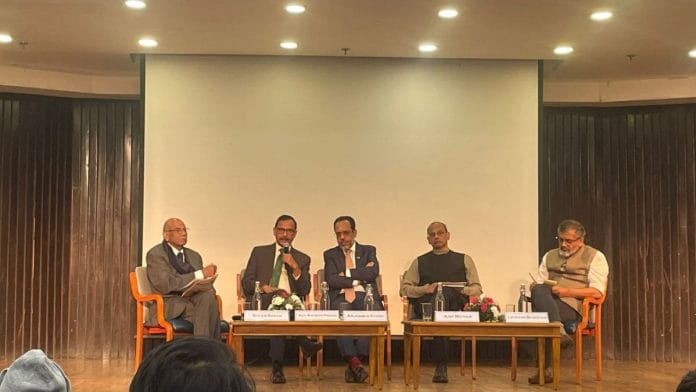



New Delhi: As a pollution-induced haze surrounded the India International Centre late last week, Dr. Arunabha Ghosh reflected on his time as the Special Envoy for South Asia at the recently concluded United Nations Climate Change Conference or COP30 in Belém, Brazil.
“This was a year when climate multilateralism was very much at stake. The year began with President Trump announcing the exit of the United States from both the Paris Agreement and the United Nations Framework Convention on Climate Change,” said Ghosh, to a solemn audience at IIC’s multipurpose hall. “So, it was very important that we entered COP30 with a view to retaining a modicum of trust in a continuation of the multilateral process.”
Ghosh was giving a presentation titled “The world is not binary: reflections from a COP of truth and a COP of implementation” to a room of academics, IIC members, journalists and climate activists. After opening remarks by Shyam Saran, President of IIC, Ghosh explained how he landed on the title of the presentation.
“We tend to approach these [climate] issues with a singular focus, sometimes on carbon, sometimes on specific countries. And we leave aside the nuances that are necessary to inject not just justice as a point of principle, but also as a point of practice,” he said.
Also read: Environmental law is not just fights in court. Filling ration card form is also legal aid
Navigating a new role
Set against a backdrop of failing climate diplomacy, Brazil’s presidency attempted to widen the COP’s architecture—creating space not just for technical negotiations but for political leadership, coalition-building and even public pressure through a “global ethical stocktake”.
“They organised these conversations amongst folks who extend beyond the climate space—activists, academics, poets, people representing society at large and trying to get their voice on why action on climate change matters,” said Ghosh.
Appointed Special Envoy for South Asia just days after the India-Pakistan flare-up, Ghosh said that he had to invent a job description, since none was given to him. Barring Pakistan, he had to reach out to other countries in South Asia—where he found commonality in the kinds of pressures countries were facing.
To underscore just how serious the crisis was, Ghosh—who is the CEO of the Council on Energy, Environment and Water (CEEW)—highlighted that one in four people affected by natural disasters over the last two decades have been in South Asia.
“Already 80 per cent of Indians live in areas that are highly vulnerable to multiple climate hazards. Whether it’s drought, flood, cyclones, or a combination of all three,” said Ghosh, citing data compiled by his colleagues.
Also read: Indian women missing from climate change action. $5 trillion goal is impossible without them
Geopolitical realities
After his presentation, Ghosh was joined on stage by Ravi Shankar Prasad, the former Special Secretary of the Ministry of Environment, Forest and Climate Change, Laveesh Bhandari, the President of the Centre for Social and Economic Progress and Dr. Ajay Mathur, a former member of the PM’s Council on Climate Change and a professor at IIT Delhi.
The panel opened by acknowledging Brazil’s pivotal role in steering COP30 toward implementation-focused outcomes. Speakers highlighted two major deliverables: the roadmap for the $1.3 trillion finance goal and a parallel roadmap on forestry, both seen as essential for developing countries
“We need to temper our expectations from the COP. They are not meant to be revolutionary,” said, Prasad who also serves as an advisor to CEEW. “They are evolutionary. They decide on issues and agendas which are on the table.”
By that measure, he argued that COP 30 delivered what was on the negotiating table. He did note that geopolitical realities, including the withdrawal of a major historical emitter from climate commitments, dampened ambition around fossil-fuel outcomes and adaptation finance.
Mathur addressed the geopolitical challenge more bluntly, pointing to the US administration’s increasingly active discouragement of climate ambition abroad. “Mr. Trump does something every morning which surprises me even more,” he said, as the room exploded into laughter.
Yet he argued that market signals—such as round-the-clock renewable power in India now under-pricing new coal—were beginning to reshape energy choices irreversibly. But the lack of human capacity in the countries of the so-called Global South was concerning.
“It’s not just the fact that we have low per capita incomes, but the fact that a very large number of people who think about climate change and who think about the kinds of strategies that we could adopt are lost to the developed countries,” he said.
(Edited by Theres Sudeep)