








New Delhi: For Mahima, who runs the operations of the Mehrauli Community Library, comics are not just fun books or distractions, but a bridge to literacy.
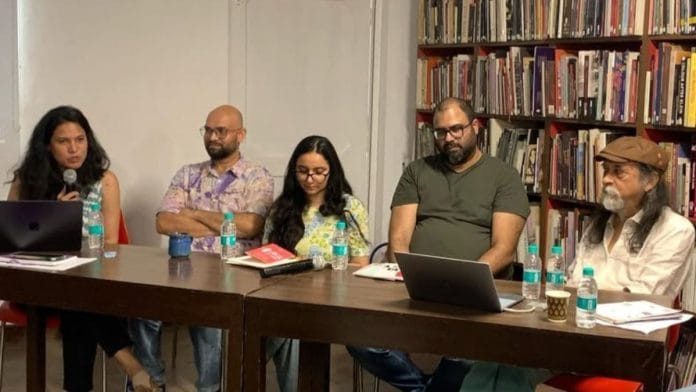
“Comics meet children where they are in their language, their humour and their reality,” she said, speaking at the roundtable discussion titled ‘Comics as Witness’ on 14 March at the Foundation For Indian Contemporary Art Reading Room in Delhi.
The session brought together comic creators, publishers, distributors, and editors to discuss comic book readers and cultures of readership in India. The panel included Comixense magazine Chief Editor Orijit Sen, comic artist Vidyun Sabhaney, Zubaan Books Executive Director Bidisha Mahanta, Rakesh Khanna, Director and Editor-in-Chief at Blaft Publications, and Mahima.
The event marked ten years since the publication of First Hand: Graphic Non-Fiction from India, a comic conceptualised by Sen and Sabhaney.
According to Mahima, comics are changing how people read. “Comics invite collaboration unlike picture books where one person reads to another,” she said, adding that comics build read-aloud and performance skills as well as teamwork.
She said kids are most drawn to comics that use their language. “Once a child finishes one, they immediately hunt for the next in the series, building a consistent reading habit.”
Also read: Mysore Sandal Soap, cigarettes & sambar—Bengaluru artist maps the city through its smells
‘A precious commodity’
India has a rich tradition of comics that cover diverse topics like mythology, social satire, and superheroes. But from the mid-1990s, its craze has been declining, said graphic designer Orijit Sen, who has authored River of Stories, considered India’s first graphic novel published in 1994.
“Comics were a precious commodity when we were brought up. However, it was not a respectable thing,” he added.
Sen reflected on comic subcultures in the 1990s, sharing personal anecdotes from his own journey as a comic creator. He said they had a barter system in childhood where they would exchange comics with friends. “Some had Amar Chitra Katha, some had other books.”
At the discussion, speakers talked about the various issues affecting comic-making — from language, caste, class, politics to technology.
“Translation is one thing to reach different communities,” said Mahanta. She highlighted feminist collaborations for making comics and how the medium can help visualise oral histories.
The speakers discussed the size of the comic market and its evolving nature.
“In the last decade, comics emerged well and its market also expanded but a question remains, what will be its future,” said Sabhaney, a comic creator based in Delhi.
Sabhaney said that since 1990, comic reading has decreased but more people are now reading graphic novels. “Creators have a set of stories that they want to tell. Comics are created for particular issues such as documenting protest,” she said.
But both creators and publishers acknowledge that creating comics is not an easy task. “It has a certain difficulty and requires a lot of deliberation, work and continuity,” said Shikhant Sablania, comic creator and co-organiser of Indie Comix Fest.
When an audience member asked about comics moving online, Sablania said, “The dynamic of comics is changing. The creator wants to reach as many people”.
(Edited by Aamaan Alam Khan)