








New Delhi: In a gathering of the Indian women’s blind cricket team, Virat Kohli’s name popped up in the most unusual manner. It was about Kohli’s sledges on the ground.
“Cricket is a gentleman’s game, we do not sledge like Virat Kohli,” Priti Prasad, a player from the Indian women’s cricket team for the blind, said at the screening of the documentary Dekh Le! India / See It! India.
Directed by Shanthi Mohan and Mukund Moorthy, in collaboration with Samarthanam Trust and the Cricket Association for the Blind in India (CABI), the documentary traces the journey of its women players. It documents their lives from their homes in small towns to the World Cup.
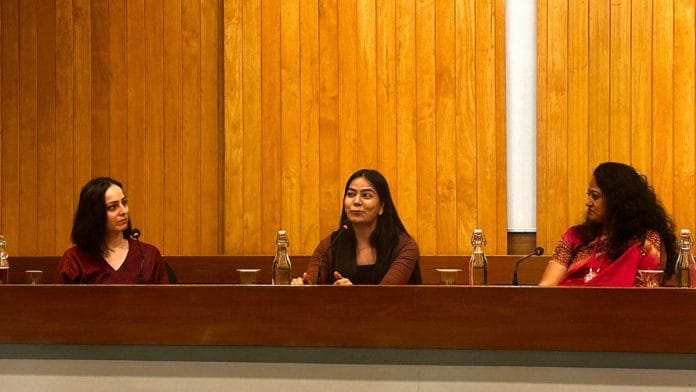
The Gulmohar Hall of the India Habitat Centre had few attendees on 7 March, but those present were keen to learn more about the film, the players, and their journeys. Many admitted they were unaware of the team and its achievements.
The screening, organised by the Kriti Film Club, was followed by an elaborate discussion with Priti Prasad and Anuradha, members of the film crew. Kritika from the film club moderated the conversation.
Prasad, who received a series of questions from the audience, played in the T20 in 2023. Prasad, who hails from Bihar, moved from Darjeeling to Delhi to pursue cricket. She had been interested in the sport since childhood, and her family supported the endeavour.
Speaking from the dais, Prasad was excited to tell her story—from Darjeeling to London, where the team lifted the Blind Women’s T20 World Cup. From her first flight, she experienced both fear and victory on international ground.
“Today, people recognise me as someone who plays blind cricket for India. Through the sport, I have been able to make my parents proud,” she told ThePrint.
Prasad recalled her first meeting with her current teammates. It was at a hostel in Bengaluru. The city and its people were new to her. But years of togetherness as a team changed her. From disliking south Indian food to loving dosa, Prasad and her teammates have come a long way.
Prasad is an all-rounder and is a wicket-keeper on the team. She is a B2 player, a classification marker for players based on the degree of disability. Cricket is her priority; it has given her an identity.
Commenting on the state of blind women’s cricket in India, she acknowledged that after the team won the Blind Women’s T20 World Cup, the BCCI started supporting it.
Also read: Delhi’s overlooked wildlife didn’t disappear overnight; it faded slowly
Dekh Le! India
At Gulmohar Hall, the documentary opened with a graphic introduction to blind cricket, showing how it differs from regular cricket.
Dekh Le! India was first screened at the Samarthanam Art Centre on 27 June 2025. It is available in six languages. Through the use of compelling, emotive visuals, the directors have brought out stories of the players who have struggled to make their mark in the history of cricket.
The film tells the story of Simu Das, highlighting the struggles within her family. It portrays the challenges faced by her mother, who worked as a cook while also caring for Das’ disabled brother and supporting the family.
Coming from a small village in Assam, Das grew up in a household that survived hand to mouth, making her journey into cricket even more remarkable. From these stories of hardship to the team’s victory in London, the documentary shines a light on the little-known world of blind cricket in India.
The 69-minute documentary ends with a powerful message. The women players send a message to the viewers—do not pity us.
(Edited by Prasanna Bachchhav)