








New Delhi: In the Kashmiri-language indie film Batt Koch, an ageing Kashmiri Pandit named Poshkar Nath Koul begins to lose his memory after his wife’s death. As days and time blur together, he decides he must visit Kashmir once—before memory abandons him completely.
The film, which saw its Delhi release Saturday at PVR Anupam in Saket, traces Koul’s first visit to the Valley after 35 years since the exodus forced him out of his home in Mattan, Anantnag.
Batt Koch first premiered at the International Film Festival of Srinagar in November 2025. It was released in Jammu in February 2026, where it saw a full house for an entire week. Having received an enormous response in Chandigarh too, the film is set to travel to Ahmedabad, Pune, Mumbai, Bengaluru, and Srinagar.
A ‘real tribute’
Batt Koch brings to the screen the lives of a forgotten community living in the bylanes of Jammu. The film captures its enduring connection to Kashmir.
And the film’s protagonist, Koul, is not just one man. He lives in every Kashmiri Pandit household in Jammu as the keeper of memory and the custodian of culture. For the young generation, he is their second-last link to Kashmir.
Two young Kashmiri Pandit filmmakers, Ankit Wali (27) and Siddharth Koul (26), teamed up with independent production VR SearchKashmir to portray the quiet agony of a displaced community. The film does not pit Kashmiri Pandits against Kashmiri Muslims, nor does it chase a sensational vengeance plotline. Instead, it lingers in the daily life of a Pandit household whose inhabitants have spent decades in Jammu—a place they still struggle to call home.
Theatre actor and director MK Raina completely subsumes himself into the role of Koul. For Kashmiri Pandits who came to watch the movie, it was a “real tribute” to their memories of exile. At PVR Anupam, many walked out of the hall with red eyes, wiping away tears.
It was Shoojit Sircar’s film Piku (2015) that inspired Siddharth Koul to attempt his film. He was moved by the stubborn love of an ageing Bengali man for his house, his refusal to sell it, and his visit to Kolkata.
“That film stirred something personal in me. I felt an urge to explore a similar emotional truth, but in my own language—Kashmiri—and within the world I came from,” said Siddharth.
Also read: 2 girls, 15 km, a world apart — the distance between school and child marriage in Rajasthan
The fading of homeland
What keeps company with a family that fled its homeland in the dead of night, gripped by fear and terror? A radio playing Kashmiri songs, a language spoken at the dinner table, food that carries the taste of home. But how does it learn to live with such rupture?
The film traces this transition from Kashmir to Jammu—and the slow fading that follows. The younger characters stumble over Kashmiri words, while the staples of home cooking slowly give way to junk food.
Koul corrects his granddaughter Osheen’s (Sakshi Bhat) broken Kashmiri. Koul’s son Rajesh (Anil Koul Chingari) keeps reminding Osheen to apply for a migrant certificate.
Kashmir is like a ghost in this household—it haunts, hurts, but also makes the inhabitants smile. Rogan Josh, dangling dejhoor earrings, pink salt tea, every small detail carries echoes of Kashmir.
Kashmiri Muslims also enjoyed the film.
For Zainab, a student from Kashmir studying in Delhi, it was her first time at a cinema hall. “I have been studying in Delhi for two years and have been wanting to watch a good movie, but kept delaying it. I’m glad I chose this one,” she said.
Friends, songs, ageing
In the film’s closing stretch, when Koul finally returns to Kashmir—a journey his wife had always dreamed of—an old Muslim friend recognises him on the way to his house. He has kept Koul’s bag safe all these years.
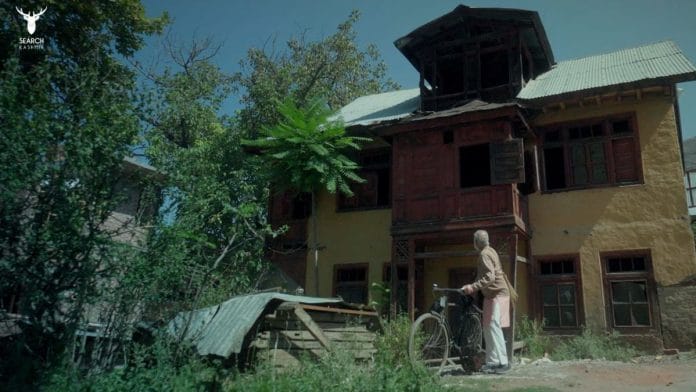
And then a sequence unfolds. As if Koul were back in his younger days, he rides a bicycle through the neighbourhood, singing old Kashmiri songs.
He stops before the houses of his Kashmiri Pandit neighbours. They no longer live there. The buildings stand like ruins—abandoned, their windows hollow and walls weary with time.
He looks at one such house and murmurs, “Tche tchuk budyomut (You have aged).”
(Edited by Prasanna Bachchhav)