








New Delhi: At a time when dog lovers across India have taken to the streets to demand a evidence-based lawful policy on stray dogs against the Supreme Court’s November order to relocate all stray dogs across the national capital, animal welfare activists and doctors are now dissecting the challenges in India’s animal birth control rules that were brought in to prevent rabies and to control dog populations. While on paper, India has a clear, scientific plan to control the two. The ground reality, however, is that the plan is starting to struggle, not because it has failed, but because it is stalled and is being replaced with ad-hoc solutions, the activists say.
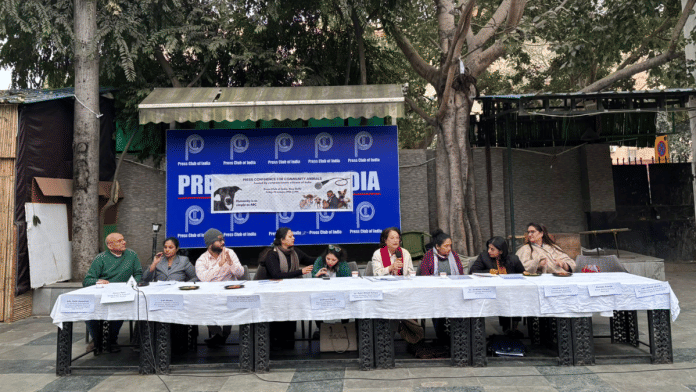
These concerns became central to a discussion on India’s Animal Birth Control (ABC) rules organised by the Compassionate Citizens of India on 2 January at the Press Club of India in New Delhi.
“If the intention is to control rabies and dog bites, then removing community dogs from their territories is wrong,” said Dr Ekta Jain, an epidemiologist and an animal welfare activist. “India already has a humane and evidence-based system. The problem wasn’t the policy, but the way it disrupted the system.”
The panellists questioned the recent court orders, administrative circulars, and project shutdowns affecting ABC programmes across several cities. They argued that the ABC framework, which has made sterilisation mandatory, along with anti-rabies vaccination and the return of dogs to their original territories, has been weakened through poor implementation and the alleged overreach of the administration, even as rabies remains a health challenge.
Despite the challenges, animal rights activists allege that the Animal Welfare Board of India (AWBI) has interfered with municipal tenders. It halted ongoing projects and imposed additional requirements not provided for in the law. One of the key concerns raised by the speakers is the sudden demand for renewal of recognition of nearly 3,000 organisations previously authorised to conduct ABC work. Of these, the speakers said, only 75 have reportedly been re-approved.
The new ABC rules are complex and require multiple committees at the central, state, district and local government levels. Many are non-functional, and others don’t exist. According to the panellists, the ABC programmes have been halted or suspended in dozens of cities, including Mumbai, Bengaluru, Hyderabad, Chennai, Pune and Ahmedabad.
Also Read: 91% of Indians report feeling safer because of street dogs, says new survey
Why mass removal wouldn’t work?
The speakers stressed that relocating or culling of dogs has been tried in India for decades, but has shown little success.
Dr Jain said that studies from different countries have shown that removing dogs from an area creates a “vacuum effect” and new and different animals create their habitat, increasing the risk of rabies transmission.
She pointed out that it is the vaccination coverage, and not the removal of dogs, that determines how rabies is and can be controlled.
“Dogs must remain in their local territories if the aim is to stabilise populations and stop the spread of disease,” she said.
ABC rules remain India’s only legally and scientifically recognised method to control community dog populations and to prevent rabies. The ABC Rules of 2023 have been challenged by the Federation of Animal Welfare Organisations, which filed petitions in the Bombay High Court, Karnataka High Court and the Supreme Court in March 2024. The speakers said that these petitions remain pending and that the AWBI has not filed replies in any of the courts so far.
“The petitioners argue that the rules are being used to centralise control of ABC projects and restrict participation to a small number of organisations,” a statement issued by the Compassionate Citizens of India said. Under the Prevention of Cruelty to Animals Act, 1960, the AWBI is an advisory body with no statutory authority to issue binding directions, it said.
For Dr Rajni Safaya, former AIIMS professor, emphasis must be put on the importance and need for trained healthcare workers, proper vaccine storage, and post-exposure treatment. “It is the gaps within systems that do not get addressed,” she said.
But Dr Safaya also cautioned against large-scale sheltering of dogs, especially in high-density confinement, which she said increases the risk of disease outbreaks that can also spread to humans.
“Mass sheltering is not only inhumane, it is a public health risk,” she said.
The Supreme Court, in an August 2024 order, took suo motu cognisance to remove all stray dogs across Delhi NCR and to place them in shelters after an increase in rabies bites and dog attacks. The apex court altered its order twice more, with the latest November 2025 order directing the removal of stray dogs from public premises, sterilising and vaccinating them before relocating them to designated shelters.
Also Read: UGC tells universities to prevent entry of stray dogs in campus, calls for ’round-the-clock vigil’
When the system starts breaking down
The panellists argued that the crisis at hand was not the scientific backing of the ABC rules but the governance and implementation of those measures.
For Delhi-based animal rights activist Monisha Baweja, animal feeders and volunteers, who play a key role in caring for stray dogs and work towards assisting sterilisation, are increasingly being harassed.
“We’re not acting outside the law. We’re following the Constitution and the ABC rules,” she said, adding that police personnel often lack awareness of existing legal protections.
Animal welfare worker Udit Bhatia, Director of the Chandigarh-based Megafauna Welfare Foundation, who was also a panel member, pointed out the discrepancies between the official claims and on-ground realities. In several states, he said, sterilisation numbers are cited without transparent data, while tenders and monitoring committees remain non-functional.
Bhatia said that in cities where sterilisation vans have stopped coming, the impact soon becomes visible on the streets. It’s a reminder that policy-level discussions don’t stay inside courtrooms.
“Where ABC rules have been implemented properly, complaint rates and dog bite cases have sharply fallen,” he said. “Where it hasn’t, failure is being blamed on the policy rather than on poor governance.”
(Edited by Insha Jalil Waziri)
Neither the dog, nor the government. Blame people like Samridhi Tewari for the mess we are in.
Thousands of toddlers and senior citizens are getting mauled and bitten by stray dogs everyday. In many cases, children are being mauled to death. All thanks to people like Samridhi Tewari whose indifference to human suffering and misplaced love for stray animals are at the root of this issue.
The Supreme Court would do well to label stray dogs and cats as vermin or pests. This would allow people to take care of this menace on their own.