





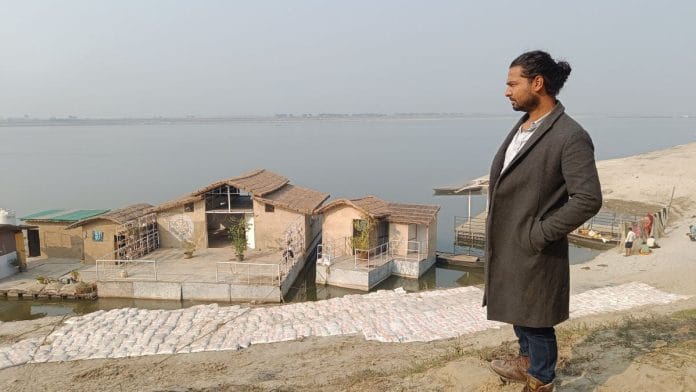



Ara: Mechanical engineer Kumar Prashant’s five-year-old dream to create floating houses in India’s flood-prone areas is no longer his alone. He built a prototype in Ara. The chief secretary of Bihar, Pratyay Amrit, visited his project in December and showed much interest in scaling it up.
And now he has to race against time. In the third week of January, he fine-tuned every slide and fixed every word on a presentation for Bihar CM Nitish Kumar—how a floating house can be designed to withstand the fury of Bihar’s floods.
Nitish Kumar is expected to visit Bhojpur district as part of his ongoing Samriddhi Yatra this month.
“I have asked for approval for a plan to build a mini floating village comprising 20-25 houses,” said 36-year-old Prashant, founder of Centre for Resilience, sitting inside the floating house on a sunny January afternoon on the banks of the Ganges in Ara.
Prashant founded the Centre of Resilience in 2020. He uses novel methods such as waste-upcycling and construction to tackle a variety of Bihar’s socio-economic issues, from climate change to the disappearance of Indigenous cultures.
In flood-ravaged Bihar, where climate change is deepening both environmental and economic vulnerability, Prashant’s experimental floating village in Ara is offering a shift from relief-driven responses to long-term resilience. His low-cost amphibious houses—built from indigenous and waste materials—rise with floodwaters, regulate extreme temperatures and have withstood multiple seasons without maintenance.
Prashant said that the floating village is more than a housing solution. “The initiative positions climate resilience, waste-to-resource innovation and community stability as a pathway for Bihar to adapt to a rapidly changing world,” he said.
Also read: Bihar floods in Eklavya Prasad’s photos—a legacy of neglect, man-made barriers wreaking havoc
Bihar’s solution for climate change
When Prashant started making the floating house in 2020, villagers mocked him, saying Bhaiya pagla gaye hain (Brother has gone crazy).
“But I knew what I was doing. As the house gradually took shape, the same people started to feel empowered,” said Prashant, who trained the local people to help build his dream project.
The materials he used to make the house included large blue drums for floating, metal pipes and a mixture of mud and animal dung. He completed construction in 2023—a one-bhk house with one bathroom. It cost him Rs six lakh.
He spent almost three years testing its durability, exposing it to flood, heat and cold. “I has not required any maintenance, which suggests that it is durable. Now our focus is to make it more cost-friendly,” he said.
According to the Bihar Economic Survey 2026, a total of 27 flood protection schemes of Rs 3146.71 crore for different districts were announced. The survey report said that in 2024, 13.42 lakh families and 10,135 houses were affected due to floods in 27 districts of Bihar.
Affected families spend several months just recovering the losses, said Prashant, who grew up in a flood-prone village.
“It’s a kind of damage that occurs every year. And climate change is making it even more devastating,” said Prashant.
His work has been featured in local newspapers, one headline reads: Baadh mein tabah gaon ko nayi zindagi denge tairte ghar (Floating houses will give a new lease of life to villages, which were devastated by floods). Another reads: Sakaar ho rahi paani par ghar banane ki parikalpana (The concept of building houses on water is becoming a reality).
He has since become an evangelist for floating houses on podcasts and at conferences. In December, he was invited to the podcast titled Innovation for Change at the Patna Book Fair held at the iconic Gandhi Maidan. He also took his work to a two-day conference for divisional commissioners and district magistrates at the Bihar Institute of Public Administration & Rural Development (BIPARD) in Gaya in December 2025. In November, he spoke at the Griha Summit at Delhi’s India Habitat Centre during a session titled Ideas to Innovations – Transforming Climate Action. His floating house is regularly visited by local MLAs and even the Bhojpur district magistrate, Tanai Sultania. In January, IPS officer-turned politician and MLA from Buxar, Anand Mishra, visited his Centre of Resilience (CoR).
Prashant turned a part of his house into a workshop for sculpting under the Resilient Livelihood, a skills training programme, which is part of his centre’s work. Workers were busy making a sculpture of a pigeon from scrap material. It will be installed in Bhojpur district. His team had earlier made a grand sculpture of Shahi Litchi, which was installed in Muzaffarpur.
The floating houses that Prashant’s team will work on after the final nod from the government will be set up at the Digha Ghat on the Ganga in Patna. He has named the project Mothership.
“We call it Mothership because it is more than a structure. It is the core that holds, guides and supports many systems at once,” he said.
(Edited by Theres Sudeep)