





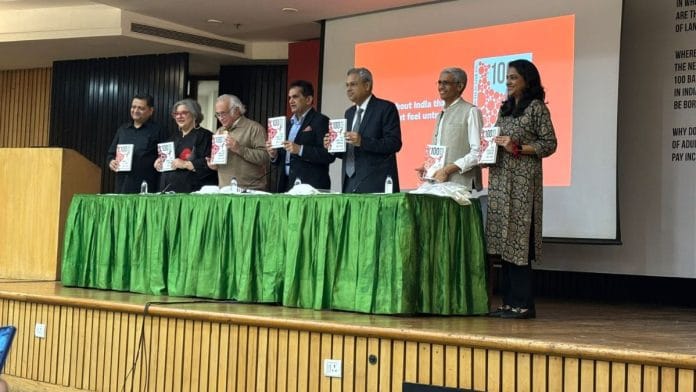



New Delhi: When did India’s baby boom peak? How many Indians eat meat? In 100 Ways to See India: Stats, Stories, and Surprises, senior journalist Rohit Saran turns complex government data into crisp pie charts, spare text, and striking visual spreads, to show how one can look at India, by scale and by contradictions.
“We are a data surplus country, and in 100 Ways to See India, this book captures the diversity of India,” said senior Congress leader Jairam Ramesh, at the launch of Saran’s book at India International Centre Tuesday evening, to a hall packed with journalists, politicians, economists, and bureaucrats.
It was a masterclass in reading India through numbers. Saran, the Managing Editor at The Times of India, has spent over three decades shaping data-driven storytelling across newsrooms, and since the 1990s, he has worked with statistics as well as visuals, and turned raw data into narratives.
Apart from Ramesh, Saran was joined by former G20 Sherpa and ex-CEO of NITI Aayog Amitabh Kant and the Secretary in the Ministry of Statistics and Program Implementation, Saurabh Garg. The conversation was moderated by veteran journalist and author Kaveree Bamzai, former editor-at-large of India Today Group, which turned the evening into a wide-ranging discussion on how statistics have shaped the story of India.
Data vs myth
Ramesh describes India as a “data surplus country”. While the numbers exist, he says, what is often missing is interpretation.
He cites Vidya Devijaya’s book The Story of India Through Hundred Objects, where she took 100 objects, which were taken for granted, and wrote a story on India.
“This is the story of India through a hundred pie charts. Basically, looking at the data that is very much in the public domain, which we use on a day-to-day basis. Rohit (Saran) has made sense out of this data,” Ramesh said, adding that societies and nations need myths.
“They need foundational myths. And one of the foundational myths of our country is that we are a vegetarian country,” he said. “There is a decline in cows, and a rise of chicken.”
The audience burst into laughter.
Data tells interesting stories, patterns, and trends. Like, ten years ago, the stock market was irrelevant for a majority of Indians.
However, as per the data collated by Saran and through his pie charts, Ramesh said that there are 12 crore Indians who have their savings invested in the day-to-day movements of the stock market.
“That’s not a small number. That’s a very large number. And if you assume that normally you will have one person per family, you’re talking of a very large proportion of urban India, at least, having a vested interest or a stake in financial markets. So a lot of data will get picked up, but data which is convenient for your conclusions. Because, you know, our public debate is not defined by data. Our public debate is defined by conclusions,” he said.
But what was surprising for Ramesh was the coastline data.
“We are used to thinking of a 7,500-kilometre-long coastline, starting from West Bengal and going all the way up to Gujarat. And actually, it turns out that the coastline is 11,000-odd kilometres,” he said.
Also read: How the Indian subcontinent overlooked its terracotta history — the hidden clay traditions
Data as power
For Kant, data needs to be looked at beyond aesthetics.
Talking about the Aspirational Districts Programme, he describes how real-time data was used to run districts and spur the competition.
“It was just a fear of data which made these districts improve,” he said.
Recalling the time when Kant was posted in Kerala, and he “fought with the communist government,” he said, back then, nobody had heard of Kerala as a tourism destination.
“Everybody used to travel to Rajasthan or Kashmir. I was made Secretary of Tourism,” he said. So, they used tourism satellite accounts to demonstrate the sector’s multiplier impact on jobs and growth. The evidence persuaded a sceptical government to support the industry.
“My belief has always been that if you use data effectively, you can convince politicians to drive growth, progress and prosperity,” he said.
For Garg, who heads the ministry responsible for national statistics, official data has not always been user-friendly.
“Statistics is supposed to be really boring,” he said, adding that Saran ensured the data is not boring.
He talked about efforts to make data sets machine-readable and more timely.
“The narrative is that the country is built on data,” he said. “The decision-making, whether in the government or the private sector, is so much more evidence-based rather than anecdotal-based.”
Garg said that in the census, there will be a built-in AI chatbot to help the enumerator when a question is asked, to figure out what the possible options are, etc. And that is helping to reduce the time taken for surveys, and therefore improves productivity.
“So over the next few years, we will see data in fact becoming like a fifth factor of production from land, labour, capital and knowledge, because data is also a raw material for AI. AI models need data; they need volumes of data, and it is necessary, therefore, to have credible data out there. And, AI will change productivity now,” he added.
(Edited by Saptak Datta)