






New Delhi: France has entered its second week of protests over the rape and murder of 11-year-old Lyhanna Rameau Bernard, a schoolgirl from Fleurance.
Anger over the killing has been building since her body was found on June 4, with protesters saying her death was the result of “institutional failures” that allowed the accused to slip through the cracks despite earlier complaints against him.
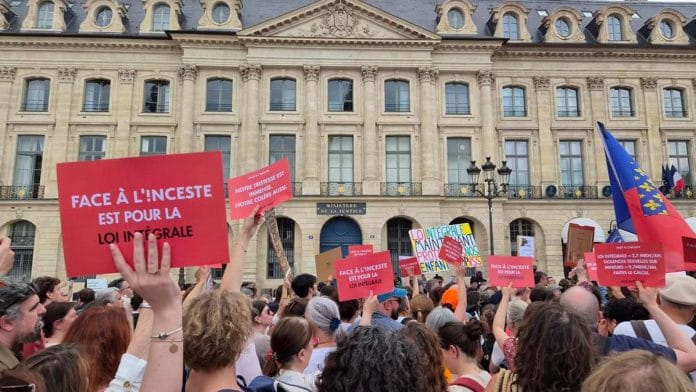
Thousands gathered outside the Ministry of Justice in Paris on Monday, while demonstrations were also held outside courthouses across France. In Auch, where the case is being handled, the statues of Justice outside the courthouse were blindfolded for a second week. Protesters said the act reflected their belief that justice today is “deaf, blind and mute.” They demanded a comprehensive law against sexual violence and the resignation of Justice Minister Gerald Darmanin.
“No excuse for predators,” read one placard held in front of the gates of the Ministry of Justice.
The latest demonstrations follow a nationwide mobilisation on June 8, when more than 60,000 people, including women and their young daughters, took part in protests across nearly 200 cities in memory of Lyhanna.
According to French media reports, a coalition of 150 feminist organisations has called for weekly demonstrations every Monday outside courthouses across France and at the Ministry of Justice in Paris. Organisers are also planning a nationwide march on July 4.
“It is highly likely that it is Mr Darmanin who doesn’t want to listen to us,” said Anne-Cecile Mailfert, president of the Women’s Foundation, at the 8 June protest. “If he doesn’t want to hear us, we are going to make even more noise.”
Also Read: You now need a prescription to buy cough syrups. Good move or a sign of ‘doctor-govt nexus’?
The crime, the accused, and institutional failure
A series of lapses has led to the nationwide groundswell of public anger.
Lyhanna was reported missing on May 29 after leaving school in Fleurance in southern France. Days later, her body was found nearly ten kilometres from her home, inside a grain silo.
Investigators later arrested Jerome Barella, the father of one of her classmates. She was last seen with him around 3 pm on the day of her disappearance, according to French media reports.
Barella, 41, had previously been reported to police over allegations of sexual abuse against a child. According to French authorities, a complaint was filed in August last year by the mother of a 10-year-old girl. Medical evidence later confirmed that the child had been sexually abused on several occasions.
Yet despite the complaint and the medical findings, Barella was not questioned by investigators in the nine months that followed.
Barella had also faced two other accusations of molesting young girls, though those cases were closed due to insufficient evidence. He had previously been dismissed from his job as a maintenance worker at a secondary school for inappropriate behaviour toward a minor.
Last year, lawmaker David Taupiac had written to France’s justice ministry about severe staffing shortages and operational problems at the prosecutor’s office in Auch, which oversees Fleurance.
While the French Justice Minister acknowledged “shocking and unacceptable failings in the services of the state”, he rejected calls to step down. Instead, he has ordered prosecutors to review an estimated 70,000 ongoing allegations of violence against minors by July 14.
Francois de Roujou de Boubee, the lawyer for Lyhanna’s parents, dismissed this instruction as “impossible unless you do a shoddy job.”
Mounting anger, Macron urges restraint
Last year, French police recorded more than 75,000 minors as victims of sexual violence, a 5 per cent increase from the previous year. Children’s and women’s rights groups estimate that 160,000 children are sexually abused each year, warning that a lack of resources often delays investigations and leaves children exposed to abusers.
At the nationwide mobilisation on 8 June, one placard held up by a young girl outside the Ministry of Justice read: “No child should become just a name on a damn banner.” At the centre of the placard was Lyhanna’s name. In the corners were four others—Maelys, Loana, Lola, and Louise—girls whose deaths had sparked national outrage across France in recent years.
“You wipe yourselves with our complaints,” read the words painted across a woman’s chest in bold black letters.
As thousands returned to the streets for a second consecutive week, carrying photographs and placards in memory of Lyhanna, they had a single demand: “We want the justice system to change.”
French President Emmanuel Macron has acknowledged that the handling of Lyhanna’s case had shaken public confidence in the justice system.
“It is trust in our institutions that is at stake,” Macron reportedly said in a cabinet meeting. “It is obvious that there have been clear malfunctions. We must now understand what falls under individual responsibilities and what concerns systemic lapses within all the public services involved.”
At the same time, Macron urged restraint, saying, “We do not respond to a tragedy with shouting.”
(Edited by Asavari Singh)