





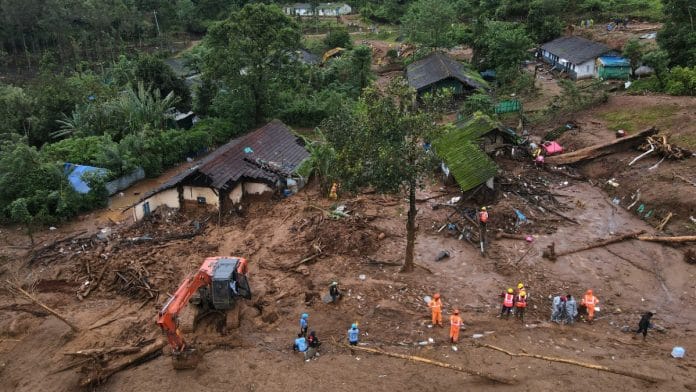



New Delhi: AI is expected to play an important role in predicting landslides by analysing satellite data and detecting tiny ground movements invisible to the human eye. This technology can help save lives by providing early warnings of any kind of ground displacement in vulnerable areas.
Researchers from Melbourne University are using AI systems trained with radar images collected by satellites to determine how slopes fall. These systems identify areas where the ground is slowly shifting.
Satellites have been collecting images—and data—of the Earth for decades. NASA’s Landsat program has been recording changes on Earth from space for more than 50 years, and this data continues to be analysed.
In addition, a company called Planet has recently been capturing daily images of the Earth and has collected thousands of images of nearly every part of the planet. With such imagery and AI-generated maps, disasters like landslides can be better anticipated and prepared for in advance.
Antoinette Tordesillas, a mathematician at the University of Melbourne, said in an interview with the BBC that landslides are not always sudden events. In many cases, the ground begins moving gradually long before a collapse.
Also read: Where’s climate in AI conversations? Biodiversity collapse is missing
Nepal experiment
The village of Kimtang in central Nepal presents a real-world example of how artificial intelligence is being used to identify landslide risks.
Melbourne University scientists used AI to analyse satellite data, images, maps and confirmed that the ground beneath the area is unstable, with some parts at high risk of landslides.
They identified a large danger zone, not just from a standard satellite image, but from a coloured map created by an AI system.
The AI marked the unstable zone a bright red against the dark blue of the surrounding hillside.
“Their village, where they live and farm, is actually on the slope,” Tordesillas told the BBC.
The findings of the research also reveal that radar-based satellite images can detect otherwise invisible signs of ground movement days, weeks, or even years before a collapse.
According to the US Geological Survey, around 25–50 people die every year due to landslides in the United States.
As per data presented in India’s Parliament (Lok Sabha) by the Ministry of Home Affairs, 1,989 deaths occurred in 2020–21 due to disasters such as floods, landslides, and cloudbursts. Between 2015 and 2024, 316 deaths from landslides were reported in Uttarakhand.
In the UK, scientists studied around 3,00,000 slopes with AI and found that nearly 3,000 are slowly moving.
Although these movements are very small, just a few millimetres per year—they could still lead to future landslides. AI-generated warnings can therefore be used as a precaution to help prevent future disasters.
(Edited by Theres Sudeep)