





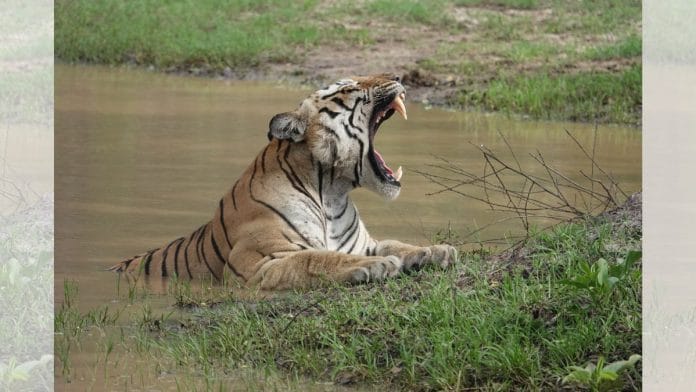



New Delhi: India’s tiger population is expected to jump by at least 10 per cent to 15 per cent according to initial estimates of the ongoing country-wide tiger census, sources at the Ministry of Environment, Forests and Climate Change said.
Officials and experts, however, told ThePrint that most of the increase in tiger populations this time will be seen outside the core areas of the reserves — in the buffer zones, nearby territorial divisions, and tiger corridors.
The All India Tiger Estimation (AITE), the country-wide tiger census, conducted every four years, is currently in its sixth edition. It began in late 2025 and will continue through 2026, with the final report expected in July 2027. The exercise involves all 58 tiger reserves and estimates tiger populations both inside and outside protected areas.
“We use a variety of direct and indirect measures — pug marks, scat droppings, camera trapping images — to estimate the number of tigers both in the core areas and the buffer and territorial divisions,” said Rajnish Kumar Singh, deputy director of Pench Tiger Reserve. “It is not as much a census as an estimation, using statistical models and confidence intervals.”
In 2022, the last census estimated a total of 3,682 tigers across the country, with Madhya Pradesh topping the list with 785 tigers. Karnataka, Uttarakhand and Maharashtra followed with 563, 560 and 444 tigers, respectively. India has seen a steady annual growth rate of 6 per cent in its tiger population since 2006, when the census began.
Sources in states like Madhya Pradesh also told ThePrint that the state could see a 25 per cent rise in its tiger population, crossing the 1,000-mark. Other reserves like Ranthambore and Sariska Tiger Reserves in Rajasthan already maintain regular camera trapping logs of the tigers in their areas, and expect to see either an increase or a stable tiger population in the AITE.
“Most tiger reserves in the country are saturated enough. A few like Melghat, or Satpura (in Maharashtra and Madhya Pradesh) may have the potential for a few more tigers,” said YV Jhala, a conservationist and key figure in Project Tiger. “Otherwise, the increase in tiger populations will mostly be in buffer zones and multi-use areas.”
The 2026 Tiger Census comes at an opportune time, as the country’s protected areas are slowly filling up with tigers. In the last few years, it has raised questions about the increasing nature of human-tiger conflicts, with over 73 attacks in 2024. The results of the census will provide information not only about the number of tigers, but also about their density, the areas they frequent, and the changing geographical spread of the population.
“We need to build a shared agenda for wildlife living outside the protected areas, because high-density tigers and high-density people are a recipe for disaster,” said Jhala. “How to manage and ensure this situation doesn’t arise? It is open to national debate. But we need to start thinking about this immediately.”
Increase in tiger population
Madhya Pradesh has been a hub for India’s tiger population, consistently ranking among the top five tiger states since the launch of Project Tiger in 1970. The vast grasslands, even terrain and forests, along with a strong prey base, contributed to its rise to the top of the tiger states in the country.
With a total of nine tiger reserves, major ones like Panna, Pench, and Bandhavgarh reserves are now almost at capacity, and the new tiger census is likely to reflect that in its results.
“It was in 2006 that we realised tigers don’t stay relegated to only protected areas, and that any landscape that is feasible and has prey will see tigers moving in to it,” Singh said, adding that it was then they decided to increase the tiger census to broader areas and not just inside the reserves.
The phased tiger census involves field surveys and statistical model-based inferences, among other measures, which cut across reserve boundaries to see tiger movement. Singh said that newer tiger reserves are being developed in Madhya Pradesh, and villagers are being relocated to accommodate the growing tiger population.
“In this census, Nauradehi, Kanha and Sanjay Dubri could see a rise in tiger populations, because they’re the new ones that are being developed and connected through corridors,” said Singh. “Even now, we’re seeing tigers venture out into the buffer zones and the nearby forests, because a tiger doesn’t see reserve boundaries to them, it’s all the same.”
According to Jhala, there are very few areas left in India with enough prey base where tigers haven’t already ventured. States like Odisha, Jharkhand, and Chhattisgarh, despite having vast empty habitats and reserves like Palamau, Simlipal and Indravati, do not have enough prey abundance for tigers to naturally venture there.
However, buffer zones and tiger landscapes outside the reserves are hugely attractive to the apex predators, looking for both territory and prey. The biggest prey base for these venturing tigers is the livestock in rural areas.
“We have hardly any wild prey left that the tigers haven’t gotten to, but our livestock populations, like goats and cows, are increasing in abundance,” said Jhala. “For tigers, it doesn’t matter as long as they’re getting food.”
Also read: Maharashtra’s Kham shows even ‘dead’ urban rivers can be revived—here’s the blueprint
A similar pattern
A similar pattern has been unfolding in Karnataka, where forest reserves such as Nagarhole, Bandipur and BRT are also witnessing a stable to rising number of tigers, which are increasingly being recorded in landscapes adjoining their major reserves.
According to Shripati BS, director, BRT Tiger Reserve, this is not just a tiger-specific issue but also extends to elephants and other animals in sanctuaries.
“Tiger numbers are increasing because we’ve made great efforts at conservation, but after a point, there cannot be an increase in forest land anymore,” said Shripati. “In this case, tigers need a minimum amount of territory, and they will go out into non-protected areas too because that is their nature.”
This is also the major reason for human-wildlife conflict near tiger reserve areas, with this, livestock hunting even leading to some people indulging in retaliatory killing of tigers, such as in MM Hills Sanctuary in Karnataka earlier in 2025. If there is no plan to address wildlife outside protected areas, Jhala said this could become a much more frequent occurrence. Before anything else, policymakers need to begin thinking about the problem of plenty in Indian tigers.
“We need to be active and manage the situation so that tiger populations are regulated. If density will be high, conflict will be high – no two ways about it,” said Jhala.
Meanwhile, in 2025, there were a total of 167 tiger deaths across the country, and in the first week of 2026, there have been six tiger deaths recorded on the NTCA website. Notably, over 140 cases of tiger deaths last year are still marked as ‘under scrutiny’ by the NTCA, meaning the cause of death is not yet known.
This is the highest number of ‘under scrutiny’ deaths in the last ten years, but experts say it is not much to worry about.
“As long as the growth rate is positive (a product of births, their survival, and adult deaths), the actual number of deaths reported is irrelevant,” said Jhala. “Deaths of any wild animal are difficult to document since most are undetected. So official numbers reported depend on efforts to find carcasses, not how many died.”
(Edited by Saptak Datta)