





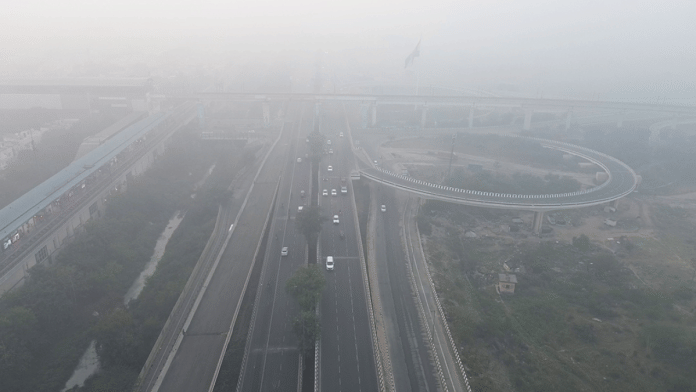



New Delhi: Even as the average AQI levels remained high in Delhi-NCR, extending the pollution season compared to previous years, the average load of pollutants in Delhi’s air has consistently reduced over the last decade. PM 2.5 and PM 10 levels recorded a year-on-year reduction, according to the city’s Economic Survey released on 23 March by Chief Minister Rekha Gupta.
The data shows that coarse pollutants—particulate matter with a diameter less than 10 micrometres (PM10) — in Delhi’s air were 295ug/m3 in 2015. It was 303ug/m3 in 2016, 277ug/m3 in 2017 and 277ug/m3 in 2018.
The levels came down further to around 221ug/m3 in 2021, 223ug/m3 in 2022 and 219ug/m3 in 2023.
Levels of fine particulate matter (PM 2.5) have also shown a notable difference.
In 2015, Delhi’s PM2.5 levels averaged at 133ug/m3. It touched 137ug/m3 in 2016, 130ug/m3 in 2017 and 128ug/m3 in 2018.
It is important to note that two of these years were aberrations. In 2016, Delhi experienced one of the worst pollution spells since pollution monitoring began in the city in 2010. Unique weather conditions, marked by extremely low wind speeds and intense fog, trapped air pollutants for days.
The pollution recording for 2020, however, was on the other end of the spectrum. Due to the Covid-19 lockdown, commercial activities were restricted for most of the year. This led to an out-of-the-ordinary, unsustainable reduction in pollution levels.
A data analysis by ThePrint shows that while PM2.5 and PM10 levels might have come down, the number of days with poor air quality in the national capital region has remained the same.
In 2015-16, Delhi had 69 “very poor” air quality days, with the air quality index (AQI) ranging between 200 and 300, from October to January. Ten years later, after the imposition of the Graded Response Action Plan (GRAP) and other pollution measures, there were 68 “very poor” air quality days.
According to the Central Pollution Control Board (CPCB) scale, a region’s air quality is categorised into six parts. When the AQI is between 0 and 50, it is considered “good”. It reads as “satisfactory” between 51 and 100, “moderate” between 101 and 200.
A reading between 201 and 300 is recorded as “poor,” and changes to “very poor” when between 301 and 400. An AQI between 401 and 500 is considered “severe”.
Also Read: Neither pollution nor Iran crisis—here’s what is causing Delhi’s mid-March haze
Action against pollution
The survey claims that the government took a slew of measures to reduce pollution in the region.
Apart from the implementation of a dedicated Air Pollution Control Plan in 2025, the government also set up a team of 100 “Vayu Rakshaks” or air guardians, along with the installation of CCTV cameras across the city to ensure continuous monitoring and check for violations.
“Government has taken several steps in the recent past to improve the environmental conditions, which include massive focus on afforestation, installation of Anti-Smog Gun at construction sites, deployment of mechanical road sweepers (MRS), water sprinklers (WS) and mist sprays at hotspots,” the survey read.
(Edited by Insha Jalil Waziri)