





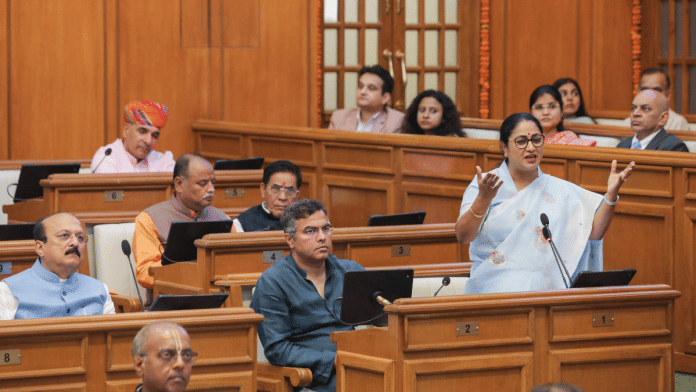



New Delhi: Delhi Chief Minister Rekha Gupta on 24 March announced that 21 per cent of the city’s budget for 2026-27 has been allocated as the “Green Budget”. From increasing the Environment and Forests sector budget to Rs 822 crore and allocating Rs 300 crore for pollution control schemes, to collaborating with the World Bank for advanced pollution monitoring systems, the Delhi Budget 2026-27 incorporated multiple measures in its first-ever Green Budget.
“This budget represents a commitment to making environmental responsibility a core element of our governance. Our green budget ensures every policy and decision is made keeping in mind the interests of the people and the planet,” said Gupta.
According to Gupta’s budget speech, the state government plans to allocate Rs 130 crore for forest development, Rs 44 crore for wildlife protection, and Rs 25 crore for the Delhi Parks and Gardens societies. The total outlay for the Green Budget is Rs 22,236 crore.
What is a Green Budget?
According to the OECD, Green Budgeting combines environmental and climate goals into fiscal planning, allowing governments to track, report, and assess the environmental impact of spending and revenue decisions.
The 2026-27 Green Budget also tackles problems relating to pollution and waste generation, specifically air pollution. Highlighting key aspects of the section, the Delhi government mentioned allocating Rs 2 crore to the Delhi Pollution Control Committee (DPCC) as financial support, for continuous monitoring, enforcement and implementation of pollution control measures in the city. This includes measures such as the real-time monitoring of pollution levels, emergency war room services, and mobile tracking of pollution through apps like SAMEER and OCMMS.
“The mountains of garbage in Delhi are not a problem that emerged overnight; they are a result of years of insufficient waste disposal. Our government has resolved to transform this situation,” the CM added while introducing the budget.
Gupta announced that the government plans to double Delhi’s current waste processing capacity from 7000 metric tonnes to 15,000 metric tonnes per day. For this, the budget announced the expansion of four waste-to-energy plants in Okhla, Narela, Ghazipur and Tekhand.
Additionally, the budget also announced a new measure related to “waste to wealth” that includes processing cow dung into energy.
“Approximately 1,500 tonnes of cow dung waste, generated daily in Delhi, will be processed and converted into energy,” said Gupta.
“This will lead to a reduction in emissions and fuel imports, and Delhi will emerge as a model of a circular economy.”
Other measures mentioned in the budget relating to the environment and climate sector include planning e-waste management, and advancing Delhi’s Carbon Credit Monetisation Scheme to allow for measurement, reporting and trading of carbon credits.
(Edited by Insha Jalil Waziri)