





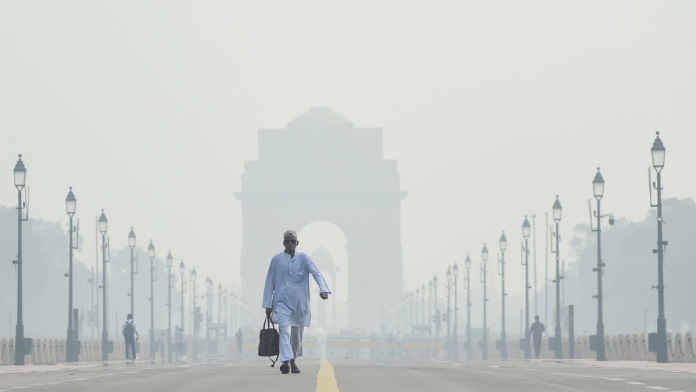



New Delhi: A dense haze has settled over parts of North India, including Delhi, Ghaziabad, Noida, and Meerut, leading to the air quality index rising sharply to 257 on the afternoon of 10 March, compared to 6 March when it was at 172. The temperature in Delhi rose to 34 degrees Celsius, and residents were greeted with a dusty outdoor atmosphere even during the day.
The India Meteorological Department (IMD) on Tuesday morning said that the haze was caused by a western disturbance (WD) system over the Himalayas, bringing in moisture and clouds from the Mediterranean to India.
Even as the IMD assured that the spike was due to normal fog conditions combined with calm winds, social media users questioned whether there was a connection between Delhi’s haze and the war in the Middle East. On Sunday, as US and Israeli airstrikes hit oil facilities in Tehran, the city was engulfed in a cloud of smoke. The meteorological impact of oil and gas being bombarded led to toxic, black rain falling in Iran on Monday, with the Iranian government warning citizens to remain indoors.
In the monsoon, these WDs are responsible for the majority of India’s rainfall. During the spring, however, these weather systems are met with calm winds at the boundary layer, causing them to settle as fog in the lower atmosphere.
“It is nothing unusual, as in the past too, in March, major dense fog spells in this region under similar favourable meteorological conditions have occurred,” said IMD scientist RK Jenamani in a statement to the media.
The sudden spike in the city’s air quality began over the weekend, when the AQI jumped from 172 on Friday to 246 on Saturday, plunging the city into “poor” air quality. Tuesday’s AQI reading marks the fourth straight day of “poor” air in the city.
Some organisations, such as the Pakistan Weather Portal (PWP), in a post on X, said that the same weather system that caused rainfall in Iran will move towards Turkmenistan and Pakistan in the coming days. However, other, anonymous accounts also said that a “toxic cloud of black rain” will move towards Asia, including China and India, causing people on X to question whether the sudden haze in the city was linked to this weather system.
Aside from the IMD, other independent meteorologists like SkyMet Weather also assured citizens that North India’s weather conditions were caused by a much more local and common phenomenon.
“We have seen news circulating that the fumes from Iran are reaching Delhi NCR and will increase pollutants — but we don’t foresee it happening,” said Mahesh Palawat, vice-president of Meteorology and Climate Change at SkyMet Weather, in a video posted on X.
“The winds need to be very strong for that smoke to reach Delhi, and currently the wind direction doesn’t support it. The impact will be negligible over northwest India,” he added.
Palawat attributed Delhi’s haze, like IMD, to the WD travelling from the Mediterranean. He also added that as these winds travelled over Balochistan, Central Pakistan and the Thar desert, they picked up loose dust on the way which reached Delhi.
Also Read: India wasn’t always like this. Things have never been as bad as they are today
March haze
This is not the first time that Delhi has been engulfed in dense fog or haze well after the winter pollution season. According to Jenamani, one of these fog episodes between 6 and 8 March in 2008, had triggered the failure of “critical power transmission lines across North India.”
In fact, this incident was documented and investigated by the Central Electricity Authority, which, in its report published in December 2008, pointed out how fog conditions and increased humidity led to multiple transmission lines tripping and causing power outages.
Fog essentially contains moisture, which collects on electricity transmitters. These transmitters already have dust, pollution and other material collected in them, and with the addition of moisture, they become slightly conductive and electricity from the power lines then starts leaking through them.
(Edited by Insha Jalil Waziri)