





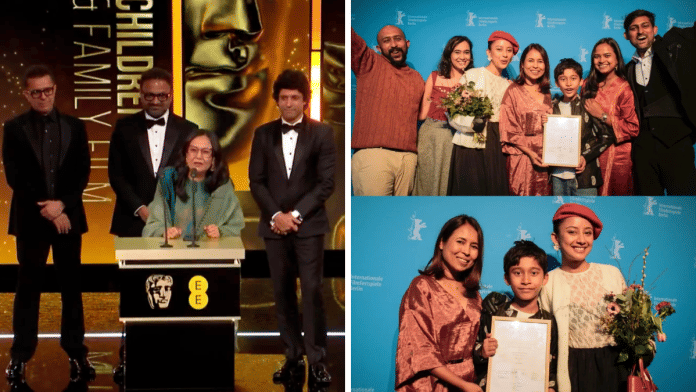



New Delhi: Two filmmakers from northeast India won landmark victories over the weekend. Lakshmipriya Devi’s debut Manipuri film Boong won a BAFTA for Best Children’s and Family Film, beating Hollywood giants like Disney’s Lilo & Stitch and Zootopia 2, making it the first Indian film ever to win in the category. A few hundred kilometres away, Assamese filmmaker Rima Das won the Crystal Bear Special Mention at the 2026 Berlin International Film Festival for her film Not A Hero.
The BAFTAs were held early Monday morning IST in London, while the Berlin International Film Festival was held on 21 February.
Devi started her acceptance speech with the greeting “Khurumjari”, which is Manipuri for “Hello”.
“I just want to use this opportunity to say that we pray for peace to return to Manipur. We pray that all the internally displaced children, including the child actors in the film, regain their joy, their innocence, and their dreams once again. So, thank you, BAFTA, for giving us not only an award, but this stage to express our hope,” said Devi.
Devi’s film portrays the life of a nine-year-old schoolboy who escapes racial shackles and ignores the border division in the state to reunite his family. The film was shot months before the conflict broke out in Manipur between the Kukis and Meiteis, and was produced by actor Farhan Akhtar and Ritesh Sidhwani’s Excel Entertainment.
“The BAFTA win for Boong and Das’s Berlin win shows that films from the northeast are on par with those in the world. These wins are a boost for upcoming filmmakers from the region because they can see that our stories, too, are as good as from anywhere else in the world,” Dominic Sangma, a filmmaker from Meghalaya, told ThePrint.
Also Read: Where is Northeast in Bollywood? India is finally growing an appetite
Making history
Devi’s Boong premiered at the 2024 Toronto International Film Festival (TIFF) with a limited theatrical release on 19 September 2025.
The film looks at racism, identity and the insider-outsider debate. It is a tribute to Devi’s home and Manipur, where she spent most of her childhood.
“Many of the things shown in the film happened to me during childhood. Adults often think kids are too young to understand certain things, but children have their own way of looking and comprehending things,” Devi had said in an earlier interview with ThePrint.
Devi’s BAFTA speech has been shared widely across social media. Filmmakers, actors to netizens have lauded her achievement.
“To hear that khurumjari uttered on an international platform. Every meitei and Manipuri speaker feels so proud and seen right now,” wrote a user on Instagram.
Another wrote, “Coming from a place so underrated, and unrepresented, at the backdrop of a conflict still ignored and sidelined by the government. So glad to have watched the screening in Imphal too!”
Das, on the other hand, is a veteran on the world stage — she not only directs her films but is also their cinematographer, editor and writer.
The Assamese film Not A Hero had its world premiere at Berlin’s Generation Kplus Competition, a category dedicated to stories about children and young adults. This is Das’s third film to get a screening at the Berlinale after Bulbul Can Sing (2018) and Village Rockstars 2 (2024).
The first edition of Village Rockstars by Das was also India’s official entry for the Academy Awards in 2018, along with being the first Assamese film to be nominated for the Oscars.
Das also won the National Film Award for Best Editor and Best Film for Village Rockstars.
“There is, however, my concern about why our films do not always find space in mainstream, while the rest of the world is able to connect with them,” said Sangma, whose Garo film Rapture (2023) was released across 33 French cities and 36 theatres worldwide in 2024. His previous film, Ma. Ama (2018) won the National Film Award for Best Feature Film in Garo at India’s 66th National Film Awards.
“But there is no doubt that the wins give hope that our stories, told from our own perspective, have their own place, and give hope that stories from one’s own land and language should be made. You don’t always need to go to Mumbai to make your film,” he added.
(Edited by Insha Jalil Waziri)