





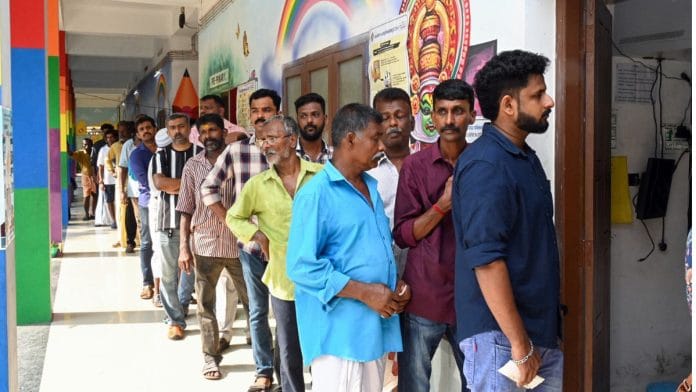



Bengaluru: Kerala witnessed a voter turnout of 78.03 percent Thursday—a more than four percentage point increase from the 73.9 percent turnout recorded in the 2021 assembly elections—according to the Election Commission of India’s (ECI) data, signalling the significance of the assembly elections this time around.
Not only has the BJP run one of its most “competitive campaigns” in Kerala this time, but the Left has also fought this election tooth and nail to retain power in the last remaining state under its control.
On reasons for the increase in voter turnout, Professor G. Gopa Kumar, former vice-chancellor of the Central University of Kerala (CUK) and political analyst, told ThePrint, “One is the improvement of the electoral rolls after SIR (Special Intensive Revision)… that has definitely improved the quality of voting, which has increased turnout. The second is the very clear determination, which we call anti-incumbency, which brought out more people to the booths.”
Professor Kumar said the third reason was the BJP’s competitive campaign, which mobilised large chunks of voters, potentially improving its own vote share by two to three percent.
He added: “The other two (the CPIM-led Left Democratic Front & the Congress-led United Democratic Front) are conventional coalitions, but this coalition (National Democratic Alliance) has never been tried… there’s a better appeal for the BJP than in the past.”
Kerala’s voter turnouts have historically not been examined keenly, as regime changes were the norm until 2021. The LDF and the UDF have contested as pre-poll alliances since the late 1970s, and although alliances existed before that, they differed from today’s coalitions. In the last assembly elections, the LDF, led by Chief Minister Pinarayi Vijayan, retained power, marking the first such victory in Kerala’s political history. After that, political parties and observers began considering voter turnout more seriously.
From 1967 to 2021, voter turnout was largely in the mid-70s. Exceptions occurred in 1960, when turnout was 85.72 percent, and in 1987, when it was 80.54 percent. However, the fluctuations in voter turnout have had little impact on change of guard until 2021.
This time may be different. “…the 2026 assembly elections will be the most important in the history of Keralam… The high turnout reflects that the people of Keralam and all Malayalees believe that too,” BJP Kerala President Rajeev Chandrasekhar wrote in an X post on 10 April.
What the numbers suggest
Against the run of play, the LDF retained power in Kerala in 2021, upsetting a trend that has sparked both hope and despair in opposition parties.
“In 2021, for the first time, a continuity was broken. But, in this election, the earlier trend is returning,” Gopa Kumar said, adding that a higher voter turnout could well signal a change in government, as reinforced by conventional political wisdom.
In 2016, voter turnout rose to 77.1 percent from 74.92 percent in the 2011 polls, leading to the ouster of the Oommen Chandy-led UDF and ushering in Vijayan as the Chief Minister.
In 2021, the LDF retained power, which observers attribute to its effective handling of the COVID-19 pandemic and the introduction of new economic reforms that eased private capital investment into the ‘Left-leaning’ state. This ‘Left-leaning’ perception holds true even when the UDF comes to power, as no party has attempted to shake Kerala’s core socialist ethos, which centers on inalienable labour rights and a welfarist approach.
This, perhaps, is one of the reasons why the southern state has been wary of ceding ground to the Prime Minister Narendra Modi-led Bharatiya Janata Party (BJP), which the wider population in Kerala associates—among other things—with pro-capitalist leanings that could threaten the state’s core socialist foundations.
But its higher vote share and effective mobilisation of support cannot be ignored anymore in Kerala, analysts say.
Since the late 1970s, Kerala’s political landscape has been defined largely by two ‘fronts’—a perpetual pre-poll alliance of like-minded parties who face the polls together.
This election, however, the BJP ran a reinvigorated campaign, especially after registering a historic wins in the Thiruvananthapuram Municipal Corporation—as well as a few wards spread across the state—in the December 2025 local body polls.
Earlier in the 2016 assembly election, the BJP contested 98 seats and secured 10.53 percent of the total vote share. This included veteran leader O. Rajagopal’s landmark win from Nemom.
Later in 2021, the BJP contested 115 seats and secured 11.3 percent of the total vote share but did not win a single seat. To put that into perspective, the Communist Party of India (CPI) secured just 7.58 percent of the total vote share. However, it logged 17 victories.
Political pundits predict that the BJP may win at least three seats in this election. Even if that does not happen, the party’s vote share, they say, will likely increase significantly—possibly approaching 20 percent.
Also Read: BJP vs CPI(M) in Nemom is litmus test for Rajeev Chandrasekhar. But Congress could decide outcome
Many parties, 2 main coalitions
The Communist Party of India-led (CPI) led the first elected Communist government in the 1957 Kerala assembly elections, which saw a voter turnout of 65.49 percent. This was followed by a record turnout of 85.72 percent in 1960, when the Congress-led alliance swept to power, winning 63 seats with a 34.42 percent vote share. In 1980, despite a lower turnout—72.23 percent—the LDF defeated the UDF in the state. In 1996, voter turnout was around 70 percent, marking the UDF’s return to power.
Overall, while voter turnout has fluctuated over the years, it does not show a consistent or predictable relationship with electoral outcomes in Kerala.
Political observers suggest this is due to the alliances’ dedicated support bases which remain steady despite political shifts.
Meanwhile, there have been some permanent fixtures in the LDF and UDF. For instance, despite various versions of the Left alliance, the Communist Party of India (Marxist) remains the dominant party. Similarly, permanent fixtures have existed in the challenging camp, such as the Congress’s leadership role in the UDF, and its firm partnership with the All India Muslim League (AIMUL).
Over the decades, the parties in the respective coalitions have changed their suffixes—mostly after internal rebellions—but have also retained or even increased their vote share. One such party is the Muslim League, which has a significant presence in northern districts, such as Malappuram, Kozhikode, Kannur, and Kasaragod.
‘Watershed moment’
J.V.C. Sreeram, a psephologist and political analyst, noted that a Congress-led UDF victory in this election would mean no Left-led government anywhere in the country since 1967. Conversely, if Chief Minister Pinarayi Vijayan-led LDF retained power for a third consecutive term, it would be equally historic.
“In whatever way you look at the landscape, on 4 May, if any of these things happen, it is going to be a watershed moment,” he told ThePrint.
Professor Kumar likened the 2026 Kerala assembly election to the 1967 “mid-term” poll when a historic seven-party coalition led by the CPI(M) and including the CPI and the Indian Union Muslim League was formed to challenge the Indian National Congress. However, he also noted that the nature of alliances then was more fluid than the structured fronts seen today.
Regarding the results, political observers are hedging their bets and even considering a possible hung verdict. Professor Kumar , however, said with conviction that a government will come into power on 4 May.
“Even if a hung assembly emerges, one or the other small LDF constituent may switch to the UDF or vice versa, because these alliances are not ideological. And therefore, even if a hung verdict comes, I can assure you that there will be a government,” he told ThePrint.
He said one certain factor was that the BJP would emerge as a significant stakeholder in Kerala’s politics. After chipping away at Hindu votes in several constituencies, the party campaigned on the ‘development mantra’ this time to bid for seats in areas such as Manjeshwar, Kasargod, Palakkad and Nemom, to name a few.
Sreeram said that even if the BJP won four to five seats, it could also be construed as a “watershed moment” for the state. All questions will be answered on 4 May.
(Edited by Madhurita Goswami)