








Kolkata/Delhi: Nearly 27 lakh people in West Bengal won’t be able to vote in this election after deletion of their names from the electoral rolls following adjudication by judicial officers.
Briefing reporters at a late-night press conference Monday, Manoj Kumar Agarwal, the West Bengal Chief Electoral Officer (CEO), while announcing that the voters’ list for the first phase would be frozen at midnight, said that nearly 45 percent of the 58 lakh cases disposed of by judicial officers till Monday evening would be struck off the voters’ list. This translates to approximately 27 lakh voters.
“Voters whose names have been deleted by judicial officials can approach the appellate tribunal. If their names are cleared by the tribunal, they will be included in the voters’ list and can cast their votes later, but not in this election,” he said.
Former chief election commissioners ThePrint spoke to said that this will be the first time such a huge number of individuals will be disenfranchised and denied their right to vote.
The total number of electors in West Bengal, as of February 28, when the final electoral roll was published following the Special Intensive Revision (SIR), stood at 7.04 crore. This is a decline of 8.09 percent from the 7.66 crore voters who were registered before the SIR exercise began in the state.
The ECI had published the final electoral roll for West Bengal on 28 February, according to which the names of 60 lakh individuals were deleted and another 60.06 lakh names—where there were “logical discrepancies” in the documents—were put under adjudication.
The Supreme Court (SC), which is hearing the West Bengal SIR matter, was informed by the Calcutta High Court Chief Justice Monday that judicial officers decided 59.15 lakh of the 60 lakh cases submitted for adjudication, as of 12.04 pm. The ECI also told the Supreme Court that just 26,000 objections were pending before judicial officers, as of Monday afternoon, and that they would be cleared by late that night.
19 appellate tribunals yet to start functioning
The harassment does not end here—individuals whose names are deleted from the electoral rolls have the right to challenge it before an appellate tribunal, but that presents another challenge: only six of the 19 appellate tribunals headed by retired judges have started functioning so far.
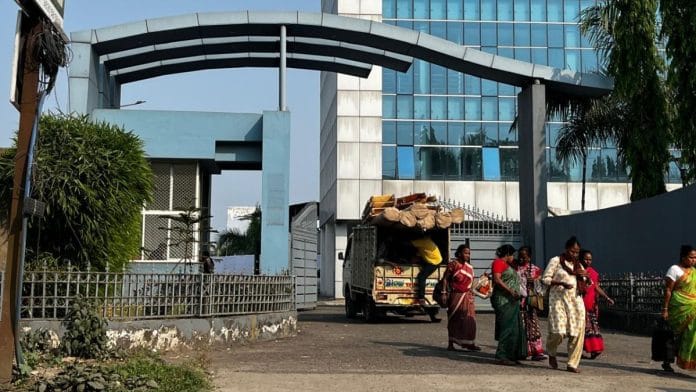
On Monday, when ThePrint visited the Syama Prasad Mookherjee–National Institute of Drinking Water and Sanitation building in Salt Lake—where the 19 appellate tribunals are to function—it found that work was underway to set up the tribunals’ offices. The guards at the gate said that the tribunals had not yet started functioning and that work was currently underway to set up the offices.
The appellate tribunals have so far heard five adjudication cases, including that of Mohtab Sheikh, the Congress contestant from Murshidabad’s Farakka Assembly seat, whose name was under adjudication. With nomination filing closing on Monday, the tribunal, after hearing the matter, directed that Sheikh’s name be restored in the electoral roll.
Earlier in the day, speaking to ThePrint, former CEC S.Y. Quraishi said that since the process of verification was not complete, the deficiency was administrative, not the fault of the voter. “They cannot be disallowed from voting. The Supreme Court should order that all those, whose cases are pending, should be allowed to vote in these elections, and the process of verification can go on after the elections,” Quraishi told ThePrint.
Ideally, he said, the appellate process should also be complete before electoral rolls were finalised for the upcoming elections. Until then, he said, finalisation of the list might not be valid because the voters had not been heard.
Former election commissioner Ashok Lavasa also said that the preparation of electoral rolls must be finalised by the date of filing of nominations. “Any process which does not ensure that the roll is full and final by that time, will leave people out… In this case, the process was initiated by the ECI, and with the intervention of the Supreme Court, the adjudication process was put in place. If that process does not ensure a decision is taken in all pending cases, obviously some people will be left out. If people are left out because the system cannot decide on the genuineness of their claims, then I think it is unfair to those people.”
He pointed to a scenario in which an appellate tribunal decided a case after polling concluded and upheld a voter’s claim. “Does it not mean that that person has been denied their constitutional right to vote because of an administrative process which was initiated by this election commission?” he asked.
“As the body responsible for conducting elections and preparation of electoral rolls, you decide to start a process for preparing electoral rolls. You should not have announced the elections if you’re not confident that the electoral rolls will be finalised. This is not how things have happened in the last 75 years,” Lavasa said earlier in the day.
(Edited by Madhurita Goswami)
Correct me if I’m wrong, but isn’t the building in Joka and not Salt Lake!?
Are people that unaware about the scale of illegal immigration in this country and especially in West Bengal and north east ? I mean do you know how bad it is in my city Navi Mumbai ?
Seriously anyone who opposes this is just being lazy or doesn’t understand the scope of the problem. This is a threat to democracy and I am glad it happened.