





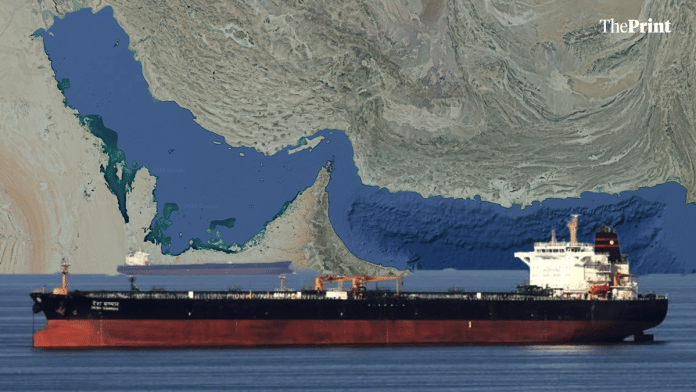



New Delhi: As tensions escalate between the United States (US) and Iran, concerns are mounting in New Delhi over the vulnerability of India’s crude oil supplies. Over half of its imports now pass through the strategic waters of the Strait of Hormuz—a sea passage between Oman and Iran that serves as a vital conduit connecting Gulf crude oil exporters to global markets.
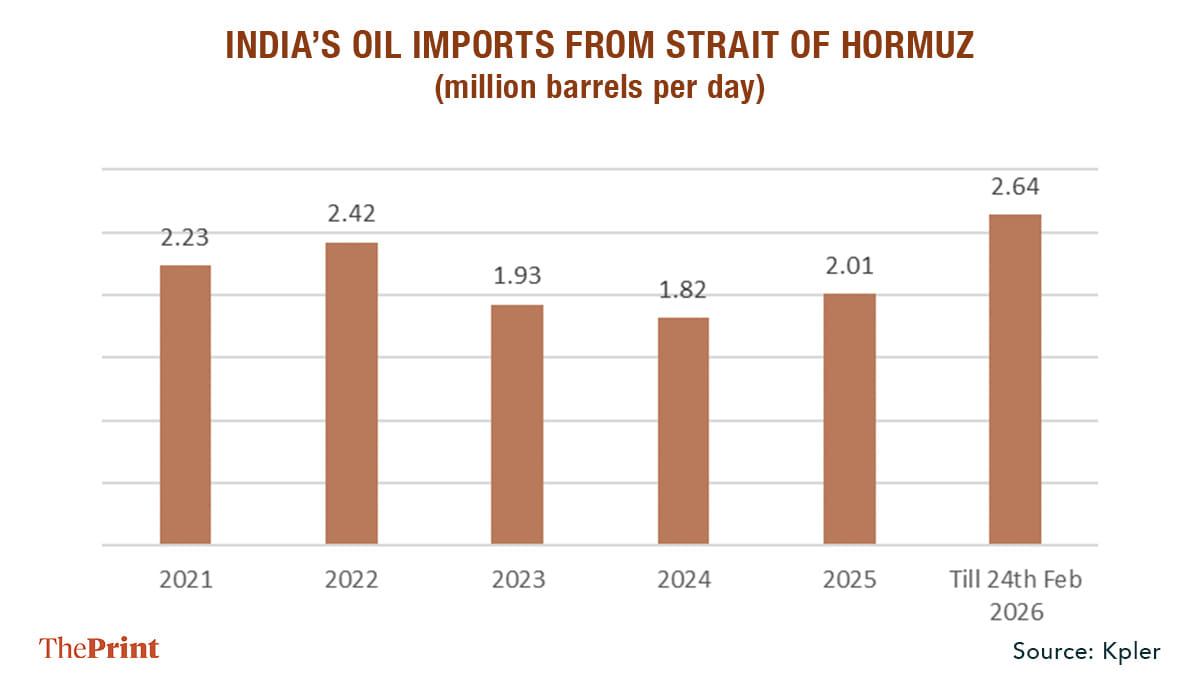
Data from commodity tracking firm Kpler show that India’s dependence on this chokepoint has surged to around 50 percent of its total crude imports and has been rising in recent months. So far this year, India imported nearly 2.6 million barrels per day (mbpd) from Gulf countries in 2026 till 24th February, underscoring the importance of Gulf supplies to India’s energy basket.
The crude flows in the Strait of Hormuz largely originate from Gulf producers—Saudi Arabia, Iraq, the United Arab Emirates, Kuwait, and Qatar—and move eastward to major Asian consumers like China, India, Japan and South Korea. These consumers together accounted for 69 percent of all crude oil and natural gas passing through the Strait of Hormuz in 2024, according to the United States-based Energy Information Administration (EIA), a government agency that collects and analyses energy-related information.
“Any disruption to the Strait would likely cause short-term supply tightness, higher freight and insurance costs, and upward pressure on crude prices, thereby impacting India’s import bill,” Sumit Ritolia, the lead analyst for refining and modelling at global trade intelligence firm Kpler, told ThePrint.
Supply risks & price pressures
Sectoral experts say that for India, which imports nearly 85-90 percent of its crude oil requirement, the implications of any disruption are significant. Even if physical supplies remain uninterrupted, a price spike driven by geopolitical risk could inflate the country’s import bill.
Prashant Vasisht, Senior Vice-President and co-group head (corporate ratings) at ICRA Limited, told ThePrint that globally, crude oil prices have already started rising in anticipation of a conflict. “Already, crude oil prices have gone up by about five to six dollars per barrel,” he added.
“If prices rise because of a perceived disruption or actual disruption, then it would have an impact on India’s import bill, even if we start sourcing crude oil from somewhere else,” said Vasisht.
Rajesh Verma, deputy director for tanker shipping at Drewry Maritime Research, a leading consultant to the maritime and shipping industry, told ThePrint that any disruption in crude oil supply from the Arabian Gulf is impossible to replace by any other source of supply, as it accounts for 18 to 20 percent of global oil supply.
“If the passage is blocked, an oil shortage will affect not only India but also the rest of the world, including China. Any such disruption would significantly tighten global crude supply, sending oil prices soaring to record highs,” Verma said.
According to Prerna Prabhakar, a Fellow at the Centre for Social and Economic Progress (CSEP), a policy think tank, India has diversified its oil supply in recent years. However, the greater concern is not supply but price volatility.
“Higher oil prices also carry clear inflationary implications for the domestic economy, particularly through fuel, transport, and logistics costs,” she said.
On the other hand, India’s ability to rely on alternative suppliers, such as Russia, may be limited. Imports from Russia have declined in early 2026 due to tightened US sanctions. Meanwhile, purchases from Gulf nations—particularly Saudi Arabia and Iraq—have surged to multi-year highs. This shift is precisely why India’s reliance on the Strait of Hormuz has been critical in recent months.
According to Verma, India can rely on its strategic oil reserves in the event of a long disruption in the Strait of Hormuz. However, given the importance of the passage, he believes that the US-Iran crisis would be “resolved within days, if not weeks.”
Strategic reserves are emergency stockpiles of crude oil maintained by governments to ensure national security and supply continuity during crises. India’s current reserves can cover approximately 9-15 days of import requirements, providing a crucial buffer for short-term disruptions.
Ritolia argues that long-term closure of the strait would also have economic repercussions for Iran. “The probability of a sustained closure of the Strait remains low, as Gulf producers—including Iran—are heavily dependent on uninterrupted export revenues. Iran itself relies substantially on crude sales to China, making prolonged self-disruption economically counterproductive,” he said.
Why the Strait matters
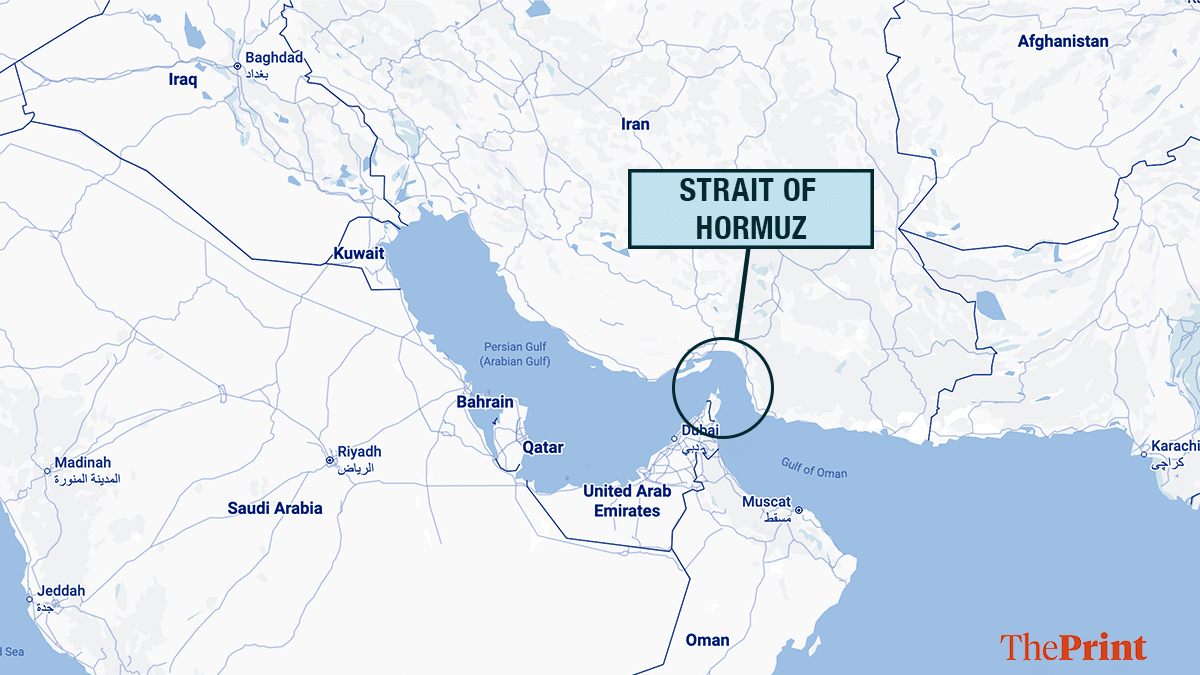
The Strait of Hormuz, located between Oman and Iran, serves as a vital conduit connecting crude oil exporters in the Middle East Gulf to global markets. Deep and wide enough to accommodate the world’s largest crude carriers, it is considered one of the most critical oil choke points globally.
Globally, one-quarter of seaborne oil trade and about one-fifth of total oil and petroleum product consumption flows through the strait. In the first quarter of 2025 alone, nearly 20.1 million barrels per day of crude oil and petroleum products transited these waters, according to the EIA.
Over the years, Saudi Arabia and the UAE have created infrastructure that bypasses the Strait of Hormuz. Saudi Aramco operates the 5 mbpd East-West crude oil pipeline, which runs from the Abqaiq oil processing centre to the Yanbu port on the Red Sea.
The UAE also uses a 1.8 mbpd pipeline linking onshore oil fields to the Fujairah export terminal in the Gulf of Oman, providing limited alternative routes in case of disruption.
Hence, due to limited alternative export routes, any disruption—even temporary—can have cascading consequences. When oil cannot transit a major choke point, it can create substantial supply delays, raising shipping and insurance costs and potentially increasing global energy prices.
(Edited by Madhurita Goswami)