





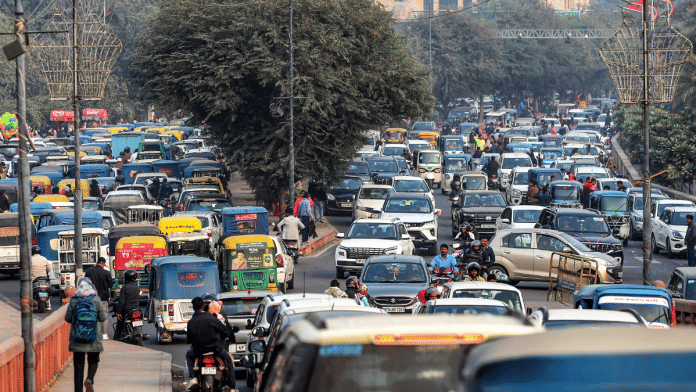



New Delhi: India’s metropolitan regions have some of the world’s largest urban populations yet the size has not translated into global economic influence, high productivity, or better living conditions, according to Economic Survey 2025-26.
The Survey, tabled in Parliament on Thursday by Finance Minister Nirmala Sitharaman, notes that investment in urban infrastructure—across transport, housing, water, sanitation and governance capacity—has lagged behind India’s economic growth.
According to the Survey, across developed and emerging economies, a few major cities drive global manufacturing, finance, logistics and innovation. Despite India’s growing economic size, its cities are yet to play this role at the scale or efficiency of global hubs like New York, London, Shanghai or Singapore.
“India’s urban population has expanded rapidly in absolute terms, with large metropolitan regions such as Mumbai, Delhi, Bengaluru, Chennai, and Hyderabad now ranking among the world’s largest urban agglomerations by population,” the Survey said. “However, population scale has not translated proportionately into urban productivity, liveability, or global economic influence.”
The Survey outlines that cities drive economic growth only when workers, infrastructure and institutions work efficiently together.
“International evidence suggests that urbanisation delivers growth dividends when cities are able to internalise agglomeration economies through efficient labour markets, infrastructure networks, and institutional coordination,” the report states.
Also Read: India’s GST boost to car sales has worsened congestion. Tax private vehicle use
Land as ‘dead capital’
The Economic Survey says that in many Indian cities, land has become “dead capital”, an asset that cannot be fully utilised because of legal, regulatory and market bottlenecks.
“In many of our cities, land has effectively become dead capital due to a combination of restrictive land-use regulations, title insecurity, and fragmented markets, as well as speculative incentives that lead to low land recycling,” the Survey states.
One major reason is restrictive land-use rules, the Survey says.
Development Control Regulations (DCR), such as low floor space index (FSI) or floor area ratio (FAR), limit how much can be built on a given plot of land. These caps prevent vertical growth and push cities to expand outward instead of upward. As a result, land in central areas becomes artificially scarce and expensive, says the Survey.
Compared to global cities like New York and Hong Kong, India’s cities have relatively lower FSI, with exceptions for denser areas such as central business districts. When the FSI is low, settlements are incentivised to expand horizontally, thereby driving up average land cost. This limits housing supply and raises prices relative to incomes, notes the Survey.
Traffic congestion
The Survey describes mobility as the city’s bloodstream—when it fails, congestion, pollution and loss of productivity follow.
Traffic congestion already imposes heavy economic costs, says the Survey. The Economic Survey quotes studies that show that workers in cities like Delhi and Bengaluru lose thousands of rupees each year due to time lost in traffic.
Bengaluru alone lost over 7 lakh productive hours in 2018 because of congestion, according to the Institute for Social and Economic Change.
The underlying problem, the Survey notes, is not excessive movement—but excessive dependence on private vehicles. “The vital signs of our cities are poor because roads are used more as storage for vehicles rather than corridors for people,” the survey states.
It adds, “Streets become congested not because citizens are moving excessively, but because cars carry too few passengers.”
According to the survey, the solution is straightforward in principle – design cities to prioritise the movement of people, not vehicles. This means high-capacity public transport as the backbone, safe walking and cycling options, reliable last-mile connectivity, and demand-based parking. When these systems work, private vehicles become a choice rather than a necessity, says the Survey.
Progress in sanitation
India’s urban sanitation landscape has seen clear improvements over the past decade, led by large-scale central initiatives such as the Swachh Bharat Mission–Urban and Atal Mission for Rejuvenation and Urban Transformation, says the Survey.
“These measures have yielded visible gains in sanitation outcomes, with the most notable being the elimination of open defecation across all cities,” the Survey states.
Under Swachh Bharat Mission–Urban 2.0, waste collection has expanded rapidly, with door-to-door collection now covering 98 per cent of wards by 2025-26, supported by a fleet of over 2.5 lakh waste collection vehicles nationwide.
However, the survey flags gaps in sanitation outcomes, noting that progress beyond basic cleanliness remains uneven. While collection systems have scaled up, many cities lag on segregation at source, efficient processing and restoration of legacy dumpsites.
Under the Garbage-Free City framework, cities are graded from 1-star to 7-star based on performance across these indicators. The findings reveal that although collection coverage has improved sharply, advances in segregation, processing and remediation have been slower, indicating that the challenge now lies in local capacity, enforcement and citizen behaviour rather than access to services.
(Edited by Ajeet Tiwari)
Also Read: Bengaluru and its inspired incompetence in running things