





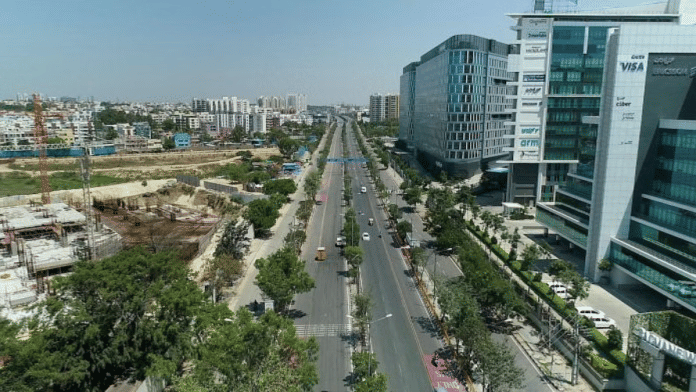



Bengaluru: As the state grapples with tightening finances, the Bengaluru Development Authority (BDA) plans to auction hundreds of plots in the Karnataka capital to raise about Rs 4,000 crore.
The auction, part of a drive to monetise assets, comes as the Congress government in Karnataka seeks to offset the financial strain of its five flagship guarantee schemes, which have consumed over Rs 1.06 lakh crore since May 2023.
“All the lands on auction are in the core area of Bengaluru. Some are bulk sites and some are smaller dimensions. But in all, we can expect around Rs 4,000 crore this time,” a BDA official said Tuesday.
The government agency, which plans, regulates and facilitates urban development in India’s IT capital, is among several state entities being leveraged for fund mobilisation before Chief Minister Siddaramaiah presents a record 17th budget in the state Assembly next May. The CM holds the state’s finance portfolio.
Also Read: Karnataka’s welfare paradox? As scheme payouts rose, rural workforce shrunk
Revenue squeeze
The state’s fiscal challenges stem from multiple pressures, including reduced capital inflows from the central government in the form of GST compensation and a declining share in the devolution pool. A mid-year GST rate rationalisation has further constrained revenues.
“The increase in committed expenditure, including the state’s spending on guarantees and various welfare schemes, has increased the revenue expenditure. Simultaneously, the shortfall in revenue receipts on account of GST rate rationalisation has further constrained the state’s fiscal position. These factors have collectively increased the revenue deficit during the current financial year,” the government’s Mid-Year Review of State Finances 2025-26 said.
The five guarantees – which were poll promises made by Congress before the Karnataka Assembly elections – include free bus travel for women, cash transfers to women household heads, subsidised electricity, free rice, and a youth unemployment allowance scheme.
Basavaraj Rayareddi, senior Congress leader and the chief minister’s economic adviser, told ThePrint that the timing of GST changes had disrupted planning. “There was a mid-year rationalisation of GST. Unfortunately, it was done in September or mid-way through the financial year. Whatever we had planned and expected will come down significantly and will impact our projects and programmes,” he said.
GST rationalisation, announced by the Centre this September, refers to changes that simplified the tax structure on goods and services from four slabs to two. It led to a reduction in taxes for several goods and services, in a move meant to help consumers and businesses. But the reforms also translate to lower taxation income for the governments.
Rising debt
Karnataka’s total debt is set to jump by nearly Rs 80,000 crore—an 11.6% increase—with it total liabilities expected to rise from Rs 6,85,101 crore in 2024-25 (revised estimates) to ₹7,64,655 crore in 2025-26 (budget estimates), according to the mid-year review.
The state has budgeted a fiscal deficit—the gap between total spending and earnings—of 2.95% of its gross state domestic product (GSDP) for 2025-26.
Against budgeted estimate of Rs 90,428 crore, the fiscal deficit up to September 2025 stood at Rs 17,384 crore, indicating that roughly 19% of the annual deficit target was reached in the first six months.
On revenue deficit—which measures whether routine expenses exceed routine income—the figures show a marginal surplus of negative 0.2 percent of GSDP between April-September, while the full-year budget estimate indicates an increase of 0.63%.
The fiscal deficit in the half-year period shows an increase of 0.60%, expected to reach 2.95% for the full fiscal.
Primary deficit—fiscal deficit minus interest payments—is down 0.04% in the first half and expected to improve to 1.46% by the fiscal end.
Despite the pressures, Karnataka remains among the few states that have maintained a good fiscal track record and not breached the fiscal responsibility act. However, the sharp decline in capital inflows has forced the state to resort to higher borrowings, with the slower-than-expected deficit growth in the first half suggesting heavier spending pressures in the remaining months of the fiscal year.
Multiple measures
Beyond land auctions, the government is pursuing several revenue-generating measures, including auctioning unused liquor licences, expected to fetch around Rs 1,000 crore, and increasing prices of various commodities and services. Other steps include developing and selling land around Bengaluru, and extending operating hours for bars and hotels.
In March, the Siddaramaiah-led government estimated revenue deficit at Rs 19,262 crore but still allocated Rs 51,034 crore for the five guarantee schemes for the 2025-26 fiscal. His budget estimated total expenditure of Rs 4.09 lakh crore, comprising revenue expenditure of Rs 3.11 lakh crore, capital expenditure of Rs 71,336 crore and loan repayment of Rs 26,474 crore.
However, the budget outlay itself may see a decline this year. “We presented a Rs 4.09 lakh crore budget (in March). And if there is a shortfall of around Rs 12,000-Rs 15,000 crore, we will stand at Rs 3.95 lakh crore. There may be some fluctuations but we will get a clear picture of where we stand only by the end of December,” Rayareddi said.
The fiscal stress also comes amid political challenges within the state government, including a leadership tussle between Siddaramaiah and his deputy D.K. Shivakumar, and dissent within Congress ranks over lack of constituency-level funds.