





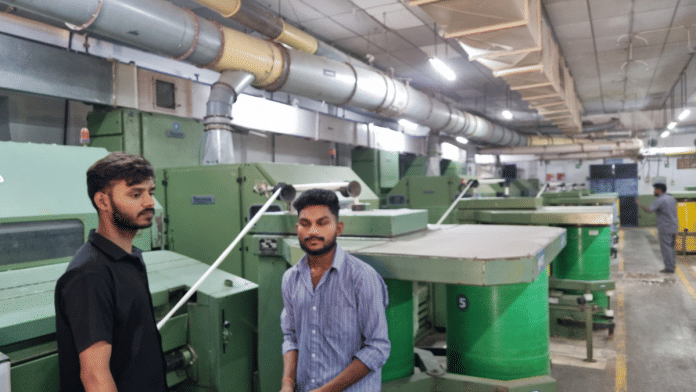



Coimbatore: In the sprawling textile hubs of Coimbatore and Tiruppur—often referred to as India’s Manchester—the hum of machines continues, but the workforce behind them is visibly sparser. Dormitories are half-empty, shop floors are short-staffed, and production lines are beginning to feel the strain.
More than three lakh migrant workers employed in spinning and textile mills across the region have not returned after travelling to their home states for Holi and Ramanavami. They have chosen to stay back in Bihar, Uttar Pradesh, Jharkhand, Odisha, and Assam, driven by rising living costs, uncertainty, and a lingering fear of being stranded in a possible lockdown—echoing the disruptions of the Covid pandemic.
Workers and mill owners told ThePrint that a severe shortage of LPG, along with a sharp rise in the prices of daily essentials, has made returning to Tamil Nadu a difficult decision.
The anxiety of the migrant workers has been compounded by Prime Minister Narendra Modi’s statement on 23 March, urging the nation to remain united, alert, and prepared to face the economic consequences of the West Asia war, much like it did during the pandemic. Dozens of workers who chose to stay and keep their jobs at the textile mills quietly acknowledged their fellow workers’ worries.
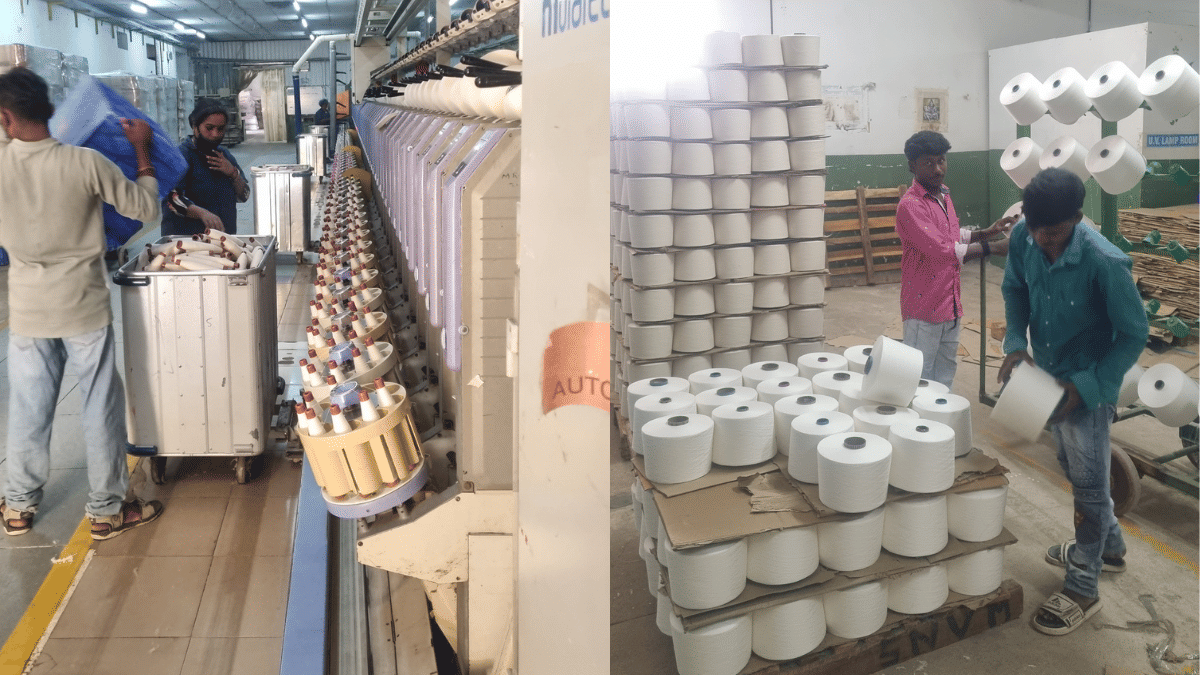
Deepika Amirapu | ThePrint
Ashwin Chandran, Chairman and Managing Director, Precot Limited, told ThePrint: “Yes, we are facing the indirect consequences of the West Asia conflict and the shortage of LPG. The reference to a Covid-like scenario, again during the summer, has caused panic. Most of our workers have not even cleared their matriculation, so for them to grasp the intensity of the crisis and read it correctly would be an unfair expectation.”
More than 600 big and small textile firms in the Coimbatore-Tiruppur textile belt employ nearly 12 lakh migrant workers in different capacities. Across the ten western districts of Tamil Nadu, almost 60 lakh blue collar (90 per cent) and white collar workers depend on the textile industry for their livelihood. Now, they are all worried.
Also read: West Asia conflict: Centre allows kerosene supply to ‘kerosene-free’ states, LPG supply ramped up
Price rise and panic
Workers at K. G. Naidu Mills and Kannabiran Mills on the outskirts of Coimbatore shared their concerns with ThePrint.
“Many of us and our counterparts in other mills in Coimbatore, Tiruppur, Somanur, and Palladam live in hostels and makeshift residences for eight to nine months in a year. We are not eligible for a local ration card and so have to depend on commercial gas cylinders. A cylinder in the black market today costs Rs 2,500 and it is a huge sacrifice to spend three days’ wages on a cylinder,” said Sri Bacchalal, who belongs to Chitrakoot in UP. Bacchalal works in the segregation unit of K. G. Naidu Mills.
Rakibul Isab from Assam, a twenty-something worker, shared how a cup of tea now costs Rs 15 as compared to Rs 8 before the LPG crisis. “All the regular pushcarts where we used to eat our meals earlier are closed and we cannot afford food at restaurants. I have restricted myself to eating a plate of chicken or mutton biryani just once a week because I will not be able to send adequate money home. On other days, I eat at the canteen in the mill,” he said. The K. G. Naidu and Kannapiran factories have hostels for migrant workers and have now allowed workers’ families to eat at the company-run canteens.
O. Rambabu, HR head of K. G. Mills, said their firm has been reassuring workers about their welfare. “From providing all meals at the canteen to workers and their families, to meeting travel expenses of workers, we have stayed in touch with them.”
But migrants such as Sundar Ram from Purnia in Bihar feel staying put in their village for a few months would do no harm. At least that’s what he has advised three of his brothers who are yet to return to their jobs at Eashwara Mills closer to Palladam.
“We are used to cooking over firewood and we have not discarded our kerosene stoves yet. My brothers and I have been working at Eashwara for nearly six years now and we can meet our expenses if we are frugal in our spending,” he said. Sundar Ram who started with Rs 470 a day in 2020, now earns about Rs 780 per day and has risen the ranks at his mill.
The fear of a lockdown and the LPG shortage has particularly affected the nearly 50 per cent female workforce at the mills, with many private hostels having shut down temporarily. Though the mills have prioritised worker safety and welfare, the dread of Covid continues to cloud their thinking, the women workers confided.
Preeti Sahoo and Samita Patra from Koraput district in Odisha have changed hostels twice in the last 20 days after the owner of their regular hostel decided to shut her 30-bed hostel because of poor revenues. With more than 20 girls yet to return from different parts of India, the hostel owner found the cost of operations prohibitive.
For Preeti and Samita, a hostel without a mess facility was no good. “We returned around 22 March and found our hostel nearly empty. While our owner allowed us to stay until we found a new place, the mess was already wound up,” Preeti said.
Dr K. Selvaraju, Secretary General of the Southern India Mills Association (SIMA), said the industry is doing its best to ensure workers feel safe. “They are paid overtime charges for extra work during shifts to make up for the shortage of workers. We have also assured them of employment and reached out to their counterparts in different states guaranteeing fair pay and good working conditions when they choose to return.”
SIMA was established in 1933 and is one of the oldest textile associations in the country representing more than 2,000 mills across southern India. Together with the Tamil Nadu Spinning Mills Association (TASMA), SIMA officials are holding weekly meetings with the Textile and Common Labour Union (TTCU) and the Handloom Weavers’ Cooperative Societies (HWCS) in Tamil Nadu, officials told ThePrint.
Sources said that the Tamil Nadu industries secretary and the TN government have apprised the cabinet secretary in New Delhi on the textile workers’ situation, given that further panic could jeopardise more than 60 lakh jobs.
Impact on the textile industry
But despite assurances and efforts of mill associations and owners, many migrants are waiting and watching from their villages. Durai Palaniswamy, executive director of the Pallava Group, a major textile producer since 1977, says they have seen a 10 per cent drop in productivity this year.
“Worker attrition is very high since many of them are yet to return. Some of us who run large textile mills in this region are yet to fully gauge the impact of the absenteeism. We are trying to manage the situation, but we are preparing for a (further) fall in productivity and margins,” Palaniswamy said.
Larger textile mills have cotton stocks to last them two-three months, but smaller mills that supply yarn to textile factories are most affected by the labour and working capital shortage.
“If the war continues for a few more weeks, the Centre will need to intervene and ask banks to help the smaller mills with working capital. We have already conveyed to the banks that the mills are open to paying additional interest for loans if an overdraft facility is allowed to keep the mills functioning,” Dr Selvaraju said.
Tamil Nadu is India’s top textile-producing state, accounting for over 41 per cent of the country’s textile exports. As of FY 2025, TN textile department data pegged exports from the state at Rs 70,855 crore. While exports to the US account for the largest share, the European Union and the Middle East also account for a sizable share of TN’s exports. With TN accounting for 46 per cent of India’s spinning capacity with 1,861 mills, specialising in cotton, man-made fibre, and apparel from key clusters like Tiruppur, Coimbatore, Salem, and Erode, the state’s textile industry is a key economic pillar.
(Edited by Viny Mishra)