





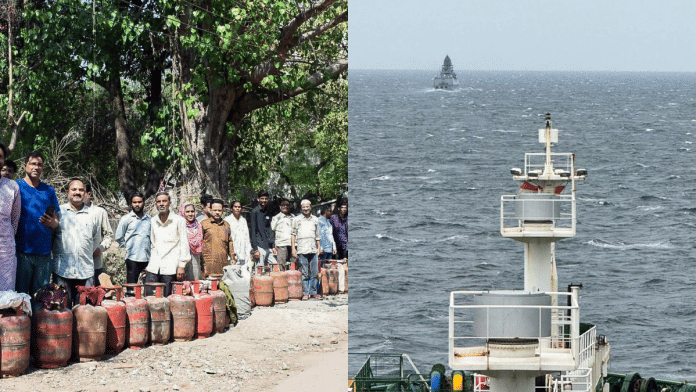



New Delhi: In a major push to expand piped natural gas (PNG) adoption amid energy supply crunch caused by the war in West Asia, the Centre issued a sweeping gazette notification Tuesday night to streamline permissions, reduce bottlenecks, and nudge households in areas with pipeline connectivity to shift away from liquefied petroleum gas (LPG).
The notification—Natural Gas and Petroleum Products Distribution (through laying, building, operation and expansion of pipelines and other facilities) Order 2026—comes into effect from 24 March. It has been issued under the Essential Commodities Act, 1955, with the government citing public interest and long-term energy security as key objectives.
At an inter-ministerial press briefing Wednesday, Sujata Sharma, joint secretary at the Ministry of Petroleum and Natural Gas, said, “To promote PNG connections, the Government of India issued another gazette notification yesterday. Its main objective is to streamline application fees and approval timelines related to PNG connections across all states.”
The order applies to all entities—public and private—that control access to land, including roads, housing societies, and other infrastructure corridors. These stakeholders are now legally bound to facilitate the laying of pipelines.
One of the most significant provisions is the introduction of strict timelines for approvals. Public authorities must process applications within a fixed period, failing which approvals will be granted automatically. The notification states that if any public entity “fails to grant permission within the specified period, the permission shall be deemed to have been granted.”
In residential areas, where projects often face resistance from housing societies, the rules are even stricter. Permissions for laying pipelines must be granted within three working days, while “last mile connectivity for a domestic PNG consumer shall be granted within forty-eight hours”.
With 60 lakh consumers located near PNG networks, Sharma said the move is aimed at accelerating a slow transition.
“In the last 25 days, about 2.5 lakh new PNG connections have been provided. Additionally, around 2.2 lakh consumers have shifted from LPG to PNG. Apart from this, about 2.5 lakh new applications or registrations have also been received,” Sharma said.
She added, “Through this gazette notification, the government has tried to reinforce it and all the CGD (city gas distribution) entities would give a written notice to all consumers in the vicinity of PNG and consumers will be given a period of three months from the notice to shift from LPG.”
She added that India’s import dependence for energy is a key factor behind the push. “The important point is that our import dependency for LPG is much higher than the import dependency for PNG and LNG. We produce 50 percent domestically as far as PNG is concerned, so it is in the national interest that we shift from LPG to PNG.”
PNG is supplied by regasification of liquefied natural gas (LNG) and distributing it through pipelines to households and industries.
Responding to reports of long queues at fuel stations, Sharma reassured the public that there is no shortage of fuel in the country.
“In the past two days, we have seen queues outside retail outlets and petrol pumps in several areas, and panic buying has also been observed. I want to assure the citizens that there is no shortage at any petrol pump,” she said, noting that India has an annual refining capacity of about 26 crore tonnes of crude oil.
The briefing also covered developments in West Asia. Ministry of External Affairs spokesperson Randhir Jaiswal said Prime Minister Narendra Modi spoke with US President Donald Trump.
“The two leaders had a useful exchange of views on the evolving situation in West Asia. The prime minister underlined the importance of ensuring that the Strait of Hormuz remains open, secure and accessible, and also conveyed that it is vital for global peace, stability and economic well-being,” Jaiswal said.
Separately, Rajesh Kumar Sinha, special secretary at the Ministry of Ports, Shipping and Waterways, said there has been no new movement of the remaining 20 Indian-flagged vessels in the Strait of Hormuz. He added that 540 seafarers on board are safe and healthy.
(Edited by Ajeet Tiwari)
Also Read: Amid supply crunch, govt offers 10% additional commercial LPG to states. But there’s a condition