





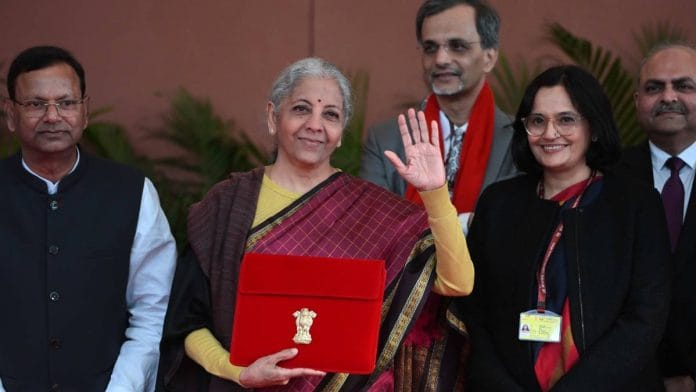



New Delhi: Union Finance Minister Nirmala Sitharaman, in her Budget speech on 1 February, proposed an outlay of Rs 20,000 crore over the next five years in Carbon Capture Utilisation and Storage technologies.
“Aligning with the roadmap launched in December 2025, CCUS technologies at scale will achieve higher readiness levels in end-use applications across five industrial sectors, including power, steel, cement, refineries and chemicals,” said Sitharaman.
The CCUS is a way to reduce carbon dioxide emissions in the atmosphere. As a climate mitigation technology, it has been under scrutiny for its effectiveness in reducing industrial emissions and its potential to achieve zero emissions in the future.
Some experts have in the past questioned the technology for “over-promising and under-delivering”.
“Two key concerns around scaling up CCUS technology are — slow adoption of CCUS technology, and a fear that using CCUS will perpetuate the use of fossil fuels and continue negative health and social impacts of emitting facilities,” a 2025 report by the World Resources Institute (WRI) read.
Also Read: Union Budget 2026-27: What it really says about India’s economy
What is CCUS?
CCUS is a way to reduce carbon dioxide from emission sources such as industries and power plants, using a mix of technologies. This is done by first capturing carbon dioxide, and then either reusing or storing it so that it does not enter the atmosphere.
“It is either permanently stored underground or incorporated into certain types of products, such as concrete or chemicals,” the WRI report read.
According to a recent report by the Global Carbon Capture and Storage Institute, an international think-tank, there are about 50 operational CCUS projects worldwide, with about 44 under construction and more than 500 in the planning stage.
The projects currently operational are estimated to capture around 50 million metric tonnes of carbon dioxide each year.
Also Read: What are the 4 telescope sites FM Nirmala Sitharaman mentioned in Budget speech?
India’s work on CCUS
India has also been investing heavily in CCUS research and technology.
In November 2022, the NITI Aayog released a document, ‘CCUS Policy Framework and its Deployment Mechanism in India’, to decarbonise “hard to abate sections such as thermal power plants, iron and steel, and cement industries”.
“CCUS is key to ensuring sustainable development and growth in India, particularly for the production of clean products and energy, leading to an Aatmanirbhar Indian economy,” the report read.
The majority of Indian industry representatives have welcomed the government’s announcement.
Manish Dabkara, chairman, managing director, and CEO of EKI Energy Services Ltd, and president of Carbon Markets Association of India, told ThePrint that a dedicated Rs 20,000 crore outlay for CCUS technologies connected decarbonisation with mainstream industry strategy — crucial for sectors where electrification alone cannot cut emissions.
“For carbon markets and climate finance ecosystems, this Budget underscores that sustainability and growth must go hand-in-hand, with policy clarity driving private capital and implementation readiness,” Dabkara said.
(Edited by Insha Jalil Waziri)