





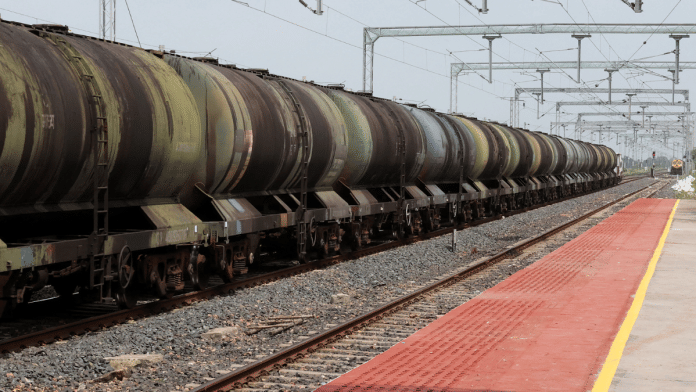



New Delhi: A 30-day “waiver” by the United States allowing Indian refiners to buy Russian oil could result in an uptick in imports from Moscow, after a decline in recent months triggered by sanctions, payment challenges and shipping constraints.
The flexibility, according to market analysts, could result in crude imports from Russia potentially touching 2 million barrels per day (mbpd) or higher, if refiners move quickly to secure cargoes, particularly as Chinese buyers are also competing for similar barrels.
This is a temporary waiver but a look at India’s crude imports data since 2024 shows that notwithstanding the ups and downs in the Indo-US relationship, Russian oil has by and large reshaped the country’s import basket over the past two years.
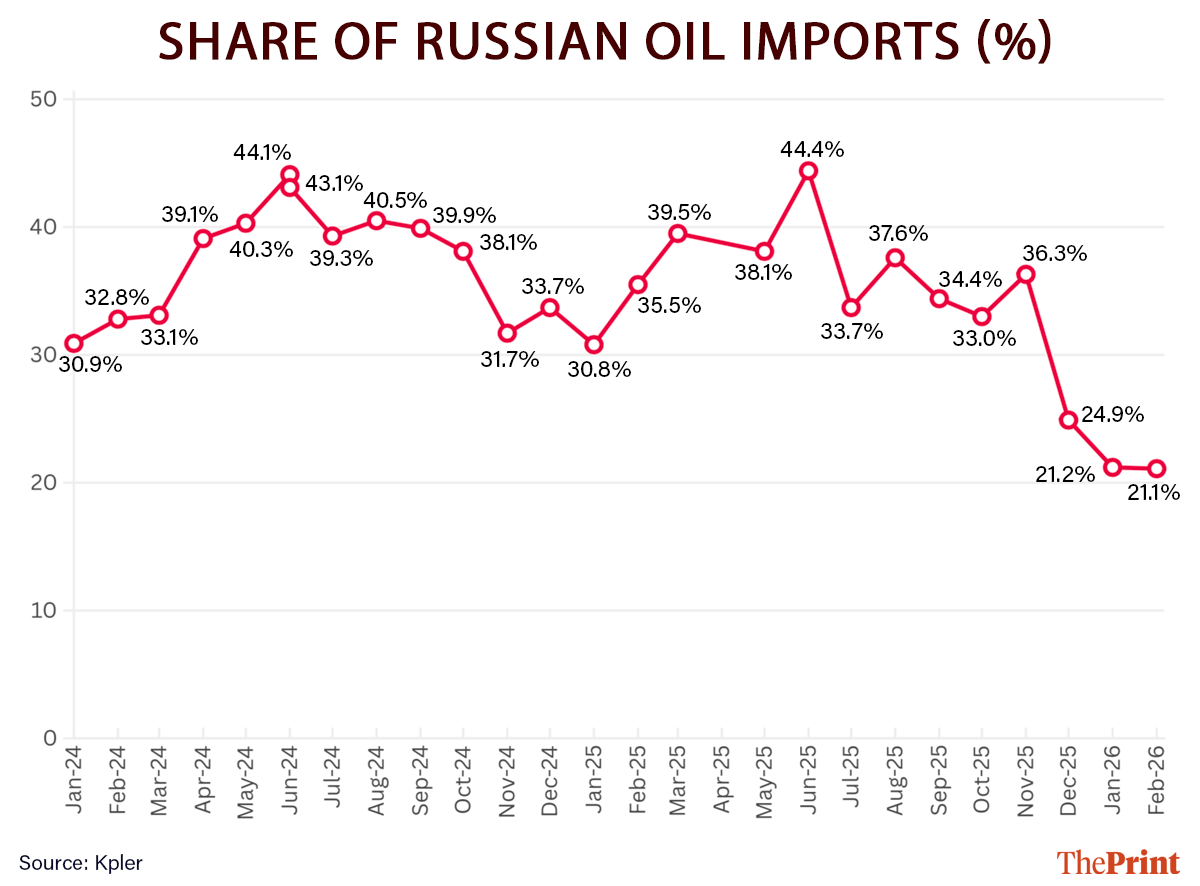
Data from trade intelligence firm Kpler shows that between June and July 2024 India imported more than 2 mbpd of Russian barrels, accounting for around 43–44 percent of India’s total crude imports, reflecting an increase in purchases made by refiners seeking to capitalise on discounted supplies.
Kpler data shows that Russian crude has consistently accounted for around one third of India’s total imports since January 2024.
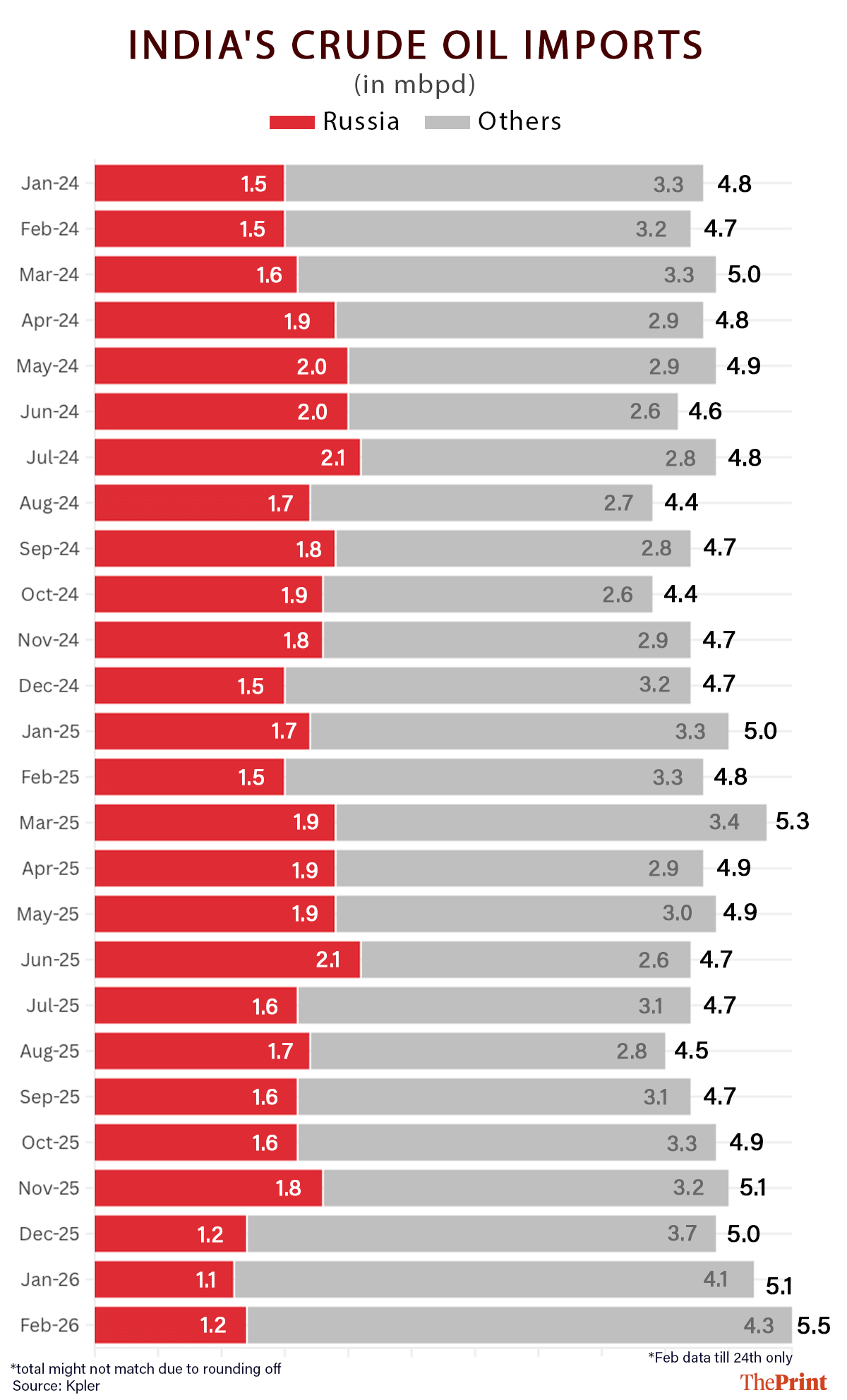
This trend continued in 2025, with Russian oil imports averaging around 1.7 mbpd, allowing Indian refiners to maintain strong margins and diversify away from suppliers in the Middle-East and Americas.
“Russian crude has remained India’s largest source of imports through January and February 2026, a position it has largely held since 2023,” Sumit Ritolia, lead research analyst for refining and modelling at Kpler told ThePrint.
Overall, India imports around 4.8 mbpd to 5.0 mbpd of crude oil, and before the Russia-Ukraine war began in February 2022, Russian crude accounted for a small share of around 2 percent in the supply basket.
But the steep discounts offered by Moscow from April 2022 transformed trade flows, making Russia a key supplier to Indian refiners. This underscores how deeply Russian barrels have been embedded in India’s import basket since the Ukraine war reshaped global oil trade.
Prashant Vasisht, Senior Vice-President and co-group head (corporate ratings) at ICRA Limited told ThePrint, “Prior to 2022, our purchases of Russian oil were only about 2 percent, but subsequently we started getting discounts because Europe was cutting off that oil from their purchases and we were buying nearly 35 percent of our requirement from Russia.”
He added, “When you are getting discounted oil, even a $2 discount can lead to huge savings as we buy millions of barrels.”
Import dips post Nov-2025
It was only after 21 November 2025, following US sanctions on Russian oil majors Rosneft and Lukoil, that Indian refiners began looking at alternatives, and started diversifying their supplier base to other markets like the Middle East.
By the end of 2025, Russian crude’s share in India’s import mix started declining. Between December 2025 and February 2026, Russia’s share in India’s total crude imports fell below 25 percent for the first time in two years, according to Kpler data.
India’s Russian crude imports came down in 2026 to around 1-1.2 mbpd amid sanctions pressure from the US and Europe. Logistical and payment issues also complicated the trade flows.
Despite the decline, Russian oil continues to remain one of India’s largest crude suppliers through early 2026 as well.
Ritolia said that the decline in volumes does not reflect a deliberate move away from Russian oil by Indian refiners.
“While inflows eased from ~1.7 mbpd in 2025 to around ~1.0 mbpd in recent months, the decline reflected sanctions pressure, tariffs, payment issues, shipping constraints and evolving trading conditions rather than a deliberate policy pivot away from Russian barrels,” Ritolia said.
Hormuz risks & diversification
Energy security concerns have intensified as the Israel-US vs Iran conflict threatens shipping routes through the Strait of Hormuz, one of the world’s most critical oil transit chokepoints.
India imported nearly an average of 2.6 mbpd crude oil from the Gulf of Hormuz in January and February 2026, accounting for nearly 50 percent of supplies.
“Nearly half of India’s crude imports transit through the Strait of Hormuz, leaving refiners exposed to supply disruptions and shipping uncertainty amid rising regional tensions,” Ritolia said.
Given the uncertainty around the Strait of Hormuz, Ritolia added that Russian crude plays an important role in balancing India’s import mix.
“Without Russian crude, (Indian) refiners would likely rely more heavily on Middle Eastern grades, increasing dependence on a single region for supply. Given the uncertainties around Strait of Hormuz flows, maintaining diversified sourcing remains strategically important for India’s energy security,” the Kepler’s lead research analyst for refining and modelling said.
Against this backdrop, the US 30-day “waiver” provides Indian refiners temporary flexibility to increase Russian purchases above earlier levels.
“Allowing refiners to lift Russian volumes above baseline levels provides an alternative supply cushion. In practice, Russian inflows could rise toward ~1.8–2.0 mbpd from the current ~1.0 mbpd, easing immediate pressure on refinery operations and reducing the likelihood of sharp run-rate cuts in the near term,” Ritolia said.
However, he cautioned that this relief may only be temporary. “The waiver is temporary and does not eliminate India’s structural exposure to Middle Eastern supply risks.”
For now, the waiver could help stabilise refinery operations and partially restore Russian inflows. But India’s broader crude procurement strategy remains a balancing act between sanctions risks, price advantages and geopolitical uncertainty that is shaping global oil markets.
(Edited by Ajeet Tiwari)