








New Delhi: A little over a year after it was launched, the Modi government’s flagship Prime Minister Internship Scheme (PMIS) to skill one crore youth in the next five years is seeing an extremely lacklustre response—low acceptance and high attrition—from candidates.
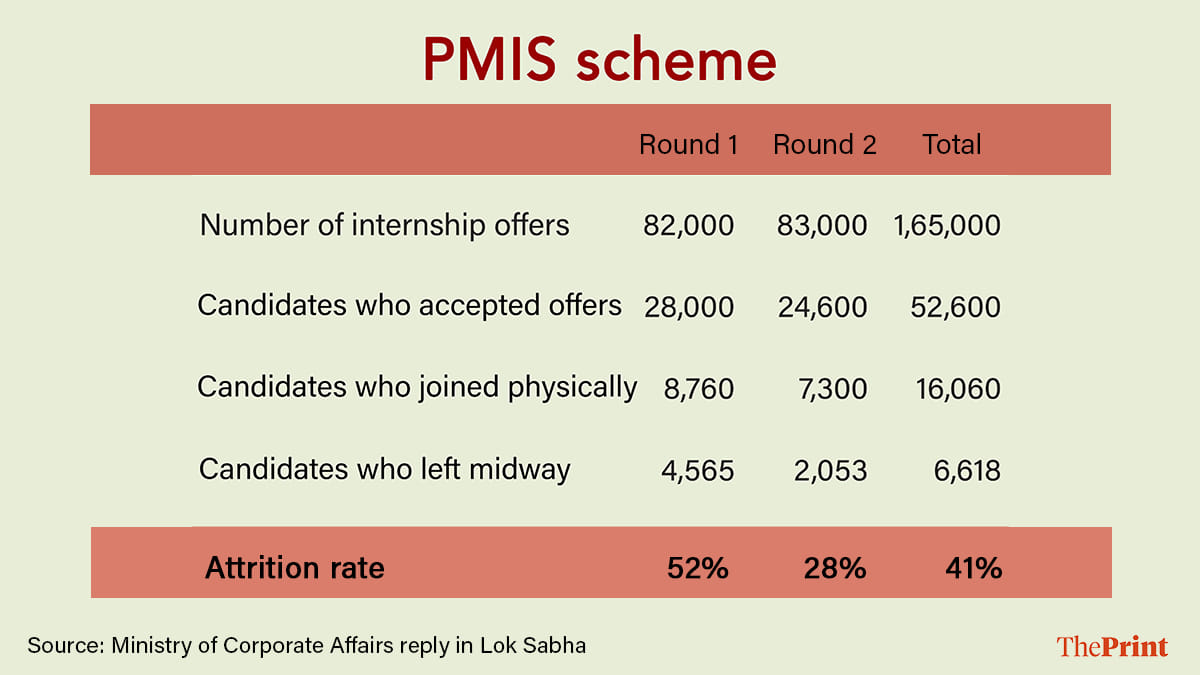
Data released by the government on Monday in Parliament shows that since the scheme was rolled out last October, barely 30 percent or 16,060 of the total 52,600 candidates who accepted the offer actually joined the private companies and public sector undertakings (PSUs) where they were offered internships.
Even more concerning for the government is the fact that 6,618 interns—nearly 41 percent—quit midway without completing the full one-year internship. Of this, 4,565 candidates are from round 1; and 2,053 candidates from round 2.
So far, just 95 candidates across both rounds have been given offer letters by their respective companies for a full-time role, government data shows.
The data was provided by Union Minister of State for Corporate Affairs Harsh Malhotra Monday in a written reply to two separate questions raised by All India Trinamool Congress MPs Sayani Ghosh and June Maliah in Lok Sabha.
The PMIS was launched last October in two phases.
In the first phase, 82,000 internship offers were made to candidates with more than 28,000 accepting it. Ultimately, only 8,760 candidates joined their companies for the internships.
Whereas, in round 2 of the scheme that started in January 2025, 83,000 offers were made by partner companies to 71,000 candidates with over 24,600 candidates accepting the final offer. Eventually only 7,300 candidates joined.
Underutilised budget
Despite being billed as a major youth-skilling initiative, the scheme has also not been able to utilise the budget allocated for FY 2025-26.
As of September 2025, the Ministry of Corporate Affairs (MCA) has been able to spend only Rs 73.72 crore—a fraction of the Rs 10,831 crore allocated for FY 2025-26—under the scheme.
The MCA’s reply attributes the low acceptance and high attrition to location constraints (candidates do not want to travel beyond 5-10 km), longer internship tenure (the 12-month internship is longer than normal skilling programmes) and lack of interest in roles on offer.
Launched in October last year, PMIS aimed to provide internships to 1 crore youth for the next five years with an objective to equip the country’s young population living in tier 2 and tier 3 cities with skills that would prepare them for the future job market.
Under the scheme, interns receive a monthly stipend of Rs 5,000, shared by partner companies (Rs 500 via CSR fund) and the government (Rs 4,500). Apart from a stipend, the government also pays a one-time grant of Rs 6,000 to each of the selected candidates.
Subdued response in round two
In comparison to round one, round two received a subdued response despite new features, including higher transparency on internship locations, more detailed job descriptions and the disclosure of additional benefits the companies would offer.
According to the reply, the pilot phase of the PMIS is being used to test concepts, strategies and systems before a full-scale implementation of the scheme.
“The full-scale roll-out of the PM Internship Scheme would be based on the feedback received from the stakeholder consultations and evaluation of outcomes during the implementation of the pilot project,” Malhotra states in the written response.
The data released by the government in Lok Sabha Monday shows that across both rounds, Andhra Pradesh, with 51,225 candidates, leads in number of applications received from candidates, followed by Uttar Pradesh with 46,272, and Madhya Pradesh with 43,851.
Among the top three states by applications, Andhra Pradesh and Madhya Pradesh saw a jump of 95 percent and 14 percent, respectively, between round 1 and round 2, whereas applications from Uttar Pradesh declined by almost 50 percent in round 2.
However, as far as actual joining of candidates is concerned, Uttar Pradesh leads all states with 1,913 candidates (1,241 in round 1 and 672 in round 2) across both rounds.
Closely following Uttar Pradesh is Assam with 1,806 candidates who joined the internship programme in two rounds. Assam is followed by Madhya Pradesh with 1,247 candidates.
But the data shows that all three states—Uttar Pradesh, Assam and Madhya Pradesh—saw a decline in candidates who joined the internship scheme in round 2 in comparison to round 1.
Response from companies
The data provided by the government also highlighted for the first time that 95 candidates across both rounds have been given offer letters by their respective companies for a full-time role.
Muthoot Finance with 32 offer letters leads the list of 17 companies that made full time job offers. The list includes Tech Mahindra (20 offers), Manappuram Finance (14 offers), IDFC First Bank (7 offers) and Dr. Reddy’s Lab (5 offers).
Only one public company—Oil and Natural Gas Corporation (ONGC) made full-time job offers to interns.
The government reply also provided a list of 93 companies which offered fewer than 50 internship opportunities across both rounds.
While, Info Edge (India) Limited was at the upper end of the spectrum with 49 offers, companies like DCB Bank, Mahanagar Gas Limited, Atlas Copco (India) Private Limited, Gharda Chemicals, Macleods Pharmaceuticals, Winsol Solar Fields, Yarrow Infrastructure and Maharashtra Eastern Grid Power Transmission Co. Ltd. made only one internship offer across both rounds.
The scheme is voluntary for companies—any company can make offers. The Lok Sabha questions specifically asked for names of companies which made less that 50 offers across two rounds.
(Edited by Viny Mishra)
Also read: PM’s internship scheme headed for overhaul after tepid response. How govt plans to woo more youth