





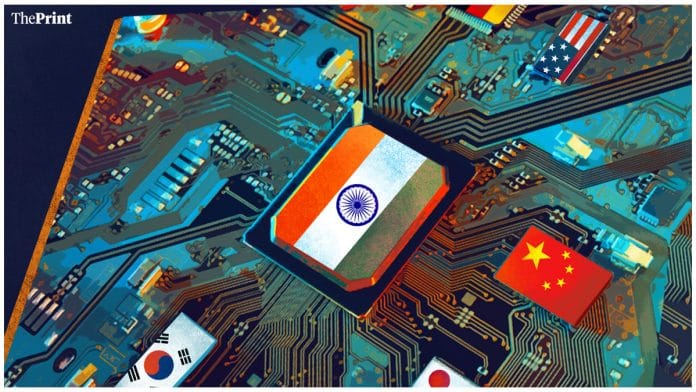



New Delhi: Union Finance Minister Nirmala Sitharaman on Sunday announced a push for India’s semiconductor sector with the introduction of the India Semiconductor Mission 2.0, which will enhance India’s focus on producing equipment and materials, developing full-stack Indian IP, and fortifying supply chains.
Presenting the Union Budget 2026-27, the finance minister said, “We will also focus on industry-led research and training centres to develop technology and a skilled workforce.”
The Finance Ministry has allocated Rs 1,000 crore to the Ministry of Electronics and Information Technology for ISM 2.0.
The first phase of the semiconductor mission, launched in 2021, was aimed at encouraging the establishment of semiconductor fabrication, assembly, and testing plants. The mission had an initial allocation of Rs 76,000 crore, and brought in major players like Tata Electronics and Micron Technology into the game.
Phase two of the mission will broaden the scope to include building equipment, design, and material sciences.
“India Semiconductor Mission (ISM) 1.0 expanded India’s semiconductor sector capabilities,” Sitharaman said, adding that the second phase will broaden the purview of the sector from just fabrication facilities to the full value chain.
Also read: Budget 2026 pushes mountain trails for tourism. It will be a challenge for state govts
Work in the sector
Under the ISM mission, the government brought in schemes to provide up to 50 per cent fiscal support for setting up semiconductor wafer fabrication units, financial assistance of up to 50 per cent of the project cost to set up display fabrication units, and support for setting up units for compound semiconductors, silicon photonics, sensors, and discrete semiconductors.
In May last year, the Centre inaugurated two state-of-the-art semiconductor design facilities in Noida and Bengaluru, which became India’s first to focus on advanced three-nanometre chip design — a significant milestone in the nation’s semiconductor innovation journey.
Over the last few years, the semiconductor industry has gained focus globally, with its applications ranging from healthcare to transport, communication, defence, and space. The global race is being led by countries such as Taiwan, South Korea, Japan, China, and the US, with Taiwan producing more than 60 per cent of the world’s semiconductors, including nearly 90 per cent of the most advanced ones.
Semiconductor industry estimates, quoted in government documents, show that the Indian market was worth about $38 billion in 2023, between $45 and $50 billion in 2024-25, and is expected to reach about $100-110 billion by 2030.
“By focusing on equipment, materials, and full-stack design, and scaling the Electronics Components Manufacturing Scheme to Rs 40,000 crore, India strengthens supply chains and builds long-term technological sovereignty,” Vineet Mittal, founder and chairperson of the Avaada Group, said.
(Edited by Aamaan Alam Khan)