





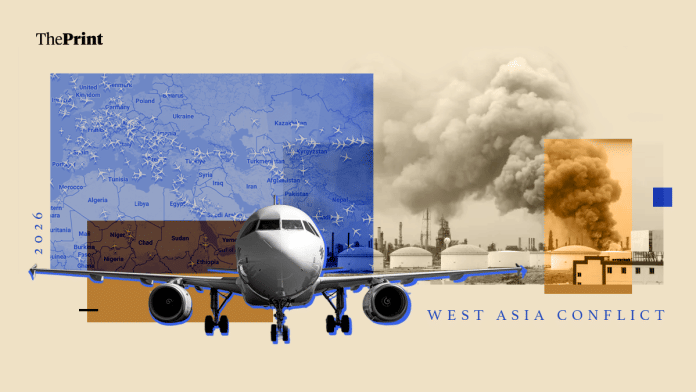



New Delhi: The escalating conflict in West Asia is taking a massive toll on the aviation sector with disruptions in flights to and from India estimated to cost Indian and international airlines nearly $8.75 billion (Rs 80,500 crore) each week the war continues, industry experts told ThePrint. Closure of airspace alone could raise quarterly airline operational costs by about 30 percent with some routes taking significantly longer hours.
On Tuesday, Air India became the first Indian airline to introduce a fuel surcharge amid soaring aviation turbine fuel (ATF) prices triggered by geopolitical tensions.
In a statement, the airline said that starting 12 March it will levy a Rs 400 surcharge on all domestic tickets, while international routes will see higher surcharges, going up to Rs 18,000 per ticket on long-haul flights such as those to the US.
“We don’t expect the airspace situation to improve for at least one week,” said aviation consultant Mark D. Martin of Martin Consulting.
He added, “The weekly impact to Indian and international airlines flying to and from India stands at an extremely conservative estimate of $8.75 billion per week. At the moment, Pakistani, Iranian, Omani and Emirati airspaces are shut. This blocks nearly all flight access to Europe, the US (Westward flights) and flights into the Persian Gulf.”
Sanjay Lazar, aviation expert and CEO of Avialaz Consultants, said if the war persists, the cost of airline tickets could rise even further.
“These diversions have already added 20 percent to the costs, landings and crew costs add another 10 percent, but if this war prolongs, and Brent Crude crosses $100-120 a barrel, the cost of ATF will spike and we will see a rise in passenger ticket prices and also a hardening of cargo rates, especially for perishable cargo,” said Lazar.
He added, “Overall, it is roughly estimated that the Middle East (airspace) closure, coupled with Pakistan shutting down its airspace, could affect Indian airlines by 3-4 hours longer flight times.” For instance, a Manchester-bound IndiGo flight had to return to Delhi Monday, after it had flown for over eight hours and crossed the conflict-affected Persian Gulf region.
Diversions and cancellations are still being reported as escalations in the Persian Gulf continue. More than 1,600 flights were canceled between 28 February and 3 March, according to the Press Information Bureau (PIB). Of these, 1,221 were flights by Indian carriers and 388 by foreign carriers.
Hostilities in West Asia have further unsettled India’s already struggling aviation sector, which had been dealing with compounding losses due to three major accidents within a single year, a mass cancellation debacle involving the country’s largest fleet carrier—IndiGo—and the India-Pakistan conflict that followed Operation Sindoor last May.
ICRA, the credit rating agency, had estimated that the Indian aviation sector incurred a net loss of Rs 170-180 billion in 2025-2026.
Aviation consultants have now started weighing the cost of the conflict in the Middle East, which is only expected to soar in the coming weeks.
Sources in multiple airlines flying international said the situation is leading to compounding losses, with no clarity on when the airlines will return to normal operations.
“Insurance premiums are excessive, while narrow body operational flights are costing up to Rs 30 lakh round-trip, large white body planes cost up to Rs 90 lakh in premium; this will lead to a substantial rise in airfare, which in turn, will dissuade the traveller,” one source told ThePrint.
Flights operating from India to West Asia are flying without schedules, almost empty, along with multiple sets of crew as the FDTL (Flight Duty Time Limitation) norms differ for India and countries in West Asia, compounding the losses for the airlines, another source added.
Industry insiders referred to this as a grim phase for the sector with travellers undergoing a sense of “sentiment loss” which is adding to loss in revenue, already fueled by rising oil prices and airspace closures.
“The April-May-June quarter is the second busiest time for Indian aviation. Families usually plan vacations and book tickets for the Summers, however international travel booking is less, leisure trips have moved from the West to the East,” a third source said.
Meanwhile, aviation turbine fuel prices have risen from $85–$90 per barrel to $150–$200 per barrel since the US and Israel launched the first wave of strikes against Iran on 28 February. Jet fuel prices in India were hiked by over 5 percent last December, pushing rates to nearly Rs 1 lakh per kilolitre, as per oil company price revision.
Fuel is the second-largest cost for airlines after labour, typically making up about 20-25 percent of operating costs.
(Edited by Amrtansh Arora)
Also Read: There’s an emerging duopoly in India’s aviation sector. 7 reforms to encourage competition