








New Delhi: India has nine to ten days of crude oil reserves while state-owned refineries maintain another 65 days of supplies, according to data that shows the country has been slow in scaling up its stockpiles to manage emergencies exactly like the one the world is embroiled in with the West Asia conflict.
India is yet to dip into its emergency reserves, but the issue has been in the spotlight since US-Israel triggered a war with Iran, which struck back by targeting the Gulf’s oil industry and choking the critical waterway through which one-fifth of the world’s supplies are shipped. India imports nearly 85-90 percent of its crude oil, and a lion’s share of it is shipped from West Asian countries.
Experts told ThePrint that India’s reserves, even after accounting for oil kept in inventories of state-owned refineries, were much less than other major economies.
The process to set up strategic petroleum reserves (SPR) was conceived in the late 1990s, but work on the ground began in the mid-2000s, and the first facility became operational over two decades later. Central governments, over the years, recognised the need to expand its stockpile, given India’s increasing demand, but the initiative was slowed by delays due to budgetary constraints and bureaucratic procedures, experts say.
Also Read: Modi govt failed to promote crude oil Atmanirbharata. Don’t let Iran war be a lost opportunity
The reserves
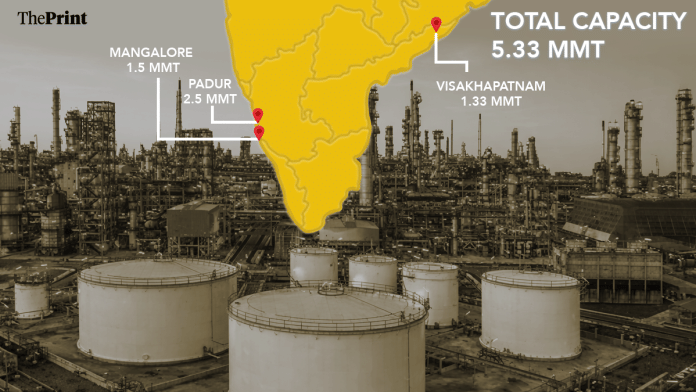
The Minister of State for Petroleum and Natural Gas Suresh Gopi told Parliament in March 2026 in a written statement that India has capacity to hold 5.33 million metric tonnes (MMT) of reserves at three storage caverns in Visakhapatnam (1.33 MMT, Andhra Pradesh), Mangalore (1.5 MMT, Karnataka), and Padur (2.5 MMT, Karnataka).
These facilities, Gopi said, currently hold around 3.37 MMT of crude oil, enough to meet roughly nine to ten days of the country’s requirement.
Apart from these, oil marketing companies such as Indian Oil Corporation, Bharat Petroleum and Hindustan Petroleum, among others, maintain an additional 64.5 days of crude oil in their commercial inventories.
Even so, the scale of India’s reserves is modest compared to global standards.
Japan, for instance, holds reserves for around 254 days, and China has stockpiles that can cover 110-140 days of net imports, Reuters reported.
The International Energy Agency (IEA) – of which India is not a full member–requires its member countries to maintain reserves equivalent to at least 90 days of net oil imports. IEA has 32 member countries, including the US, the UK, Canada, France, Germany, and South Korea, among others.
“Countries like Japan expanded their reserves after the 1970s oil shocks, building large government and private stockpiles as part of their energy security strategy. China, meanwhile, has rapidly expanded reserves since the early 2000s through strong state funding and centralised planning,” Umud Shokri, energy strategist and Senior Visiting Fellow at George Mason University in the US, told ThePrint.
But India, Shokri said, followed a more gradual approach to setting up and maintaining the reserves.
Noel Theratill, Research Analyst at think-tank Centre for Social and Economic Progress (CSEP), said India’s approach has been slow despite consumption increasing sharply over the past decade.
“India’s annual consumption of oil skyrocketed from 158.4 MMT in FY 2013-14 to 239.2 MMT in FY 2023-2024. Meanwhile, the capacity of strategic petroleum reserves has remained largely stagnant, not keeping pace with this growth in consumption,” he said.
Similar concerns were raised recently by a Parliamentary Standing Committee on Petroleum and Natural Gas, which urged the government in its March 2026 report to increase crude reserves to meet 90 days of the country’s needs. This, the committee of parliamentarians from the government and other parties, said would strengthen energy security and safeguard the Indian economy from supply shocks.
Officials of the Union petroleum ministry did not respond to requests for comment on the matter till Thursday morning.
The SPR programme
India’s strategic petroleum reserve programme has long faced delays and implementation challenges despite broad policy agreement on its importance.
The idea of building emergency oil reserves emerged in the late 1990s, as India’s import dependence steadily increased. In 1998, the Atal Bihari Vajpayee-led central government proposed the creation of strategic stockpiles, recognising the need for a buffer against external disruptions.
The next steps were taken in 2004, when the United Progressive Alliance (UPA) government set up Indian Strategic Petroleum Reserves Limited (ISPRL), a special purpose vehicle under the Oil Industry Development Board (OIDB), to build and manage these storage facilities.
Former petroleum minister in the UPA government (May 2004-January 2006) Mani Shankar Aiyar said much of the groundwork had already been done by the Vajpayee government.
“By the time I became the minister, great progress had already been made towards building up a strategic petroleum reserve. I didn’t need to do much about it because, under the Atal Bihari Vajpayee government, the required steps had already been taken,” Aiyar told ThePrint.
Construction of underground caverns for storage began in the mid-2000s, with a proposed time of four years to completion. But the three facilities became operational only between 2015 and 2018.
The Narendra Modi-led Bharatiya Janata Party (BJP) government, in 2021, also approved the plan to increase storage capacity by 6.5 MMT by setting up a fourth facility at Chandikhol in Odisha (4 MMT) and expanding the existing facility at Padur under public private partnership (PPP) mechanism.
Five years later, though, both the projects remain in early stages, primarily due to land acquisition challenges and delays, according to findings of the parliamentary committee report. The committee also pointed to repeated under-utilisation of allocated funds over the years.
“The committee notes that delays in finalising the bidding process and subsequent stages under the PPP framework led to the withdrawal of funds projected for milestone payments at the Budget Estimate stage, particularly for the Phase II project at Padur in Karnataka,” the report said.
“Successive governments have recognised the need for strategic reserves, but implementation has progressed slowly due to structural challenges rather than lack of policy intent,” Shokri said.
He added, “Large infrastructure projects often face delays caused by land acquisition disputes, environmental approvals, funding constraints, and coordination between central and state governments.”
High costs, competing priorities
A key constraint in expanding strategic reserves is cost, experts told ThePrint. Building underground storage caverns requires high investments, and the government has to bear the cost of procuring crude for storage too. These expenses compete with other fiscal priorities such as infrastructure development, welfare programmes and defence spending.
“The challenge is largely institutional and financial. Procuring crude oil, and building and maintaining strategic petroleum reserves is a very capital-intensive exercise, and governments have to balance this against other fiscal priorities,” Theratill said.
“At the same time, India’s oil consumption has grown rapidly and existing stocks last for relatively fewer days,” he added.
According to data submitted to Parliament, the operation and maintenance (O&M) costs for the three storage facilities was Rs 153 crore in FY 2023–24, and Rs 100 crore in FY 2024–25.
Apart from the approved expansion plan, ISPRL has been exploring additional storage facilities, including India’s first salt cavern-based reserve in Rajasthan’s Bikaner with a proposed capacity of 5 MMT. Other proposals include expanding the capacity of the Mangalore facility by 1.75 MMT and setting up another reserve in Bina, Madhya Pradesh.
If implemented, India’s total SPR capacity could rise to around 20 MMT.
“Assuming the completion of planned projects and achieving full capacity, the total capacity could reach around 20 MMT, equivalent to approximately 35.6 days of reserves for current consumption,” Theratill said.
Expansion, even up to the sanctioned Phase II, which will increase capacity to 11.8 MMT, will still fall short for a country that imports “more than 80 percent of its oil and faces growing geopolitical risks in major supply routes such as the Strait of Hormuz in the Gulf”, Shokri said.
Aiyar argued that reserve capacity should have been significantly increased by now.
“The NDA ministers handling the petroleum and natural gas portfolio have paid no attention whatsoever to energy security. Instead, they have raised our dependence on imported petroleum from 70 percent in my time to 90 percent now,” the Congress leader alleged.
The LPG gap
More than crude, India remains far more exposed to any supply shocks for liquified petroleum gas (LPG), the fuel that runs more than 32 crore households across the country.
“Unlike crude, India does not maintain large strategic LPG reserves, and terminal storage buffers are comparatively limited,” said Sumit Ritolia, Lead Analyst for refinery and modelling at Kpler, a firm that tracks and analyses global trade.
Currently, India has just two underground LPG caverns with a combined capacity of 140,000 metric tonnes—operated by Hindustan Petroleum Corporation Limited in Mangalore (80,000 MT) and South Asia LPG Company in Visakhapatnam.
“We have some LPG reserves, but from what I understand, it is only a few days’ worth of supply,” Aiyar said.
He added, “Petrol affects large sections of the middle class and the rich people. But LPG shortage is something that affects every citizen.”
So far, the government has maintained there is no shortage of any fuel in the country. To reduce dependence on LPG, Centre issued an order this week, mandating that authorities stop supplying cylinders to households that have access to piped natural gas (PNG) connections.
Separately, the government reduced allocation of commercial LPG to ensure uninterrupted domestic supply.
(Edited by Prerna Madan)