





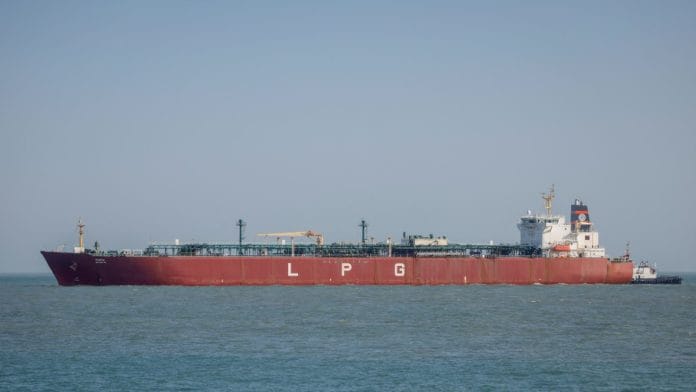



New Delhi: India’s heavy reliance on West Asia for liquefied petroleum gas (LPG) is unlikely to ease anytime soon due to persistent cost and logistical constraints associated with alternative sources, according to a market analyst tracking the oil and gas sector.
While India has explored alternative LPG suppliers such as the US, Russia, and Argentina, these suppliers can only provide incremental volumes.
“The US is the most scalable alternative, given its large export capacity, while Russia can offer discounted barrels, and Atlantic Basin suppliers like Argentina and Africa can provide incremental cargoes,” Sumit Ritolia, lead analyst for modelling and refinery at Kpler told ThePrint.
However, these alternatives face significant logistical hurdles. Compared to Gulf suppliers, shipments from these regions involve voyage times that are two to three times longer, along with higher freight costs and limited vessel availability. “This increases landed costs and reduces flexibility in responding to short-term disruptions,” the Kpler analyst said.
West Asia cargoes dominate India’s LPG imports due to proximity, which keeps freight costs low, long-term contracts ensure supply stability, and producers can supply large cargo volumes suited to India’s demand. “As a result, while diversification is possible, it comes at a clear cost disadvantage and slower response time, particularly in a tight market,” Ritolia added.
Data from Kpler shows India imported nearly 600 thousand metric tonnes of LPG from the Gulf region until 17 March. Although lower than February 2026 levels, the region still accounts for the bulk of India’s imports. Other suppliers in March included the United States, Russia and Argentina.
Ritolia noted that some LPG cargoes are being routed from the western side of Saudi Arabia, bypassing the Strait of Hormuz. However, two Indian-flagged vessels—Nanda Devi and Shivalik—together carried around 93,000 metric tonnes of LPG through Hormuz this week.
“Diversification, as seen in crude, has been slower in LPG because alternative supply chains are less flexible, more expensive, and require dedicated shipping and terminal infrastructure,” Ritolia said.
He added that West Asia is likely to remain India’s primary supplier. “The Middle East continues to dominate due to its cost competitiveness and logistical efficiency,” he said.
In the last week, the government has taken a slew of measures to ensure supply management of LPG. State-owned city gas distribution companies have rolled out incentives to encourage households to shift from LPG cylinders to piped natural gas (PNG) connections.
The government also incentivised states by offering them additional 10 percent of commercial LPG supply over and above the existing 20 percent, provided states support a long-term transition to piped natural gas.
Also Read: Amid supply crunch, govt offers 10% additional commercial LPG to states. But there’s a condition
India’s LPG capacity constraints
India’s LPG storage capacity remains limited, hence it is highly dependent on imports. Unlike crude oil, where India has built strategic reserves, LPG storage is more complex and capital-intensive, requiring specialised, pressurised or refrigerated infrastructure, cited Ritolia.
The country currently has two underground LPG caverns with a combined storage capacity of 140,000 metric tonnes: 80,000 metric tonnes at Mangalore operated by Hindustan Petroleum Corporation Limited and 60,000 metric tonnes at Visakhapatnam operated by South Asia LPG Company.
Domestic production meets about 40-45 percent of India’s LPG demand, while imports account for the remaining 55-60 percent, a large share of which comes from West Asia.
Russian oil flows rebound
India’s crude import strategy has also shifted in recent months, with Russian supplies regaining importance. Indian refiners reduced Russian crude intake after US sanctions in November 2025, bringing volumes down to around 20 percent in February 2026 from over 40 percent in 2025.
However, the West Asia crisis and a temporary 30-day US waiver have reversed that trend.
“With Middle Eastern crude accounting for nearly half of India’s requirements, the most practical option was to return to Russian barrels,” Ritolia said, pointing to supply risks triggered by the US-Israel and Iran conflict.
Russian imports have since climbed to around 1.8 million barrels per day (mbpd) in March and could stabilise at 2.0-2.2 mbpd as refiners prioritise supply security. “From a margin perspective, refiners focused on exports are better positioned, as they benefit from international pricing, whereas those catering primarily to the domestic market continue to face pressure due to unchanged retail prices,” Ritolia noted.
(Edited by Amrtansh Arora)
Also Read: Build-up stalled, House panel pulls up govt on underutilisation of funds for new crude storage sites