





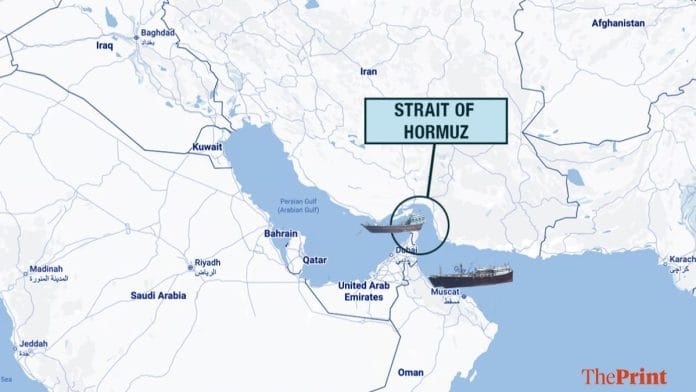



New Delhi: India has enough petroleum reserves to cover roughly 40–45 days of import volume through the Strait of Hormuz, but a prolonged disruption in the Gulf due to the widening Middle East conflict could significantly raise its import bill and strain energy security, according to trade intelligence firm Kpler.
The firm’s data suggests that India’s current commercial crude stocks—including volumes held in its Strategic Petroleum Reserve (SPR) facilities at Mangalore, Padur and Visakhapatnam— stand at around 100 million barrels.
“With imports via the Strait of Hormuz averaging roughly 2.5 million barrels per day (mpbd)—about half of India’s ~5 mbd total crude imports—these combined reserves could theoretically cover around 40–45 days of imports in a crude disruption scenario,” Sumit Ritolia, the lead analyst for oil markets at Kpler told ThePrint.
In comparison to China — which has built significantly larger emergency stockpiles over the past decade — India’s reserves are smaller in both absolute and relative terms.
However, Ritolia cautioned that these buffers are designed to manage temporary supply shocks, not sustained outages.
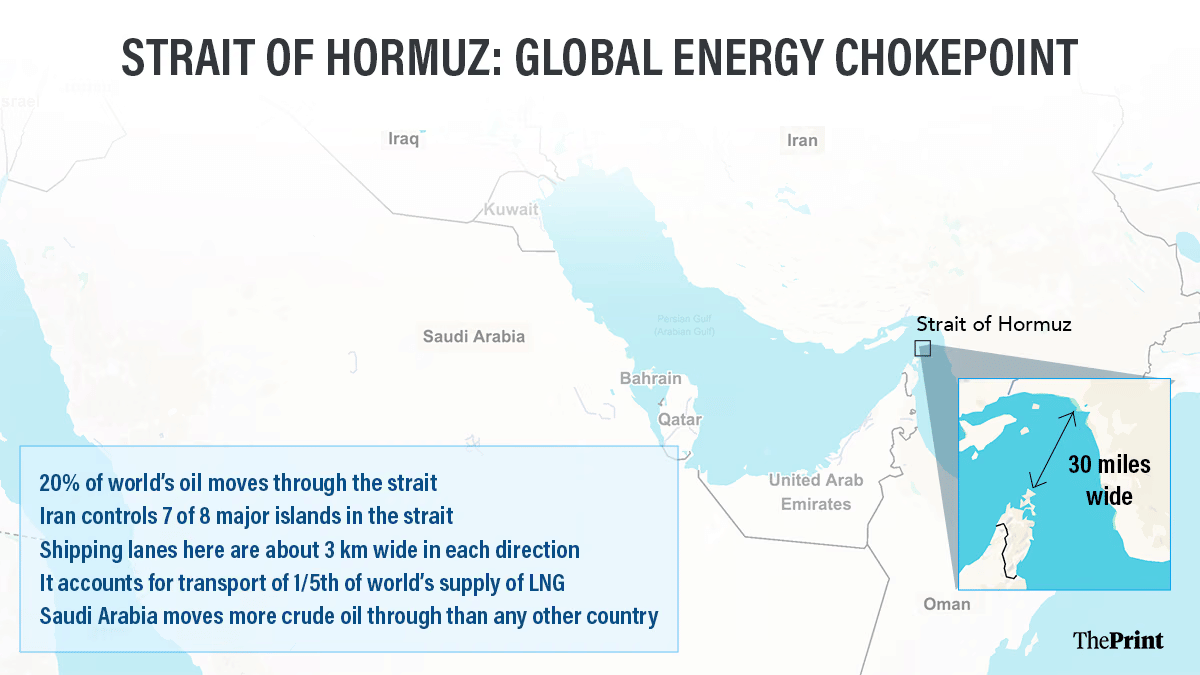
India imports nearly 90 percent of its crude requirement, with around 50 percent sourced from the Middle East. About 2.5 million barrels per day — roughly half of its total crude imports — typically transit through the Strait of Hormuz between Iran and Oman, underlining the country’s structural vulnerability.
The warning comes amid a sharp escalation of the conflict in the Gulf that has impacted global oil and gas markets.
The oil and gas shipping through the Strait of Hormuz has nearly come to a halt since late 28 February, following US–Israeli strikes on Iran that triggered transit risks and a rapid repricing of war-risk insurance premiums.
Kpler’s tracking data shows eastbound exits from Hormuz collapsing to just three observed ships on 1 March, carrying a combined 2.8 million barrels of crude and products — down from around 21 to 22 million barrels on 27 and 28 February. The decline represents more than 85 percent reduction in traffic since.
“If the Strait of Hormuz remains disrupted or shipping forced onto longer routes, India’s crude import bill would rise meaningfully,” Ritolia said.
He added, “Even without a full blockade, higher freight, war-risk insurance and geopolitical premiums would lift landed costs.”
Short-term & long-term risks
For India, the immediate risk is more about prices than physical shortages. “The near-term risk is primarily price volatility and higher import costs rather than immediate physical shortage, for now,” Ritolia said.
One potential short-term option could be to absorb Russian cargoes floating in the Arabian Sea and the wider Asian region without firm buyers, which could be taken in relatively quickly if required.
‘India is among world’s largest exporters of refined products, particularly diesel & jet, redirecting export volumes to domestic market would provide additional buffer,’ Sumit Ritolia, Kpler.
However, if tensions in the Middle East continue for a longer duration, government intervention may become necessary, he said.
“The government could prioritise domestic energy security by asking refiners to moderate or temporarily curb refined product exports to ensure adequate domestic supply,” Ritolia said.
He added, “Given that India is among the world’s largest exporters of refined products, particularly diesel and jet, redirecting export volumes to the domestic market would provide an additional buffer.”
In a worst-case scenario—involving a prolonged shutdown of Hormuz flows alongside sustained geopolitical escalation—crude prices would spike sharply, freight markets would tighten, and refiners could eventually be forced to trim production if replacement barrels are not available, according to Ritolia.
For now, markets are pricing in risk rather than a full-blown supply crisis. But if oil flows do not normalise soon, there would be a wider impact beyond the Gulf, reshaping oil and gas trade patterns and adding fresh macroeconomic strain for import-dependent economies such as India, Ritolia said.
Impact on gas markets
The global gas market has also been impacted by the shutdown of Ras Laffan Liquified Natural Gas (LNG) complex in Qatar.
On 2 March, QatarEnergy halted production at the 77 million tonnes per annum Ras Laffan LNG export complex after a drone attack launched from Iran struck an energy facility there.
The Ras Laffan complex accounts for nearly 19 percent of global LNG supply, making the shutdown an immediate shock to gas markets. Asia is particularly exposed, accounting for nearly 90 percent of LNG supply from the facility, according to Kpler brief on social media platform LinkedIn.
(Edited by Ajeet Tiwari)
Also Read: What is Strait of Hormuz & why its closure by Iran could disrupt global energy trade