





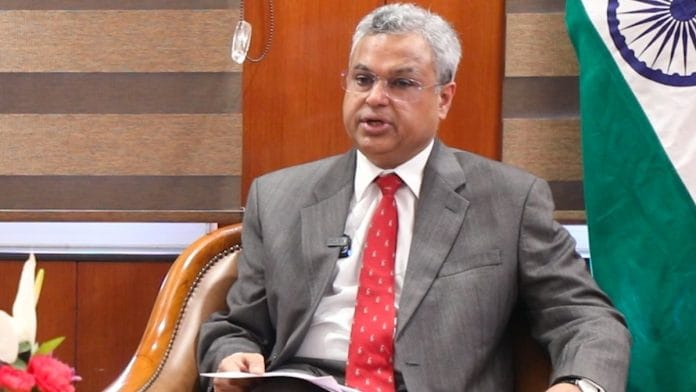



New Delhi: The financial year 2022-23 has been chosen as the revised base year for calculating India’s Gross Domestic Product (GDP)—in place of FY 2011-12—as it was found to be the first “normal economic year” in the last few years, said Saurabh Garg, the Ministry of Statistics and Programme Implementation (MoSPI) secretary.
The new series is set for a ‘Friday release’ on 27 February, in a move that government officials say will better reflect structural changes in the economy, incorporating improved data sources and methodology.
In an interview with ThePrint, Garg said that several recent financial years were unsuitable as a “benchmark”. “As GST was rolled out in July 2017 (middle of the financial year), FY 2017-18 was also not a normal economic year,” he said, adding that household data constraints ruled out FY 2018-19, and that FY 2019-20 and FY 2020-21—impacted by the COVID-19 pandemic—were “obviously not normal economic years”.
Even FY 2021-22, which saw a sharp rebound, was distorted. Garg explained that the year “witnessed recovery in economic activities after COVID-19 induced shocks, and GDP grew sharply, largely due to base effect”.
A base effect refers to a statistical phenomenon wherein growth appears high because it’s measured against the previous year’s low.
The choice of FY 2022-23 was endorsed by the Advisory Committee on National Accounts Statistics, which includes representatives from central ministries, state governments, academia, and research institutions.
“The base year is revised from time to time to capture the structural changes in the economy that might have taken place in the intervening period,” Garg further said, adding that it would be the government’s “endeavour” to “revise the base year every five years”.
The revision goes beyond simply shifting the reference year; it involves changes in how data is collected and how GDP is calculated.
One major reform relates to measuring the household sector, including informal businesses and small enterprises. In the earlier series, this segment was estimated “either through inter-survey growths or through some proxy indicators,” meaning projections were made using indirect measures.
Under the new series, Garg said, “level estimates of the household sector will be compiled through regular surveys—Annual Survey of Unincorporated Sector Enterprise (ASUSE) and Periodic Labour Force Survey (PLFS)—being conducted each year.”
This means fresh, annual data will replace extrapolations from older surveys.
Another significant methodological shift will be adopting “double deflation” in manufacturing and agriculture, cites Garg.
In simple terms, deflation refers to adjusting for inflation to calculate the real growth. Double deflation adjusts both output and input prices, separately, providing a more accurate estimate of value added.
The secretary said, “As such, single deflation has been completely done away with,” adding that deflators will now be applied at a more granular level.
The new series will also integrate the Supply Use Table (SUT) framework with national accounts.
SUT maps what industries produce (supply) and how those goods and services are used—either by other industries or final consumers (use). The secretary explained, “Balanced SUT ensures that total supply matches total demand in the economy.”
Integrating SUT is expected to “help minimise discrepancy” between GDP measured from production and expenditure approaches.
Better data, wider coverage
The government is also expanding the use of administrative data. “New data sources, like Goods and Services Tax (GST) data, Public Finance Management System (PFMS), E-Vahan, etc., which are more comprehensive and available at a shorter time lag, have been explored,” Garg said.
Additionally, companies engaged in multiple activities will no longer have their entire output assigned to their principal activity. With activity-wise turnover data now available, value-added will be segregated across sectors, improving sectoral accuracy.
Whether the new base year will significantly revise India’s past growth rates remains to be seen. The secretary said, “As estimates are being worked out, it would be difficult to quantify the change in growth rates at this stage.”
The revised estimates will be published on 27 February 2026 on the ministry’s website.
A back-series—recalculating previous years’ GDP using the new base and methods—is also planned “by the end of 2026” to allow comparisons over time.
(Edited by Madhurita Goswami)
Also Read: In the West, there’s anxiety. In India, optimism—Rishi Sunak says India poised to be leader in AI