





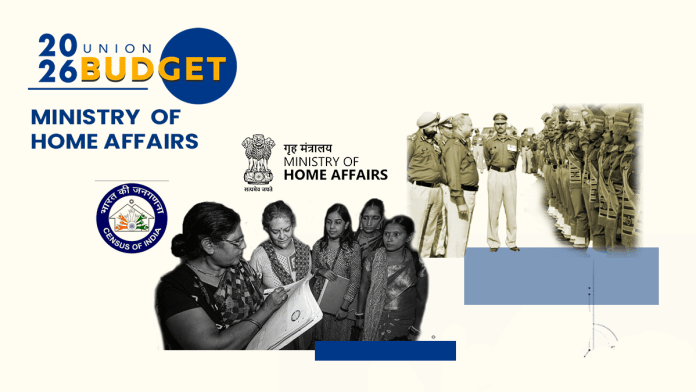



New Delhi: Union Finance Minister Nirmala Sitharaman Sunday allocated funds nearly six times the revised expenditure for last year’s Census and related exercises. The allocation has been increased to Rs 6,000 crore in the Union Budget for the financial year 2026-27, compared to the revised estimates of last year’s Budget, which stood at Rs 1,040 crore.
The massive boost in funding for the Registrar General of India (RGI) comes at a time the Centre is scheduled to conduct a nationwide census. The first phase of the exercise, originally scheduled for 2021, is now set to start in April.
In the first phase, around 30 lakh enumerators and other field workers will carry out recording of data and details, such as mapping of buildings and houses, to gather information on households, such as quality of amenities like water and electricity supply, latrines, kitchen fuel, along with assets such as TV, phone, and vehicle.
The first phase will conclude in September, followed by enumerators moving on to count the number of people and record their details under categories such as name, age, sex, relationship to the head, marital status, language, education, economic activity, place of birth/residence, religion, fertility, and disability status. The upcoming census will also record the population’s caste for the first time since Independence in 1947.
The budgetary allocation for the RGI and the Census exercise was initially Rs 574.80 crore in last year’s Budget, which was later revised to Rs 1,040 crore, likely owing to the initiation of processes before the Census exercise could take place.
Reacting to the Budget presented by Sitharaman, Union Home Minister Amit Shah said the budget further enhances India’s reputation as an attractive investment destination across a wide range of sectors.
#ViksitBharatBudget embodies Bharat as a nation forging its new identity as an emerging economic power center with resolute trust in its own strengths.
Post covid, PM @narendramodi Ji’s visionary economic policies have fuelled the Indian economy. #ViksitBharatBudget turbocharges…
— Amit Shah (@AmitShah) February 1, 2026
Massive boost for police infrastructure
The Finance Minister also increased the government’s planned expenditure on modernising the infrastructure of the internal security apparatus. The budgetary allocation for the infrastructure of the Central Armed Police Forces (CAPF), Central Police Organisations, and Delhi Police has been increased by nearly 50 per cent compared with the revised estimates of the previous year’s Budget. The CAPFs comprise the Central Reserve Police Force (CRPF), Border Security Force (BSF), National Security Guard (NSG), Central Industrial Security Force (CISF), Sashatra Seema Bal (SSB) and the Indo-Tibetan Border Police (ITBP).
A total of Rs 5,394 crore has been allocated to infrastructure projects under these categories, compared to Rs 3,684 crore in the revised Budget last year. A total of Rs 4,379 crore was originally allocated to the same verticals in last year’s Budget, released by Finance Minister Sitharaman.
A CAPF officer said the boost in infrastructure funds would expedite new centres for training personnel, new buildings for administrative purposes in internal security theatres such as Jammu and Kashmir and Manipur as well as new infrastructure on the border for Border Security Force personnel.
The budgetary allocation for infrastructure projects of Delhi Police has also been beefed up nearly 50 per cent—from Rs 162.51 crore as per the revised estimates of last year’s Budget to 342.50 crore for the next financial year.
The budgetary allocation for the Inter-Operable Criminal Justice System (ICJS) has also seen a massive jump of nearly 50 per cent—from Rs 300 crore in the last year’s Budget to Rs 550 crore in the next financial year.
The ICJS is a national platform designed to integrate the five key pillars of the justice system—police (CCTNS), e-courts, e-prisons, forensics, and prosecution—to enable seamless data transfer between government agencies and departments involved in the criminal justice system.
(Edited by Viny Mishra)