





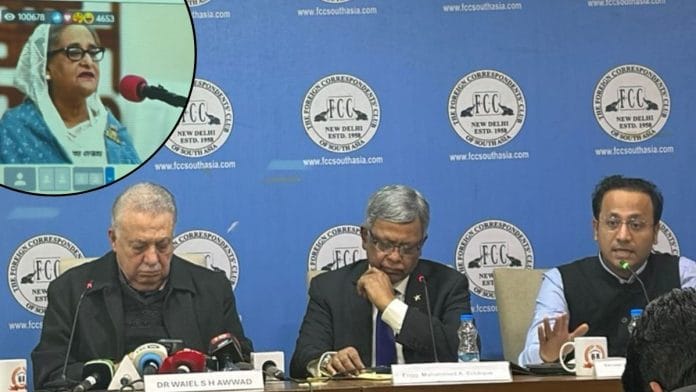



New Delhi: In an audio address, former Bangladesh Prime Minister Sheikh Hasina has now called Chief Adviser Muhammad Yunus a “murderous, corrupt, fascist leader, who sold the sovereignty of Bangladesh and its land to foreign powers”.
Her message was played at a Foreign Correspondents’ Club event, titled ‘Save Democracy in Bangladesh’, in Delhi Friday. One ex-minister from her Awami League government and several members of the country’s diaspora attended the programme in person.
“He is a usurper, a money launderer, a plunderer, and a corrupt, power-hungry traitor,” Hasina’s voice played in a pre-recorded audio message before a gathering of journalists in Delhi, blaming Yunus for “bleeding our nation dry with his all-consuming paradigms, straining the soul of our motherland”.
Calling her party Awami League “independent”, “the most important political party”, and “the defender of proud traditions of political and religious pluralism”, she blasted the Yunus administration, which assumed power soon after she fled the 2024 violence in Dhaka to reach Delhi, where she has stayed since then.
On the current situation in her country, she further said, “Bangladesh today stands at the edge of an abyss, a nation battered and bleeding, navigating one of the most perilous chapters in its history.”
In two separate addresses, one in English and the other in Bangla, her tone and rhetoric differed.
In English, she repeatedly attacked the Yunus administration for what she called rampant “lawlessness” and turning Bangladesh into a “blood-soaked land”. Further, she called his administration “a foreign-serving puppet regime”, adding that it needed to be overthrown.
In her address in Bangla, she was harsher towards Yunus, saying, “How did he (Yunus) come to power? Did he come on the people’s mandate? Did he come on the votes of the people? No, he forcibly took power, so who gives him legitimacy?”
The conference was organised by former ministers of the Awami League government, and Mohibul Hasan Nowfel, the former Bangladeshi education minister, responded to most of the questions that journalists asked after the audio play.
After years of Hasina’s rule, Bangladesh will usher in a new government through the 12 February polls. On the same day, a referendum will ask voters to cast a “Yes” or “No” on whether they approve the implementation of the July National Charter (Constitutional Reform), which contains proposals for political and constitutional reforms.
Speaking about the referendum, Nowfel said that the process is confusing and opaque; ordinary people do not understand what they need to approve, and the government is openly campaigning for a “Yes”, making the referendum unfair. He added that the July charter itself is unclear to several people and any constitutional change requires an elected parliament and a two-thirds majority, not a referendum alone. There is also no explanation of what happens if the referendum is defeated.
‘An age of terror’
Hasina said that since her ouster from Bangladesh, “the nation has been plunged into an age of terror. Democracy is now in exile.”
Citing diminishing press freedom and violence against women and minorities flourishing unchecked, Hasina said that human rights had been “trampled into the dust”.
“Life and property have no security. Law and order have collapsed,” she told the audience, painting a picture of a country gripped by mob violence, looting, and extortion.
The sharpest barbs were reserved for Yunus personally.
Claiming “a treacherous plot to put away the territory and resources of Bangladesh to foreign interests”,, she said, “By betraying the nation, the murderous fascist Yunus is pushing our beloved motherland toward the furnace of a multinational conflict.”
“By betraying the nation, the murderous fascist Yunus is pushing our beloved motherland toward disaster,” she said, warning of a “treacherous plot” that threatens sovereignty itself.
Her speech was as much a rallying cry as it was a denunciation of Yunus.
Calling on “all democratic, progressive, and non-communal forces of the pro-Liberation camp”, Hasina urged unity to restore the Constitution “written in the blood of martyrs”, in a reference to the 1971 Liberation War against Pakistan.
Hasina also sought to position the Awami League as the only legitimate custodian of Bangladesh’s democratic and pluralist traditions.
Describing the Awami League as “Independent Bangladesh’s oldest and most important political party”, she said that her party was “inexplicably interwoven with our country’s culture and democracy”. Further, she vowed that the party would also help the people “restore the thriving homeland that was snatched away”.
The five demands
She also laid out five demands, which, she said, were essential to “heal” Bangladesh.
Firstly, the removal of what she called the “illegal Yunus administration”, something that she claimed would restore democracy and create conditions for free and fair elections. “Bangladesh will never experience free and fair elections until the shadow of the Yunus clique is lifted,” she declared.
Her second demand was an end to what she described as daily street violence and lawlessness, arguing that stability was a prerequisite for economic recovery and the functioning of civic services.
The third was an “ironclad guarantee” regarding the safety of religious minorities in Bangladesh and women, among the most vulnerable. She urged that targeted attacks “must end” so that every citizen could feel safe in their community.
Fourth, Hasina also demanded an end to what she termed politically motivated “lawfare” ot the use of legal processes to intimidate, silence, and jail journalists, Awami League members, and other Opposition figures. She also urged the restoration of trust in Bangladesh’s judiciary as an “impartial and noble institution.”
Her fifth and final demand was for the United Nations to conduct a “new and truly impartial investigation” into the events of the past year, arguing that only a “purification of truth” could allow the nation to reconcile and move forward.
“The international community stands with you,” she told her supporters, asserting that the interim government had failed to listen to the people’s voices. “Together, we are strong, and together, we can make our demands heard.”
“Do not give up now,” she told the people of Bangladesh. “Join us in the fight to take back our nation from those who seek to destroy it. Help us rebuild democracy in Bangladesh.”
(Edited by Madhurita Goswami)
Corrupt Jamaat Shibir and BNP are two terrorist groups in Bangladesh. They did not hesitate to kill mothers and children, they are militant Jamaat Shibir and BNP, they have destroyed Bangladesh. Pakistan’s Bij Shibir and BNP terrorists, some young militants called Samnayak have destroyed Bangladesh. They have caught an Awami League member named Saddam and filed a false case against him. BNP terrorists, Shibir terrorists, Samnayak terrorists did not stop here. They have killed Saddam’s child and killed his wife. Many such killings are going on against Awami League members and Awami League supporters. Pakistani scoundrels did not spare Bangabandhu’s son Russell, how come this time they have killed Saddam’s wife and child. Those who can kill children because of the violence of their politics are nothing but terrorists.
I hate conspiracies but the more I have read about Bangladesh and the ouster of sheikh hasina (let’s be honest she was stealing elections irrespective of how good she was for her country) there is a lot of truth to the fact that western governments particularly old school American politicians (Trump is not one of them) didn’t like sheikh hasina and basically orchestrated a regime change. They were basically waiting for the right spark and they found it.