





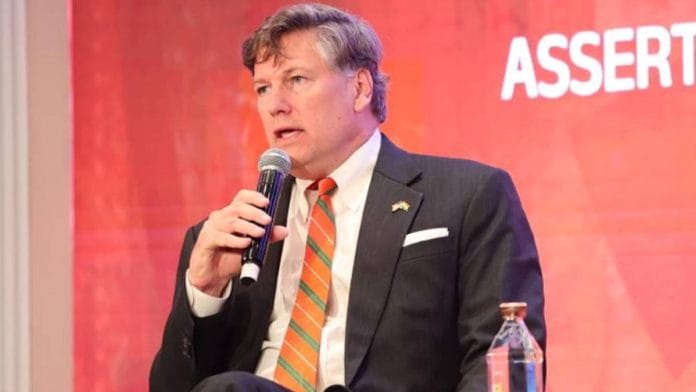



New Delhi: India is a key partner of the US in the Indo-Pacific, but with limitations—it must understand that the US “will not make the same mistakes with India” that it made with China two decades ago. This was the message that US Deputy Secretary of State Christopher Landau delivered to New Delhi Thursday.
“We are very excited about the (India-US) trade deal that is almost at the finish line now and think that could be the basis for unlocking almost limitless potential… India should understand that we will not make the same mistakes with India that we did with China 20 years ago. We are going to let you be able to develop all these markets and the next thing you know, you are beating us at many commercial things,” Landau said, speaking at the Raisina Dialogue in the national capital organised by the Ministry of External Affairs and the Observer Research Foundation (ORF).
The US Deputy Secretary of State’s statement on the kind of relationship the Donald Trump administration has with India seems based on the idea of reciprocity, but with “America First”.
What Landau did not say but implied is that China’s economic growth is partly due to previous US administrations, and that it would not be in the US’ interest to compete with another economy in the future of a similar scale or size as China’s.
Landau was, however, quick to highlight the areas where India and US can form a “win-win” partnership surrounding technology and artificial intelligence, while pushing New Delhi to increase its purchases of energy from the US.
“We think it is in our interest to be partnered with India. It has incredible economic and human resources that make it decide the future of this century… we think it is in the interest of India to deepen our partnership based on reciprocity and mutual respect… in the next few years we can really set the stage for very close India-US cooperation. We can move from the Cold War model where India kept the US at an arm’s length,” said Landau.
“I think the US and India have very sensitive interests in preventing terrorism, ensuring freedom of navigation in the high seas. We are seeing some changes in defence cooperation that would have been impossible some years ago.”
Landau labelled the energy cooperation between India and the US as “limitless” while pointing to the appointment of Sergio Gor as American envoy to India due to his close ties with Trump.
Landau’s visit comes a few days after another American official, Paul Kapur, Assistant Secretary for South and Central Asian Affairs, visited India.
India and the US under Trump’s second term as president have faced a number of challenges surrounding mainly differences in trade. However, both countries announced the conclusion of negotiations for an interim trade deal last month, which would see India eliminate or reduce a number of tariffs in sectors such as automobiles and Harley Davidson motorcycles in exchange for an 18% tariff rate.
However, within weeks of the deal being announced, the US Supreme Court struck down Trump’s ability to impose tariffs under the International Emergency Economic Powers Act (IEEPA). The US President has since found other methods to continue with his global tariffs policy, imposing a temporary 10% global tariff, which will be increased to 15% soon, according to US Treasury Secretary Scott Bessent.
The US’ additional tariff of 25% imposed on India due to its purchase of Russian oil was removed before the Supreme Court struck down the policy. Since Gor’s arrival, a number of senior American officials have made visits to New Delhi, as the two countries continue to look at areas to deepen their engagement.
Landau’s interaction at the Raisina Dialogue also comes almost a week into the latest conflict in West Asia, which began last Saturday after the US and Israel struck the Iranian capital of Tehran and killed Supreme Leader Ayatollah Khamenei.
Tehran’s retaliation has expanded since then, with half a dozen Gulf nations hit by Iranian missiles including the UAE, Bahrain, Kuwait, Saudi Arabia, Oman and Qatar. At least six US military personnel have been killed in the conflict so far.
Also Read: Israel can afford a long war with Iran—US cannot
‘Hope India & US foster more stable region’
Speaking on the situation in West Asia with Samir Saran, ORF president, Landau said the “endgame” for the US is one where the “Middle East (West Asia) is not a threat to other parts of the world”.
He asserted that Tehran since the Islamic Revolution in 1979 has been in a “death to America setting” while focussing on building a nuclear bomb, one that is “not in anyone’s interest”.
“We in this administration did not start out seeking to reach this state of affairs. We tried very hard to reinforce our redline, that is the development of a nuclear weapon. Can you imagine the threat it would be to the rest of the world if Iran can blackmail the world with a nuclear weapon?” the US Deputy Secretary of State asked.
The US under Trump had engaged in negotiations with Iran twice over its nuclear programme, before attacking Tehran in the middle of talks. The first was in June 2025, when the US launched Operation Midnight Hammer to damage Iran’s underground nuclear facilities. This time, the US and Israel claim to have pre-emptively launched strikes to kill Khamenei.
“The truth is that this part of the world has been unsettled for a long time and the root can be traced back to Tehran. Ultimately, the Iranian people are going to decide who their leadership is going to be,” said Landau.
“I hope India and the US can help foster the changes required to make this part of the world less unsettled.”
India has called on all parties involved in the current conflict to engage in “dialogue and diplomacy” to de-escalate the situation. It has yet to comment on the killing of a head of state of a sovereign nation: the assassination of Khamenei.
Almost 10 million Indians live in West Asia, and the region is a major source of energy for New Delhi. The war has impacted oil and natural gas production facilities in Saudi Arabia and Qatar. When asked if this situation would allow India to resume its large purchases of Russian oil, Landau pushed for the American alternative.
(Edited by Nida Fatima Siddiqui)
Also Read: Torpedoed by US, Frigate Dena was ‘guest of India’s Navy, struck without warning’—Iran’s Araghchi
The next decade is likely to see the USA as a fading empire. India never expected a free ride.
The best thing you have done is elect Trump – with friends like him, who needs enemies!