








New Delhi: The Free Trade Agreement (FTA) between India and the European Union (EU) is set to see a reduction or elimination of tariffs for Indian exporters in a number of sectors including marine products, chemicals, textiles and apparel, gems and jewellery, base metals and consumer goods.
The conclusion of negotiations for the deal was announced Tuesday by Prime Minister Narendra Modi, European Commission President Ursula von der Leyen and European Council President Antonio Costa.
On the first day it comes into force, the FTA will see the immediate elimination of tariffs on 90 per cent of exports of the Indian businesses when they send their products to the 27 member-State organisation.
The main areas of Indian exports to see tariff benefits from the deal include marine products (current tariff at 26 percent), chemicals (12.8 percent), textiles and apparel (12 percent), gems and jewellery (4 percent), base metals (10 percent), rail products and ships (7 percent), toys and sports goods (4.7 percent) and consumer goods (10.5 percent).
The tariffs on these would be eliminated on day one of the deal coming into effect.
These sectors account for roughly $33.5 billion of Indian exports to the 27 member-state organisations. India’s current bilateral trade with the entire organisation stands at $136 billion in merchandise and around $85 billion in services. The goal is to have the total trade grow to $200 billion in goods and $125 billion in services by 2030.
The average tariffs for Indian exports to the EU, which is currently 3.8 percent, is set to drop to around 0.1 percent.
Around three percent of tariff lines will be phased out over time, while around six percent of tariffs by the EU will be restricted with quotas for Indian exporters.
The elimination of tariffs in sectors such as marine products, chemicals, gems and jewellery and textiles are important for Indian exporters, given that they face up to 50 percent tariffs on export to the US.
The US is India’s single largest merchandise export market currently. For marine products, especially shrimps and crustaceans, the US is India’s largest export market.
In 2024-2025, India exported $1.95 billion worth of shrimps and crustaceans to the US, which accounted for 42.1 percent of the total export of these goods by Indian exporters. These exports are strained given the 50 percent duties imposed by the US since last August.
The US accounts for 33 percent India’s total export of gems and jewellery, which was worth about $9.97 billion in the 2024-2025 financial year.
When the EU FTA comes into force, Indian exporters will gain a competitive edge in a market that is home to almost 500 million people, which is larger than the US market currently.
Textiles and apparel exports to the US were worth over $6 billion in the last financial year. With the EU FTA, Indian exporters are set to gain new markets with lower tariff rates.
It should be noted that India’s main competitors in exports of textiles and apparel to the EU include Vietnam and Bangladesh, both countries which have received reduced tariffs and, therefore, have maintained a competitive advantage over Indian exporters. The FTA is set to eliminate the tariff barriers, allowing Indian exporters to gain.
Also Read: ‘Financing war against themselves’: US treasury secy Scott Bessent slams EU’s trade deal with India
What does the EU gain
In the decade after the deal comes into effect, India is set to cut tariffs on roughly 93 per cent of its imports from the EU. In a number of sectors, India is set to allow quotas reducing tariffs, which will see a total coverage of roughly 97 percent of India’s imports from the EU.
India is opening 92.1 percent of its tariff lines and 102 services sub-sectors to EU exporters. The average tariffs imposed by India on EU products is set to fall to 2.8 percent in the decade after the deal comes into effect from the current average tariff rate of between 6 and 7 percent.
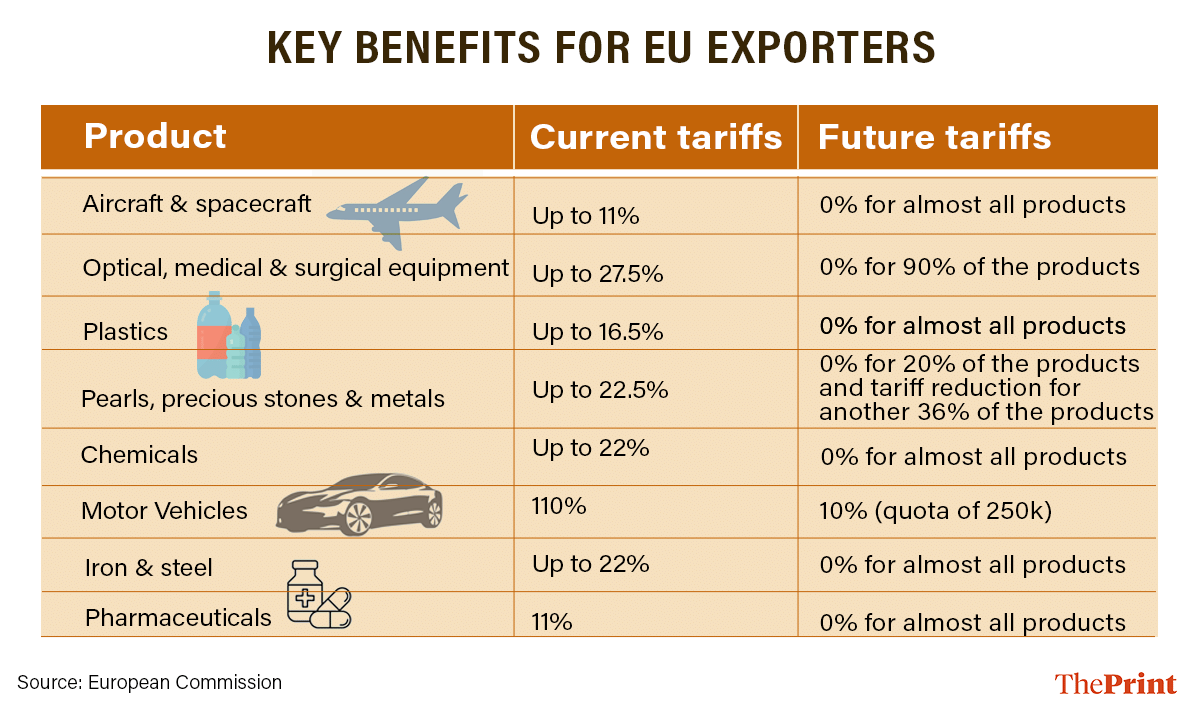
In the automobile sector, the EU’s exports to India, worth roughly $1.9 billion currently, faces a 110 percent tariff rate. This is set to reduce to around 10 percent, especially for premium cars worth above Rs 25 lakh in a calibrated cut based on quotas. The quota for European automobiles is 250,000 vehicles.
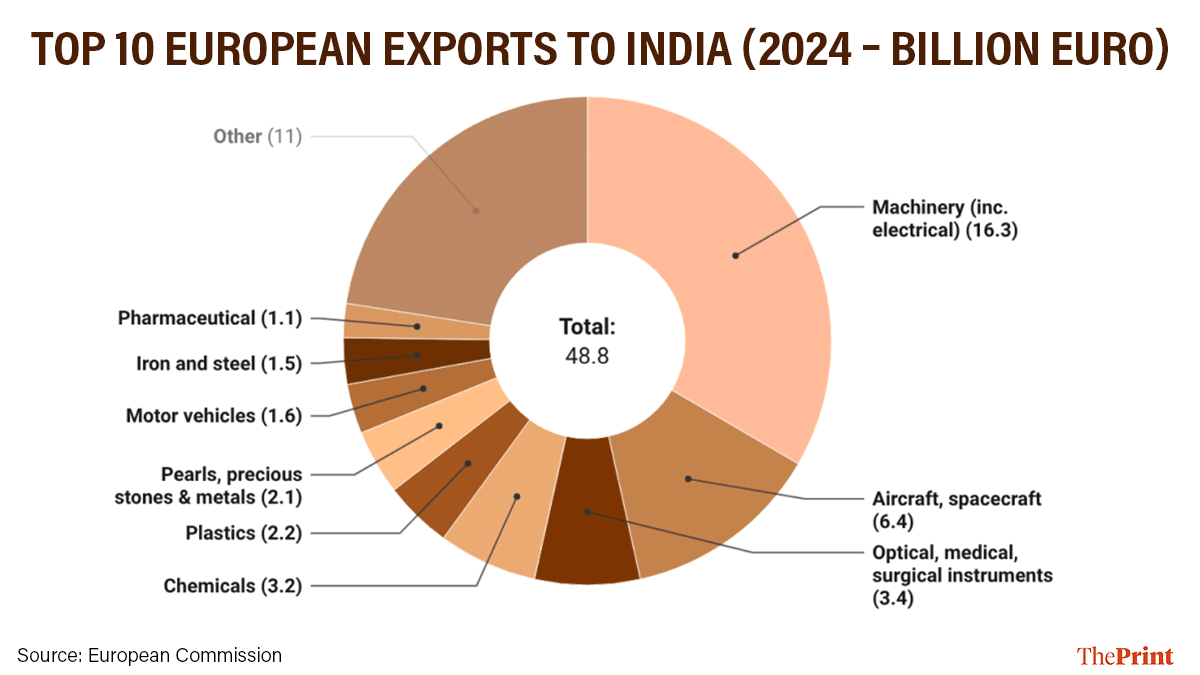
After half a decade of the FTA coming into effect, India is set to reduce tariffs on electric vehicles. In other sectors, such as machinery and electric equipment, India is set to eliminate tariffs on most goods. Other sectors to see elimination of Indian tariffs on most products include aircraft and spacecraft, optical, medical and surgical equipment, chemicals, iron and steel and pharmaceuticals.
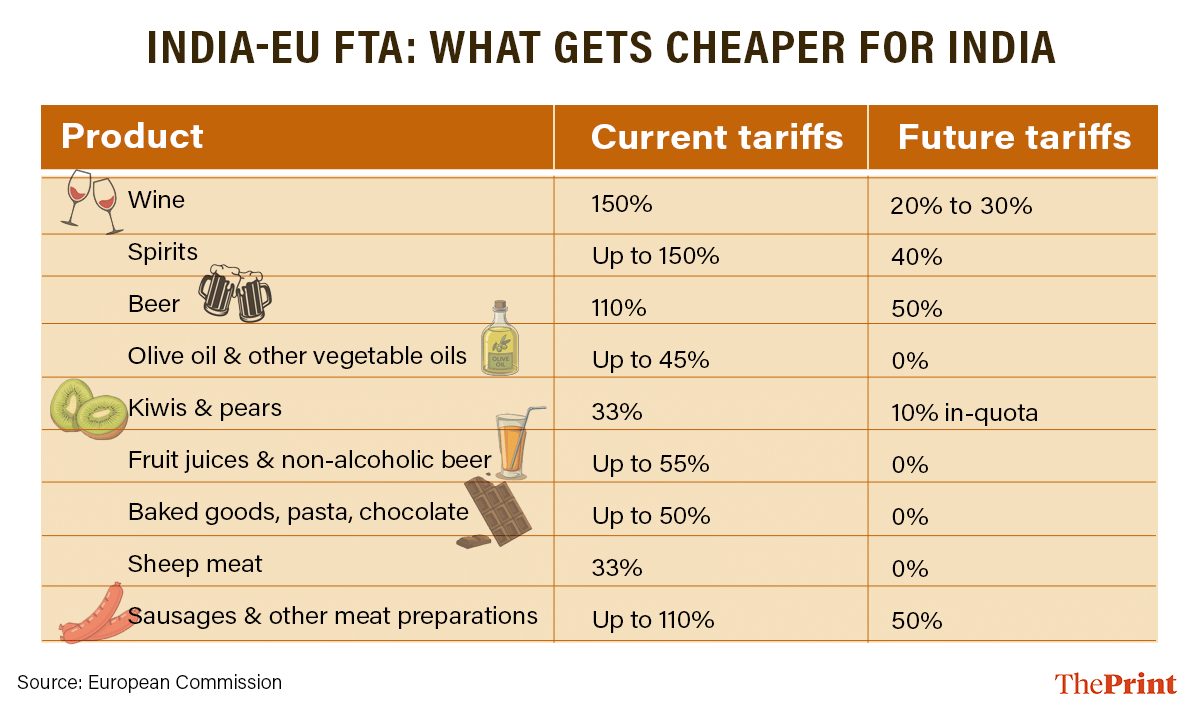
Another area where the EU exporters are expected to gain is wine. Premium wines are set to see the tariff reduced to 20 percent while the medium range of wines are set to face 30 percent tariffs from the current 150 percent duties, seeing a drastic reduction in prices for Indian consumers.
Similarly, European beer is set to see the duties more than halved from 110 percent to 50 percent, while processed foods including pastas and chocolates are set to get cheaper for Indian consumers with the complete elimination of tariffs.
Sausages and other meat preparations are set to become cheaper for Indian consumers as tariffs on these European products will fall to 50 percent from the current 110 percent.
These gains, however, will come into effect only after the FTA has been ratified by both India and the EU parliaments. The process is expected to take roughly a year, with the final agreement currently under legal review. The next stage is signing the agreement before it goes through internal processes of ratification.
(Edited by Ajeet Tiwari)
Also Read: PM Modi has a shot at history-making with EU’s India visit