





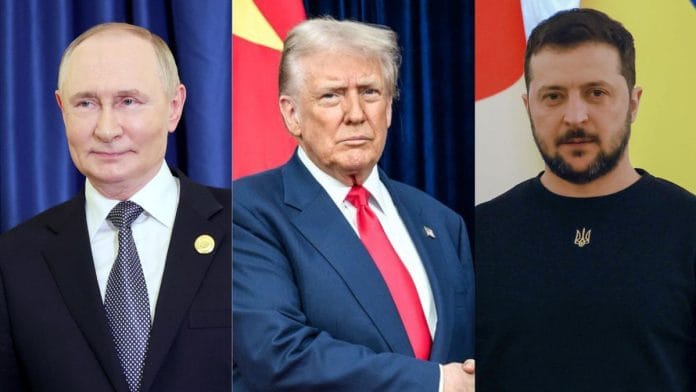



New Delhi: Putin Thursday announced that Ukraine must withdraw from the entirety of the Donbas in the East, including areas now held by Kyiv, and cede the territory to Moscow’s control before any ceasefire deal is signed—his most expansive comments yet on the peace negotiations with a particular emphasis on his maximalist demands for ending the conflict.
“If Ukraine’s troops leave the territory occupied, then military action will stop. If they won’t leave then we will achieve that by armed force,” declared Putin while speaking at a press conference Thursday in the Kyrgyz capital of Bishkek.
His comments come a week after hectic negotiations between Russia and the US and its allies in Europe and Ukraine to find an end to the almost four-year long conflict.
With Putin now doubling down on his demand of Ukraine ceding the Donbas region before any ceasefire deal, and US President Donald Trump backing off from his Thanksgiving deadline, Ukraine President Volodymyr Zelenskyy is fast running out of options.
In recent months, Russia made some battlefield gains, progressing into the key cities of Kupyansk and Pokrovsk. Moscow, however, is struggling to gain territory in eastern Ukraine, and the few significant gains it made reportedly came at high costs.
Though Putin demands immediate recognition from the US and EU of Russian control over the Donbas region, he doesn’t expect immediate Ukrainian recognition of the transfer of territory. “We need confirmation, but not from Ukraine, of course. I’m sure, in the future, we’ll be able to talk to Ukraine,” he said Thursday.
Putin’s hardline comments on peace terms come after reports that the 28-point US peace plan has been significantly altered. Negotiations between US and Ukraine officials in Geneva significantly cut down the terms—a development seen by EU and Ukraine as too close to conceding to Russian demands.
US State Secretary Marco Rubio met Ukrainian official Andriy Yermak in Geneva last Sunday. Intense negotiations during the week got the 28-point peace plan down to 19 points, Financial Times reported, citing a Ukrainian delegation member, Sergiy Kyslytsya.
Russian officials maintained a week of quiet, merely saying that any peace plan should stick to the “spirit of Alaska”. The original 28-point peace plan was seen by Putin and other Russian officials as based on negotiations at the Alaska summit between Putin and Trump this August.
European leaders were blindsided by the plan and many of them reportedly became aware of it from the media. The EU leadership spent the weekend at the G20 summit in Johannesburg in an attempt to return to the seat at the negotiating table.
The original plan would have seen Kyiv ceding territory to Moscow, namely the provinces of Donetsk, Luhansk and Crimea. Kyiv continues to control around a quarter of the territory in Donetsk. The Eastern regions, especially Donetsk and Luhansk are commonly referred to as the Donbas.
Russia launched a “special military operation” against Ukraine in February 2022, opening the current phase of open warfare between the two countries. Since 2014, the Crimean peninsula has been occupied by Moscow, while the eastern provinces had attempted to split from Ukrainian control.
The whittling down of the 28-point peace plan to a 19-point plan has seemingly triggered Moscow. US President Donald J. Trump’s special envoy Steve Witkoff is expected to travel to Russia in the first half of the next week to deliver the latest plan discussed by Washington, DC, along with their European allies and Kyiv.
Europe too had come up with a counter-proposal to the US-backed peace plan. There were critical disagreements between the two, mainly around territorial transfers to Russia, a cap on the size of the Ukrainian military and Ukraine’s relationship with NATO with the associated security guarantees.
Also Read: Indian-born scientist wrote to Obama on fossil fuel lobby. Fox News called him dangerous
Ceding of territory & cap on troops
“Putin wants legal recognition for what he has stolen to break the principle of territorial integrity and sovereignty. And that’s the main problem,” Zelenskyy said this week, appearing on video at the Fourth Parliamentary Summit of the Crimea Platform at the Swedish Riksdag (parliament) in Stockholm.
The European counterplan text, as published by Reuters, did not rule out transfer of territory. It said negotiations on territorial swaps will start from the line of contact between the Russian and Ukrainian armies.
The US-backed plan, on the other hand, proposed that Crimea, Luhansk and Donetsk will be “recognised de-facto” as Russian, even by the US. The legal implications of this phrasing are not clear.
Zaporizhzhia and Kherson will have the front lines frozen and no further territorial claims will be made by Russia, according to the 28-point plan. Russia does not control large parts of Donetsk, Kherson and Zaporizhzhia, but holds territory elsewhere, including in areas bordering Sumy where Russia had launched an offensive.
The European plan further called for an 8,00,000 cap on troops in the Ukrainian military in peacetime while the 28-point plan called for a 6,00,000 cap on ‘Ukrainian Armed Forces’. There is room for interpretation on the definition of armed forces considering reserves and paramilitary units.
For comparison, in the midst of war in 2025, Ukraine’s army has active personnel of around 9,00,000. In the pre-war era before 2022, Ukraine had around 2,00,000 active personnel, according to Global Firepower that ranks the military strength of nations.
NATO membership & Kyiv’s domestic troubles
One contentious issue is Ukraine’s “freedom to choose future alliances”, also considered as a root cause behind the Russian invasion.
A week before the invasion of Ukraine in February 2022, Putin had raised concerns over Ukraine’s NATO membership bid in Moscow, after meeting with then German chancellor Olaf Scholz.
For Ukraine, joining NATO is a matter of sovereignty and a vital security guarantee against future Russian aggression.
“No third country has the right of veto, or has the right to block our choice, I mean a Ukrainian choice, the choice of our people to choose any alliances,” the Ukrainian foreign minister had told ThePrint this March.
The 28-point plan called for Ukraine’s constitution to enshrine neutrality, ruling out any membership of NATO. The EU plan, however, removed this stipulation.
EU’s insistence on Ukraine having an option to join NATO has been a red line for Russia and is often cited by Moscow as a reason for the start of war.
Zelenskyy also acknowledged concerns regarding personnel issues in the army, saying “There are issues that should have been resolved long ago…we need a truly fair, rational distribution of personnel among brigades.”. The remark comes in the wake of Putin’s statements claiming success along the front.
After repeated claims of progress from his officials, Trump said to reporters that he doesn’t have a deadline for the agreement and posted on his TruthSocial platform Wednesday that he wouldn’t meet Putin or Zelenskyy until a deal is finalised or is “in its final stages”.
Negotiations to end the almost four-year conflict have brought to the fore the fault lines between the Trump administration, European powers and Kyiv.
Trump’s administration has, according to reports, attempted to mediate from a position of neutrality, despite almost $70 billion worth of military aid given to Ukraine.
For the EU, which had long dominated European affairs, the efforts by Moscow and Washington to apparently side-step Brussels indicate its diminishing power to address the conflict at its door.
Aditya GV is an alum of ThePrint School of Journalism, currently interning with ThePrint
(Edited by Nida Fatima Siddiqui)
The author Aditya writes in the language of pro NATO mainstream Western media. It should have been better if he had verified the facts from independent sources. Otherwise this piece more like copy pasting neo liberal mainstream western media.