





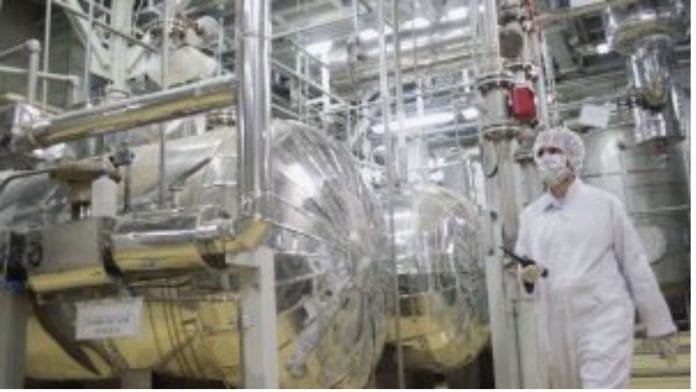



New Delhi: As the US-Israel joint operation against Iran enters its fifth week, the US President is evaluating the possibility of a ground-based military operation to appropriate 1,000 pounds (nearly 450 kg) of uranium from Tehran.
The mission, as described by US officials, is a complex and risky one, which would likely require American troops on Iranian soil for several days.
Officials familiar with the discussion in Washington told The Wall Street Journal that the final decision on the operation is yet to be reached, but President Trump is “open to the idea”.
According to the US officials, the ground operation to take over Iran’s uranium is necessary, as it prevents Tehran from developing any kind of nuclear weapon. However, the US president is reportedly still deliberating on the operation and the danger it poses to the US military.
Also read: Why Pakistan and Saudi Arabia can’t stay out of the Iran-US war
The ‘nuclear dust’
The source told WSJ that the US administration’s strategy is to press Iran to surrender its nuclear programme, along with the fissile material, as a precondition to end the war.
The source further added that, in a private conversation with political allies, the US president has been clear that Iran cannot retain its uranium and if Tehran does not agree to surrender it at the negotiating table, Washington will have to seize it by force.
On Sunday night, the US president told the reporters: “Iran must comply with the US demands or else they are not going to have their country.” While talking about the Iranian uranium, the US President added, “They’re going to give us the nuclear dust.”
The US administration is showing urgency over Iran’s nuclear mission because, before US & Israel’s airstrike last June, Tehran had reportedly more than 400 kilograms of 60 per cent enriched uranium and 200 kilograms of 20 per cent fissile material, which can be easily converted to a 90 per cent weapon-grade uranium.
Rafael Grossi, Director General, International Atomic Energy Agency (IAEA), also said at a press briefing earlier this month in Vienna that Iran’s nuclear material is likely located at the underground facilities of Isfahan and Natanz, which were targeted in June.
Operational complexity
Notwithstanding the US president’s ambitions, military experts and former officers told the WSJ that any attempt to seize Iranian uranium will result in retaliation from Tehran, which could extend the conflict by more than four to six weeks.
The experts also added that the extraction of uranium is also going to be a difficult task, as the US troops have to fly to the sites under the constant threat of Iranian surface-to-air missiles and drone swarms. Once on the ground, the troops also have to secure the perimeters, which would allow the engineers to use excavating equipment while simultaneously navigating through potential mines or booby traps.
Richard Nephew, a senior research scholar at Columbia University and former nuclear negotiator, told WSJ that the removal of the radioactive material will require special operational teams and training.
“The highly enriched uranium is likely contained in 40 to 50 special cylinders that resemble scuba tanks. They would need to be put into transportation casks to protect against accidents in several trucks,” added Nephew.
Additionally, the troops have to secure an existing airfield or establish a makeshift airfield to bring back the necessary equipment and fly the fissile material out of Iran.
Retired Gen. Joseph Votel, the former commander of U.S. Central Command, told WSJ, “This is not a quick in-and-out kind of deal,” as the operation could take more than a week or longer.
The midterm factor
On the political front, the US president is also eyeing the mid-term election, where the current polling trends suggest that Republicans could face a significant loss, and a long-term ground invasion could aggravate the political risk.
Therefore, “a person familiar with the discussions” told the WSJ, that Trump doesn’t want a protracted war and hopes to conclude the conflict by mid-April, but the Pentagon is preparing for all possibilities.
Karoline Leavitt, White House Press Secretary, stated, as reported by WSJ “It’s the job of the Pentagon to make preparations in order to give the commander-in-chief maximum optionality. It does not mean the president has made a decision.”
The Pentagon is reportedly deploying quick-response Marine units and paratroopers from the Army’s 82nd Airborne Division in the conflict region. These units are considered crucial if President Trump wants to seize other strategic locations, such as islands off Iran’s southern coast.
US officials also told WSJ that the Pentagon is planning to deploy an additional 10,000 ground troops to expand the military options for White House.
Diplomatic backchannel talks
Even though military operations are being prepared for the US president, Pakistan, Turkey, and Egypt are making diplomatic efforts to arrange communication between Washington and Tehran.
Marco Rubio, US Secretary of State, last week suggested that Washington might be able to achieve all its objectives without putting any troops on the ground.
However, according to the Defence Intelligence Agency, the US Department of Defence’s combat support agency, the threat from the Iranian missile programme remains real as Tehran can use its space launch technology to build intercontinental ballistic missiles capable of reaching the US.
The US administration is also hopeful that Iran will voluntarily renounce its nuclear ambitions as part of the peace settlement. The US has a history of such peaceful transfer of nuclear technology, including Project Sapphire in Kazakhstan and a 1998 operation to remove uranium from Georgia.
However, Pete Hegseth, US Secretary of War, has stated the US military position in a recent press conference, where he said, “The president has kept his eye focused on nuclear capabilities. We have a range of options, up to and including Iran deciding that they will give those up, which of course we would welcome.”
In response to how far the US is planning to go against the Iranian nuclear programme, Hegseth added, “I would not, never tell this group or the world what we’re willing to do or how far we’re willing to go, but we have options, for sure.”
(Edited by Viny Mishra)
Also read: Iran warns of Bab al-Mandeb disruption if US puts boots on the ground