





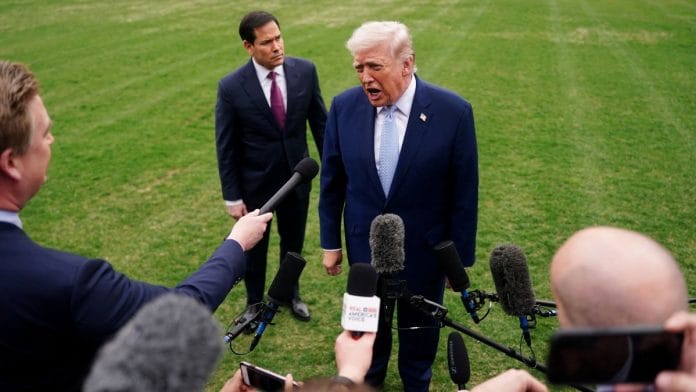



New Delhi: US President Donald Trump Monday directed his Department of Defence to “postpone” any strikes on Iranian energy infrastructure for five days, as the two countries have been having “productive conversations” on the “total resolution” of the current conflict in West Asia.
“I am please (sic) to report that the United States of America, and the country of Iran, have had, over the last two days, very good and productive conversations regarding a complete and total resolution of our hostilities in the Middle East,” Trump said in a post on Truth Social.
The American President added: “Based on the tenor and tone of these in depth, detailed, and constructive conversations, witch (sic) will continue throughout the week, I have instructed the Department of War to postpone any and all military strikes against Iranian power plants and energy infrastructure for a five day period.”
Trump’s statement comes hours ahead of the expiry of the deadline the US President had set for Iran to open the Strait of Hormuz. The international waterway sees roughly a fifth of the total global supply of crude oil pass through. However, since the war began at the end of February, the passage of maritime vessels through this global choke point has been disrupted.
Meanwhile, Iran’s state-owned Press TV said a post on X: “An Iranian source says there was no contact—whether direct or indirect—with Trump, adding he backed down after being warned their targets would include power plants across West Asia.”
🔴 An Iranian source says there was no contact—whether direct or indirect— with Trump, adding he backed down after being warned their targets would include power plants across West Asia.
— Press TV 🔻 (@PressTV) March 23, 2026
It should be noted that the US President has in the past announced that Washington and Tehran have been engaged in conversations, only to carry out aggressive action against Iranian sites. It happened in June 2025, when the two sides were negotiating over restrictions to Iran’s nuclear programme. Ahead of the February strikes, the two sides were negotiating an agreement on Iran’s nuclear programme, with Oman mediating.
Iran Sunday said it has not closed the Strait of Hormuz for vessels from non-combatants. However, the number of ships that have passed through the strait has been minimal. A number of ships set for India have been stranded in this waterway for the last three weeks. Two ships carrying liquefied petroleum gas to India were allowed to leave the Strait of Hormuz earlier this month, while two more ships are currently on their way to India.
The disruption to the supply of energy resources from West Asia has seen a surge in prices. The Brent future benchmark for crude oil is currently at $108 a barrel, roughly a 40 per cent increase since the war began. The price of gasoline in the US is inching upwards to $4 a gallon, which is politically untenable for Trump.
The US President promised to lower fuel prices across the US during his election campaign a couple of years ago. The US heads to mid-term elections later this year, and any sustained increase in gasoline prices could undermine Trump’s economic messaging domestically.
Fears over further disruption to global energy markets intensified last week after Israel launched strikes at Iran’s largest natural gas field in South Pars. Iran retaliated with strikes across the region.
Iran’s retaliation damaged production facilities for liquefied natural gas (LNG) of QatarEnergy, the Qatari state-owned petroleum company. Around 17 per cent of Doha’s annual LNG export capacity was wiped out in the damage caused by Iran at the QatariEnergy facilities in Ras Laffan.
Similarly, the United Arab Emirates’ Habshan gas field was also targeted by Iran. Hours after Trump’s ultimatum to Tehran over the weekend, Iran promised to strike at energy and critical infrastructure across the region. The promise of further escalation worried West Asian nations, as Iran declared critical infrastructure such as water desalination plants as legitimate targets, which would impact lives of millions of civilians in the Gulf.
Trump has been pushing for an international coalition to maintain the security of the Strait of Hormuz, but has found no support amongst his European allies. Last week, Trump declared that the US has begun “winding down” its operations in West Asia.
The conflict is now into its fourth week. Despite its top leadership being assassinated, Iran has been able to respond to strikes conducted by Israel and the US. Over the weekend, Iran successfully targeted the Israeli cities of Dimona and Arad. Dimona is home to Israel’s nuclear reactor.
The disruption to the Strait of Hormuz has also forced the US to issue sanction waivers to allow countries to purchase both Iranian and Russian crude. The waivers allow countries to purchase all crude currently in transit from Iran and Russia.
Trump’s administration in the last year sought to pressure countries to stop purchases of Russian oil, while reimposing a number of sanctions on purchasing Iranian crude. India faced the brunt of Trump’s punitive measures, with the American president imposing 25 per cent tariffs on New Delhi due to its reliance on Russian crude. The punitive tariffs were in effect between August 2025 and February 2026 and were removed following the India-US trade deal, announced last month.
(Edited by Viny Mishra)
Also read: Trump says US considering ‘winding down’ Iran ops, as US moves to ease global energy disruptions