





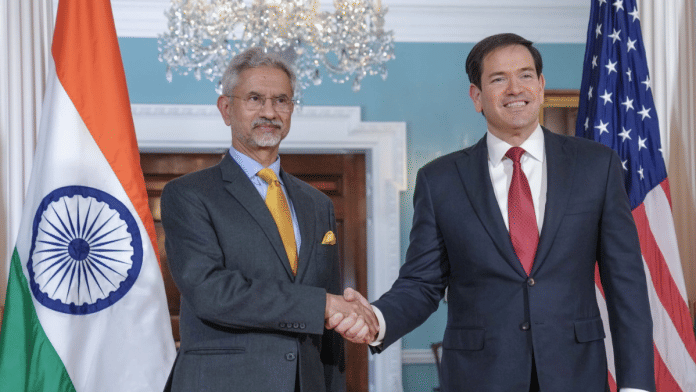



New Delhi: A day after Washington DC and New Delhi announced a long-awaited trade agreement, US Secretary of State Marco Rubio signalled an interest in “expanding bilateral and multilateral cooperation through the Quad” after his meeting Tuesday with External Affairs Minister (EAM) S. Jaishankar.
The EAM is in Washington DC for the Critical Minerals Ministerial convened by the US Wednesday.
In a readout of the bilateral meeting, US State Department Principal Deputy spokesperson Tommy Pigott said that Rubio and Jaishankar “concluded their meeting by expressing their commitment to expanding bilateral and multilateral cooperation through the Quad” and acknowledged “that a prosperous Indo-Pacific region remains vital to advancing our shared interests.”
Jaishankar, however, made no mention of Quad in his post.
Delighted to meet US @SecRubio this afternoon.
A wide ranging conversation that covered our bilateral cooperation agenda, regional and global issues.
Facets of India – US Strategic Partnership discussed included trade, energy, nuclear, defence, critical minerals and… pic.twitter.com/1rbXJHgEQY
— Dr. S. Jaishankar (@DrSJaishankar) February 3, 2026
Washington has, in recent years, publicly endorsed New Delhi’s role as a stabilising force in the Indian Ocean region, a part of its broader strategy to counter China’s growing influence. In a joint US–India statement in February 2025, it reaffirmed American support for that role. India is the current rotational chair of the informal four-nation grouping whose other members are Australia and Japan.
Jaishankar, meanwhile, posted that the two sides held a “wide-ranging conversation” covering trade, energy, nuclear cooperation, defense, critical minerals and technology, and added that they “agreed on early meetings of various mechanisms to advance shared interests”.
Quad & Trump
For US President Donald Trump, the Indo-Pacific region is crucial and contested amid competing interests with China. The objective of Quad essentially remains establishing a rules based order in the region and is also a priority for the US president who revived it in 2017 in his first term for a “free and open Indo-Pacific”—an alternative to China.
The Biden administration took it to summit level with agendas spanning maritime security, climate change to STEM fellowships.
But post the Biden era, it has not seen a leader level summit since 2024. Administrations have changed since then, as have the India-US relations.
In Trump 2.0, a meeting of Quad foreign ministers was held the day after Trump’s inauguration. After a shift in policies, in the Quad foreign ministers in July 2025, the group unveiled a new set of four priorities: maritime and transnational security; economic security; critical and emerging technology; and humanitarian assistance and emergency response.
EAM Jaishankar had then said that the Quad’s mission was now focused on building capabilities and reducing vulnerabilities rather than providing for the region.
China, meanwhile, has at multiple times taken a direct dig at Quad. In January, China and Pakistan used a joint communiqué warning against what they described as “hegemonism,” “bullying behaviours” and the formation of “small circles”, to aim at India and Quad after the seventh round of the Pakistan-China Foreign Ministers’ Strategic Dialogue, held in Beijing.
With a new trade agreement in place, Quad seems back in focus. Rubio, in a post on X, described the meeting as an opportunity with Jaishankar as an opportunity “to discuss our bilateral cooperation on critical minerals exploration and work together to unlock new economic opportunities between our two countries.”
The Quad leaders’ summit, which was to be hosted by India in 2025, has yet to be scheduled after Trump was initially reluctant to attend it but Australia has been pushing for it to be held in the first half of 2026.
US Ambassador to India Sergio Gor had said before the U.S. Senate Foreign Relations Committee in October 2025, that the group is continuing diplomatic efforts for a leader-level summit in early 2026.
(Edited by Tony Rai)
Also Read: Thank you Donald Trump, again. India now has reason to shed fear of trade deals and risky reform