





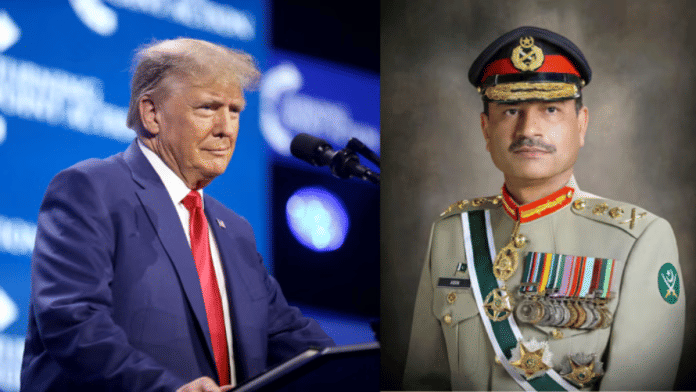



New Delhi: Pakistani Army Chief, Field Marshal Asim Munir, spoke with US President Donald Trump Sunday, as Islamabad steps up efforts to be a mediator to end the current conflict in West Asia, the Financial Times reported Monday.
“Army chief Asim Munir spoke with Trump on Sunday, according to two people briefed on the call, while Pakistani Prime Minister Muhammad Shehbaz Sharif held talks with Iranian President Masoud Pezeshkian on Monday,” reported the British newspaper.
The report added, “The conversation between the Pakistani and Iranian leaders came at around the same time as Trump announced that he was delaying his threat to ‘obliterate’ Iran’s power plants after ‘very good and productive’ conversations with Tehran to end the war.”
There is no clarity whether the back channel negotiations between Islamabad, Washington and Tehran, led to Trump delaying the strikes he threatened on Iran’s energy infrastructure Monday.
The US President had originally given Iran 48 hours to open up the Strait of Hormuz last weekend, the global trade choke point that has been disrupted since the war between the US, Israel and Iran began on 28 February.
However, Trump Monday said there are ongoing “productive conversations” between the US and Iran to arrive at a resolution to the ongoing West Asian conflict. The US President further directed the Department of Defence to postpone any attack on Iran’s energy infrastructure by five days.
Pakistan, along with Türkiye and Egypt, has emerged as countries that are vying to mediate an end to the almost four-week long conflict. Ankara has been in touch with Trump’s Middle East envoy Steve Witkof and Iranian officials in an attempt to “secure a brief ceasefire” and open the space for negotiations, the British newspaper reports.
“Pakistan’s foreign minister Muhammad Ishaq Dar held talks with his Turkish counterpart Hakan Fidan on Monday. Egypt’s foreign minister Badr Abdelatty also spoke to his Iranian and Pakistani counterparts on Sunday, as well as Witkoff and Qatar’s foreign minister,” reports the Financial Times.
Iran, however, has denied there being any direct negotiations with the US. Tehran conceded that some regional countries are involved in conveying messages from the US to Iran. Esmaeil Baqaei, the spokesperson for the Iranian Foreign Minister, informed IRNA, the official news agency of Iran, that Tehran had sent “appropriate responses” to the messages conveyed by the US through third countries.
The Financial Times reports that Ishaq Dar, Pakistan’s Deputy Prime Minister and Foreign Minister, informed his counterparts from West Asia last week that Islamabad is “mediating” between the US and Iran, but did not share further details.
Oman and Qatar have been the traditional West Asian nations mediating negotiations between Tehran and Washington D.C. Muscat had been the chief mediators in the last set of conversations between the US and Iran last month, before Trump decided to strike Tehran.
Field Marshal Munir and Pakistan have focused on improving ties with the US in the last year. From cryptocurrency deals to nominating Trump for the Nobel Peace Prize, Islamabad has sought to deepen its ties with the Trump administration through different avenues.
Islamabad had also ramped up its lobbying efforts in Washington last year, hiring a number of lobbying firms. The conflict in West Asia leaves Pakistan uniquely vulnerable to disruptions in the supply of energy resources.
Islamabad heavily relies on West Asia for oil and gas imports. The country has instituted a number of emergency measures since the war began. Almost 10 per cent of its gross domestic product was spent on fossil fuel imports in 2024. Over 90 percent of these imports passed from the Strait of Hormuz.
Iran has maintained that the Strait of Hormuz is not closed for vessels from non-combatants Sunday. At least four tankers travelling to India have transited the global waterway in the last couple of weeks, carrying liquefied petroleum gas (LPG).
(Edited by Ajeet Tiwari)
Also Read: Why Pakistan and Saudi Arabia can’t stay out of the Iran-US war
Munir is attacking Afghanistan, not military facilities, but civilian buildings, even hospitals, and here he is trying moderate between USA and Iran. As if Trump will listen to him. It is to be noted that Munir is not trying to speak to Israel.