





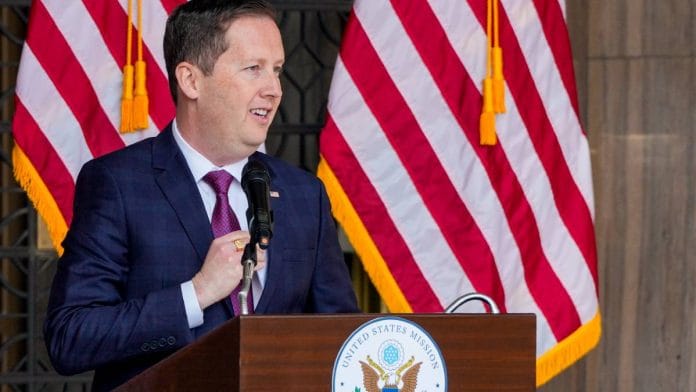



New Delhi: The next call on trade between the negotiating teams of India and the US is set for Tuesday, and Washington will invite New Delhi to join its flagship critical supply chain initiative Pax Silica next month, Sergio Gor, US ambassador-designate to India, said in his address to US embassy staff and the media in the national capital Monday.
The Pax Silica initiative is the US State Department’s effort to shore up supply chain security in advanced technology areas such as artificial intelligence and semiconductors. It was announced last month, with India not among its founding members.
“I want to share with you today a new initiative that the United States launched just last month called Pax Silica. It is a US-led strategic initiative to build a secure, prosperous and innovation-driven silicone supply chain, from critical minerals and energy inputs to advanced manufacturing, semiconductors, AI, development and logistics,” Gor said.
“Nations that joined last month include Japan, South Korea, United Kingdom and Israel. Today, I’m pleased to announce that India will be invited to join this group of nations as a full member next month. As the world adopts new technology, it is essential that India and the United States work hand in hand from the very start of this initiative.”
Gor further declared the India-US partnership as the “most consequential” for this century, adding that he envisions his role to further the “ambitious agenda” between the two nations.
“We are raising the standard for diplomacy itself, that means fair trade, mutual respect and shared security. Many of you have asked me for an update on the ongoing trade deal negotiations. Both sides continue to engage actively. In fact, the next call on trade will occur tomorrow,” he said.
“Remember, India is (among) the world’s largest nations, so it’s not an easy task to get this across the finish line, but we are determined to get there, and while trade is very important for our relationship, we will continue to work closely together on other very important areas, such as security, counter-terrorism, energy, technology, education and health.”
Gor arrived in India Friday and is likely to present his credentials to President Droupadi Murmu Wednesday. He was appointed by US President Donald Trump as the ambassador to India last year. Gor had also made a visit to India right after his Senate confirmation in October, where he held meetings with the senior leadership, including Prime Minister Narendra Modi.
The envoy’s address was a first-of-its-kind as it is the norm that an ambassador-designate does not speak to the media until they present their credentials.
Trump and Modi are yet to speak in the new year and it remains to be seen when the two leaders would meet in person. Gor Monday announced Trump’s intention to visit India in the next year or two.
Also Read: Thank you Donald Trump, again. India now has reason to shed fear of trade deals and risky reform
Tense India-US ties
Ties between India and the US have stumbled at the highest levels in the last few months, especially on the issue of trade. While India was one of the first nations to announce its intention to negotiate a bilateral trade deal with the US, in February last year, it has yet to come to fruition. The “first tranche” of the trade deal was expected to be complete by last autumn.
Last week, Howard Lutnick, US Secretary of Commerce, had said the deal fell through after Modi did not call Trump, while mentioning that New Delhi’s responses were slow and that meant they “missed the train” on completing the deal by July.
India rejected the assertion that Modi was unwilling to speak to the US president, with Randhir Jaiswal, spokesperson of the Ministry of External Affairs (MEA), stating that the two leaders spoke eight times in 2025.
Gor is starting his tenure in New Delhi as Washington gears up to pass a legislation allowing Trump to impose up to 500 percent import tariff on nations like India, Brazil and China for their continuing purchase of Russian oil.
India already faces some of the highest tariffs for any country exporting to the US: 50 percent.
Part of that tariff is a “penalty” imposed by Trump last August for India’s purchase of Russian crude. However, the amount of crude purchased by New Delhi has fallen since October after the US imposed sanctions on Russian oil firms Rosneft and Lukoil.
(Edited by Nida Fatima Siddiqui)
Also Read: Trump’s trade wars have rewritten powerplay, but India didn’t get the memo