





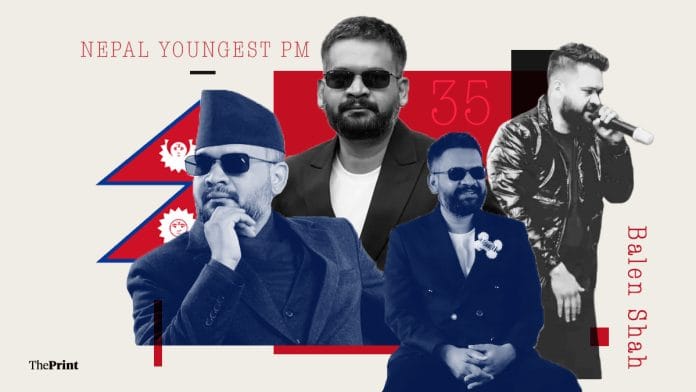



Kathmandu: With the Rastriya Swatantra Party (RSP) headed to an unprecedented majority in Nepal’s parliament, the Himalayan country is set to get its youngest prime minister ever—35-year-old maverick former Kathmandu mayor Balendra Shah who joined the relatively new RSP three months before contesting elections. Another first for Shah is that he will be the youngest prime minister in the history of the Subcontinent.
Nepal politics is now seeing what analysts term the ‘Balen wave’. Founded by journalist-turned-politician Rabi Lamichhane in 2022, it was the fourth largest party in the 2023 elections. Lamichhane was jailed during K.P. Oli’s premiership over allegations related to fraud and citizenship. After being released during the September protests, he has largely shared the stage with Shah while platforming young Gen Z protestors.
And it worked: of the 59 young lawmakers elected, 51 belong to the RSP.
The RSP has won 125 of the 165 seats where the counting is complete. Given there are 275 seats on parliament, a party needs 184 to secure a two-thirds majority.
Of this, 165 seats were decided by direct voting, along with 58 of the 110 proportional representation seats. This puts the party just two seats shy of the two-thirds threshold. RSP has secured more than half of the votes counted so far under the proportional representation system for the House of Representatives. According to the latest consolidated data from counting centres nationwide, the party has received 1,461,381 votes out of a total 2,910,677 ballots, accounting for around 50.2 per cent of the vote.
If RSP achieves this, it would be the first time in decades that a single party has commanded such a decisive mandate. Nepal’s dual voting system, which combines direct and proportional representation, has historically made it extremely difficult for any party to secure even a simple majority, let alone two-thirds of the seats.
Nepal now confronts a question that goes far beyond one man’s popularity: Can the disruptive energy that reshaped city hall scale to a fragile democracy facing economic stagnation, mass migration and intense geopolitical pressure?
For Balen Shah, the appeal has always been straightforward. An engineer and rapper-turned-politician, he rose to prominence by defeating candidates from the country’s major parties in the 2022 Kathmandu mayoral race, presenting himself as an impatient reformer determined to challenge a political establishment widely viewed as ineffective. He defeated former Prime Minister KP Sharma Oli in Jhapa 5, his home turf, paving the way to become the next prime minister.
In a country where traditional parties have dominated politics for decades — including Nepali Congress, Communist Party of Nepal (Unified Marxist–Leninist), and Communist Party of Nepal (Maoist Centre) — Shah’s rise reflects a deeper shift among younger voters who increasingly distrust the old political order.
Domestic and global concerns
Nepal’s economy is sustained by the labor of millions of citizens working abroad. Remittances sent from migrants in Japan, the Gulf states and Southeast Asia account for a significant share of the country’s income.
Remittances range from 23 per cent to 28 per cent of the country’s Gross Domestic Product (GDP) in recent years. In fiscal year 2024–25, these inflows hit a record high, representing 28.6 per cent of the nation’s GDP. In villages across the country, households often depend on a son, daughter or parent working overseas.
The scale of migration has reshaped Nepal’s society and its politics. Many of those workers cannot vote easily in elections despite directives from the Supreme Court of Nepal encouraging the government to create systems for overseas voting. Yet migrants still influence politics indirectly, urging family members at home to support reformist candidates.
The anger fueling that political shift is also rooted in economics. For many young Nepalis, the decision to leave the country is not about opportunity abroad but about the absence of it at home. Salaries in entry-level jobs can be so low that basic urban living costs, rent, transportation and food, quickly consume monthly earnings.
With Shah leading the country, the central expectation from voters would be simple: create jobs so that young people no longer feel forced to leave.
Supporters praise Shah’s governing style as bold and uncompromising. His administration in Kathmandu has been marked by highly visible enforcement campaigns, including the demolition of unauthorized structures and the removal of street vendors from public spaces.
Moreover, there is internal party dynamics at play as well. Lamichhane, a former journalist known for his forceful personality, may also find it difficult to remain in the background of a party he founded. His past reactions — including his outburst after being forced to step down as home minister in 2023 over questions about his citizenship — suggest that such tensions could escalate.
Shah, too, has demonstrated a combative streak, once threatening to burn down Singha Durbar long before protesters actually set it ablaze during last year’s unrest, as analyst Pranaya Rana has noted in his piece on Nepal’s shifting politics.
Lamichhane will likely seek to return to the powerful home ministry he once held. Legal challenges facing Lamichhane could complicate matters further, forcing Shah to choose between protecting his party leader or upholding the rule of law.
Also Read: Between the ‘disruptor’ and ‘status quoist’: Balen Shah, Gagan Thapa and Nepal’s shifting politics
Geopolitics
Nepal sits between India and China, while maintaining growing ties with the United States. Brigadier Keshar Bhandari (Retired), credited for drafting the first-ever national security policy document of Nepal, told ThePrint that Shah would perhaps lead a balancing act and even make his first state visit to India.
With China, Nepal has the Belt and Road Initiative, while the US has pursued security partnerships such as the State Partnership Program, a proposal that triggered intense political debate inside Nepal.
In Jhapa 5, where Balen Shah defeated Oli, a project under the BRI has already been approved and signed by the previous government. Shah’s current manifesto does not mention it, however. This raises the question: what will happen to that project? China, of course, is unlikely to let it be shelved.
In December 2025, Nepal’s anti-corruption agency also filed what it describes as the ‘largest corruption case’ in the country’s history, charging 55 senior Nepalese officials and employees of the Chinese state-owned contractor, CAMC, with inflating the cost of the Pokhara International Airport, a flagship project under China’s Belt and Road Initiative (BRI), by roughly $74 million.
At the same time, the U.S. attempted to involve Nepal in its Security Partnership Program (SPP), aimed at closer defense cooperation. Meanwhile, China proposed its Global Security Initiative (GSI)—just before the Gen Z protest—in parliament. Both initiatives reflect a broader competition for strategic influence in Nepal.
Shah’s appeal, for now, depends on the impression that he represents a break from traditional politics. How he handles domestic and regional politics along with insider party dynamics is what will dominate questions going ahead on whether RSP’s brute majority can break the usual ‘rotating door’ politics of Nepal.
(Edited by Nardeep Singh Dahiya)
Also Read: Balen Shah’s victory signals the fall of Nepal’s old establishment. India will have to adapt