





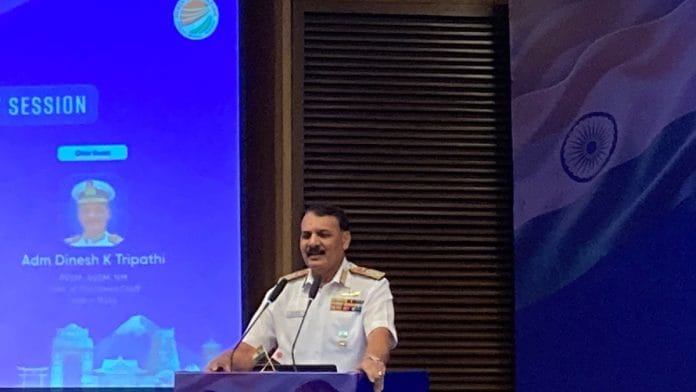



New Delhi: Modern technology has lowered the “threshold for disruption” allowing countries to “threaten” global choke points such as the Strait of Hormuz without a “notice of a blockade”, said Chief of Naval Staff Admiral Dinesh K. Tripathi Tuesday.
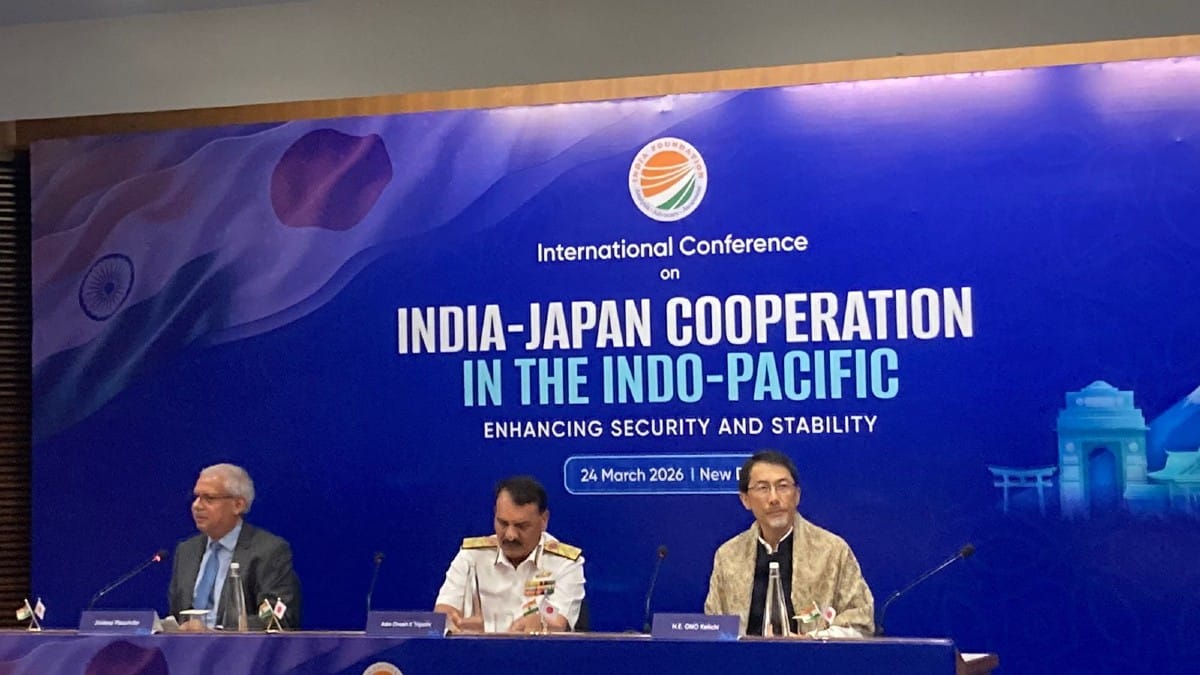
“Modern technology is lowering the threshold for disruption. Drones, unmanned systems and mines now threaten critical choke points such as the Strait of Hormuz even without a formal notice of a blockade,” Tripathi said, while speaking at the International Conference on India-Japan Cooperation in the Indo-Pacific organised by the India Foundation.
The Indian Chief of Naval Staff added: “For countries that import energy through these global commons, the fallout from any such disruption is far reaching that we are witnessing as we speak. Maritime cyber attacks doubled in 2025. Denial of satellite services and spoofing have caused vessels to run aground, disrupting trade without even a shot being fired.”
Admiral Tripathi’s comments come as the disruption to the Strait of Hormuz caused by the US-Israel war with Iran has led to an over 40 percent surge in prices of crude oil in the last four weeks.
Iran has asserted that the Strait of Hormuz has not been closed and that all but ‘enemy-linked’ ships—US and Israeli—are allowed to traverse the global waterway that accounts for a fifth of the world’s oil supplies.
Four Indian ships carrying liquified petroleum gas (LPG) have been able to transit the Strait of Hormuz after negotiations between New Delhi and Tehran.
Two of the four ships reached India last week, while two more—MV Jag Vasant and Pine Gas—are currently on their way to India, guided by Indian naval ships.
US President Donald J. Trump Monday postponed attacks on Iran’s energy infrastructure by five days, claiming that negotiations are ongoing between Washington and Tehran.
Iran has maintained that the ships are finding it difficult to transit through the Strait because insurers are unwilling to insure their safe passage.
Choke points of the future
Admiral Tripathi highlighted that the Indo-Pacific region is the “principal theatre” for what analysts today are calling “normative competition” between powers.
Without naming any country, the Indian Chief of Naval Staff pointed out that competition has involved from traditional resources such as oil and gas to “resources that will underpin future economic growth,” like critical minerals and rare earths.
“We are seeing a sharp rise in marine research activity and deep sea research. Often vessels engaging in these activities opt to go dark and intrude into littoral EEZs or sensitive maritime zones violating rules and norms. These are the emerging flashpoints in the region,” said Tripathi.
China has been increasingly sending its marine research vessels to map out the seas surrounding India. These research vessels have been perceived by New Delhi as spy vessels, as the information gathered can be of dual-use, with both civilian and military purposes.
India has taken up the berthing of these Chinese vessels in countries such as Sri Lanka and the Maldives in the last couple of years. The region is also witnessing an “intense competition for information”, said Admiral Tripathi.
Undersea cables and associated infrastructure have “increasingly become choke points”, he added, pointing out that the Red Sea crisis last year impacted up to 25 percent of data flow between Asia and Europe.
(Edited by Amrtansh Arora)
Also Read: Iran war is a sign to course correct for India. Navy must step up