





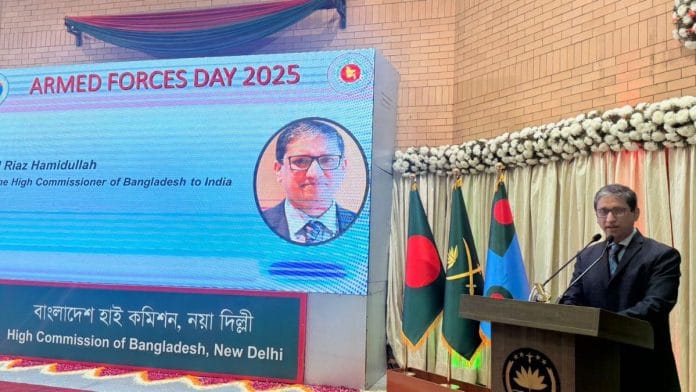



New Delhi: India Wednesday summoned the Bangladesh High Commissioner Riaz Hamidullah over “strong concerns at the deteriorating security environment in Bangladesh,” and plans by extremist elements “to create a security situation around the Indian Mission in Dhaka”.
Bangladesh is heading to elections on the 12 February next year.
After election dates were announced last week, Sharif Osman Hadi, a spokesperson for Inquilab Mancha who was also an independent parliamentary candidate, was shot at in Dhaka. The Mancha is a platform that emerged from student-led protest networks associated with the July uprising. Bangladesh-based news outlets cited claims to suggest that the shooters fled to India but no such evidence has been provided.
“India completely rejects the false narrative sought to be created by extremist elements regarding certain recent events in Bangladesh. It is unfortunate that the interim government has neither conducted a thorough investigation nor shared meaningful evidence with India regarding the incidents,” the Ministry of External Affairs (MEA) said in its statement Wednesday. The MEA also added that “India has close and friendly relations with the people of Bangladesh rooted in the liberation struggle, and strengthened through various developmental and people-to-people initiatives.”
“We are in favour of peace and stability in Bangladesh and have consistently called for free, fair, inclusive and credible elections, conducted in a peaceful atmosphere,” it added.
A demarche was issued to Hamidullah Wednesday, after National Citizen Party’s convenor Nahid Islam announced that they would take to the streets on 16 December, Bangladesh’s Victory Day in resistance to “Indian interference” in the country’s politics.
Hasnat Abdullah, another NCP member, threatened to “isolate the Seven Sisters” and give “refuge to separatists” as an act of retribution, if India did not “respect their sovereignty”.
“If Bangladesh is destabilised, the fire of resistance will spread beyond borders. Since you are housing those who destabilise us, we will give refuge to the separatists of seven sisters too,” Hasnat said Monday at an all-party protest rally organised by Inqilab Mancha in Dhaka’s Central Shaheed Minar. It drew representatives from a wide ideological spectrum, including the Bangladesh Nationalist Party (BNP), Jamaat-e-Islami, Gano Odhikar Parishad, AB Party and Islami Andolan Bangladesh, local reports stated.
Islam described the attack as a sign of a broader political assault. “With the bullet hitting Osman Hadi, the July Revolution has been attacked.” He claimed the Awami League was operating from exile in New Delhi with Indian backing and was seeking to re-establish influence within Bangladesh’s administration, police, universities and media.
“Unless the Awami League issue is resolved comprehensively in society and politics, none of us will be safe,” he said after a meeting with Bangladesh interim chief Muhammad Yunus, which was attended by opposition leaders and members of Hadi’s family.
NCP politicians had earlier Monday threatened to carry out a march in front of the Indian High Commission in Dhaka, alleging interference by New Delhi in Bangladesh’s domestic politics.
Following this, Bangladesh’s foreign ministry issued a statement calling on New Delhi to prevent suspects linked to the attempted killing from crossing into Indian territory and to ensure their arrest and extradition should they do so.
India, the MEA responded Sunday, has never allowed its territory to be used for activities inimical to the interests of the friendly people of Bangladesh.
After the announcement of rallies Tuesday, the US embassy in Dhaka too issued an advisory cautioning its citizens, adding that “demonstrations intended to be peaceful can turn confrontational and escalate into violence”.
Hamidullah, on his part, at an event commemorating the Victory Day Tuesday talked about lasting India-Bangladesh ties as he hailed Indian sacrifices in the War and talked about the “organic” relations between both countries.
Dhaka Police Wednesday afternoon stopped a march by a group calling itself “July Oikya” as it headed toward the Indian High Commission. The protesters demanded the return of former prime minister Sheikh Hasina and others who fled to India during and after last year’s July uprising.
This is an updated version of the report
(Edited by Vidhi Bhutra)
We are too diplomatic which is probably required. But it’s also time to show that we can do damage if required. Economically and politically.