





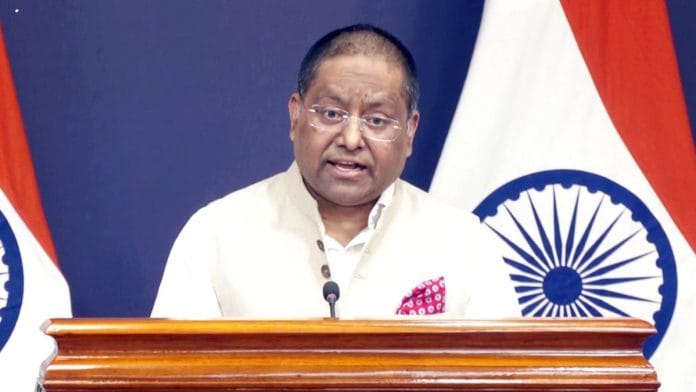



New Delhi: India Thursday rubbished a Bloomberg report that said National Security Adviser Ajit Doval had a secret meeting with his American counterpart Marco Rubio to smooth over ties and move forward with the negotiations over the trade deal.
“Regarding the report by Bloomberg, I would like to say that there is absolutely no basis for that report. No such meeting or no such visit has taken place,” Ministry of External Affairs (MEA) spokesperson Randhir Jaiswal said at a regular press briefing.
India’s denial comes a day after Bloomberg reported that Doval had made a secret visit to the US days after Prime Minister Narendra Modi met with Chinese President Xi Jinping and Russian President Vladimir Putin in the Chinese city of Tianjin for the Shanghai Cooperation Organisation (SCO) summit with a message: New Delhi wanted to put behind the acrimony that had built up between the two countries since the end of Operation Sindoor.
Bloomberg further reported that Doval underlined India “wouldn’t be bullied by US President Donald Trump and his top aides” and was willing to wait out the current administration’s tenure, given that India has faced “hostile” American administrations in the past.
The American media company claimed that it was days after this meeting that Trump called Modi and wished him for his birthday on 16 September. By the end of 2025, the two leaders had spoken a few more times, as ties seemed to thaw following a contentious call between the two last June.
The MEA made clear Thursday that such a meeting or visit did not take place between Doval and Rubio that led to improvement in ties. India and the US Monday announced the reduction of tariffs from 50 percent to 18 percent, following a call between Modi and Trump.
The US President further claimed that a trade deal had been reached between the two countries, wherein India would lower its tariffs on a number of areas to zero, in exchange for American tariffs of 50 percent being cut down to 18 percent.
India has made it clear that the trade deal will protect its sensitive agricultural and dairy sectors. It is likely that India may make similar concessions as seen in the free trade agreements with the European Union (EU) and New Zealand to allow certain agricultural products, not commonly produced domestically, to be imported with conditions.
Commerce and Industry Minister Piyush Goyal Thursday in an interaction with the media announced that the first tranche of the trade deal is likely to be signed within the next 30 to 45 days, and a joint statement is expected in the next few days.
The joint statement would offer the broad contours of the deal, while the legal framework would be inked sometime in March. The deal marks a thaw in otherwise frosty ties that defined the India–US relationship in the last half of 2025.
In June last year, Modi and Trump had a contentious call, where the Indian Prime Minister had made clear that neither the US nor its threat of tariffs led to the ceasefire with Pakistan following Operation Sindoor. Trump has repeatedly claimed that the US played a role in leading to the pause, a position Islamabad has backed.
India has maintained that it was a bilateral understanding reached by the two Director Generals of Military Operations (DGMOs) on the afternoon of 11 May, bringing the 87-hour conflict to a pause.
Trump’s advisers such as Peter Navarro had also hit out at India’s purchases of Russian oil, which led to the US President imposing a punitive 25 percent tariff on imports of Indian goods from the end of August 2025.
The punitive tariffs were placed on top of the reciprocal tariff rate of 25 percent, thereby, placing the total tariffs imposed at 50 percent – one of the highest imposed globally by the US. However, with the deal in place, the tariff rates are expected to be cut once the agreement is inked.
(Edited by Vidhi Bhutra)
Also read: Nuances, complexities & sore points of India-US trade deal sealed by Trump & Modi