





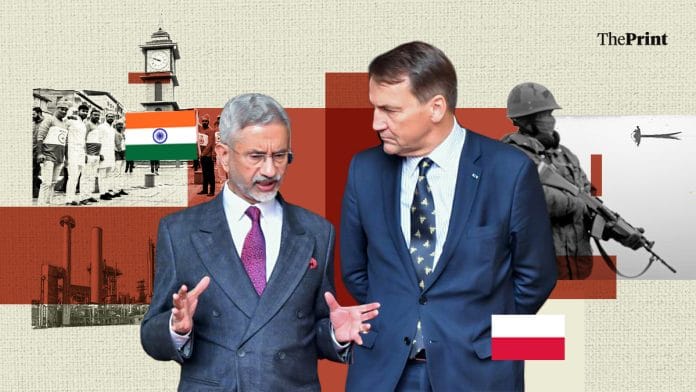



New Delhi: Last month, Polish Foreign Minister Radoslaw Sikorski was caught unawares when his Indian counterpart bluntly called out Warsaw’s ‘selective targeting’ of New Delhi.
In diplomatic circles, the tense moment was seen as New Delhi’s overriding sentiment after the European country crossed the redline on Kashmir and ran a public campaign against Russian energy purchases. This was in spite of a potentially growing strategic partnership with areas of cooperation in sensitive matters, including defence and technology.
What was seen as a turning point was the joint statement issued in October 2025 during Sikorski’s Islamabad visit wherein it had a reference to the “Jammu and Kashmir dispute” followed with a mention of solving conflicts “in full respect of the principles of international law and the UN Charter.”
Sources told ThePrint that for a joint statement to have been issued, both sides–Pakistan and Poland–would have had to “okay” the wording, which does not keep in mind India’s position that differences with Pakistan will be solved through bilateral mechanisms.
A number of countries, including those from Europe, have rarely issued a joint statement in the recent past with the abovementioned formulation. Many times individual readouts are issued by the respective countries that have differing languages, which is not unusual in international diplomacy.
The October reference indicates Warsaw’s support for any potential international mediation efforts, which irritated New Delhi. However, more recently, India was further irked by Sikorski’s public statements expressing his “satisfaction regarding the reduction of imports of Russian oil to India, because this is financing the war machine of Putin.”
The statement was made in Paris in January, during a joint press conference with Indian foreign minister S.Jaishankar and the foreign ministers of Germany and France–Johann Wadephul and Jean Noël-Barrot–respectively.
The two issues led to Jaishankar drawing the line with Sikorski, who is also the Polish Deputy Prime Minister, in his opening remarks during their bilateral meeting in New Delhi. The EAM urged Warsaw to “show zero-tolerance for terrorism and not help fuel terrorist infrastructure in our neighbourhood,” while also hitting out at the selective targeting of India’s Russian oil purchases.
The rebuke by Jaishankar has also rattled a number of European diplomats in New Delhi, according to people familiar with the matter.
Sikorski is reported to have repeated the sentiment on Russian oil purchases during his appearance at the Jaipur Literature Festival, where he was on a personal visit along with his wife Anne Applebaum, a journalist and author, before arriving in New Delhi.
His visit to India was originally scheduled as a private visit, before it added official meetings as a part of the itinerary. Sikorski met with Jaishankar and India’s National Security Adviser Ajit Doval on 19 January.
Poland has emerged as one of the strongest growing economies in Europe. Warsaw is one of the highest defence spending countries a part of the North Atlantic Treaty Organisation (NATO), spending over five percent of its gross domestic product on defence. It is one of the strongest backers of Kyiv in the ongoing Russia-Ukraine war.
Another source highlighted that the repeated references of Russian oil purchases was an irritation given that the European Union (EU) has larger trade relations with Moscow than India currently, pointing out the double standards of the narrative emanating from Warsaw.
Also Read: Polish foreign minister likely to visit India next month. Cybersecurity, AI, digital infra on agenda
Poland-Pakistan joint statement
Diplomatic sources indicated that the Ministry of External Affairs (MEA) and the Polish Foreign Ministry had discussed and closed issues surrounding the joint statement issued in October at appropriate levels ahead of Sikorski’s visit. However, for New Delhi, it was clear that the issue would also be discussed during the talks between Jaishankar and Sikorski.
“Deputy Prime Minister, you are no stranger to our region and are certainly familiar with the longstanding challenge of cross-border terrorism. I hope at this meeting to discuss some of your recent travels to the region. Poland should display zero-tolerance for terrorism and not help fuel the terrorist infrastructure in our neighbourhood,” Jaishankar had said in his opening remarks with Sikorski, referencing his visit to Pakistan, during their meeting on 19 January.
Joint statements are issued after clearance from both sides. Often individual readouts are given after meetings, wherein Pakistan often mentions it “briefed” the other leader on the Kashmir dispute. However, it has become increasingly rare for formulations regarding solving the issue through the UN to appear in a joint statement with a European nation.
For example, in 2025, days after India and Pakistan ceased hostilities following Operation Sindoor, Pakistan’s Deputy Prime Minister and Foreign Minister Ishaq Dar met with the United Kingdom’s then Foreign Secretary David Lammy.
The Pakistan readout had the usual language on J&K and Operation Sindoor, while the British readout “welcomed the sustained ceasefire” between New Delhi and Islamabad and made no references to the Indian Union Territory.
Similarly, in 2022, Annalena Baerbock, the then foreign minister of Germany, made references to having the J&K dispute solved through the UN, a statement that was sharply rebutted by New Delhi. A couple of months later, Baerbock clarified that Berlin’s position remains that the dispute must be resolved bilaterally.
Individual readouts or statements of meetings highlight the topics each side wishes to portray as important to their respective governments. There are differences in readout, which are considered normal in diplomacy.
Other countries that have strong ties with India have maintained certain sensibilities with references to J&K in joint statements with Pakistan.
For instance, the Indonesia-Pakistan joint statement following President Prabowo Subianto’s visit to Islamabad in December 2025, was careful to mention that issues surrounding J&K must be solved “through peaceful dialogue in line with relevant international principles and established bilateral processes between the parties.”
The joint statement keeps in mind India’s position that Kashmir remains a bilateral issue and will be dealt with between New Delhi and Islamabad.
Poland’s focus on Russia-Ukraine war
Jaishankar called out the “selective targeting” of India’s Russian oil purchases, calling it “unjust and unfair.” The Polish Deputy Prime Minister himself had agreed that “tariffs” were unfair, in an attempt to move the issue of Russian energy to duties imposed by the US.
The EAM, however, in a rare rebuke after Sikorski’s opening remarks made it clear that “selective targeting is not limited to tariffs—”I think there have been other forms of selective targeting.”
Sources informed ThePrint that for New Delhi, the messaging from Warsaw over the purchases of Russian oil has been an irritant, and not sensitive to an issue that is clearly driven by market dynamics and not a political direction imposed by the government.
For both India and Poland, sources highlighted, the bilateral discussions were seen as extremely positive and frank, with the Jaishankar-Sikorski meeting extending longer than the scheduled time, indicating that a number of issues including the Russia-Ukraine war and Pakistan were discussed. However, irritation remains at a political level.
Sikorski had told the media later that Warsaw considers the Russia-Ukraine war similar in nature to India’s concerns over cross-border terrorism emanating from Pakistan, and that both issues were “frankly” discussed.
However, the damage had been done in the build-up to the meeting that has left a chill in ties. Poland is a key member of the European Union (EU) and a strong-backer of the free trade agreement with India. For New Delhi, Warsaw is important for its outreach to Central Europe.
(Edited by Tony Rai)
Also Read: NATO air command detected breach of its airspace ahead of Christmas. It turned out to be SANTA01
Import of Russian oil is NOT benefiting India’s common man – its being imported for the benefit of a business house at the expense of Indian goods that were being exported to the USA. Resultantly the fall in exports to the USA is harming a wide array of agricultural and industrial products..